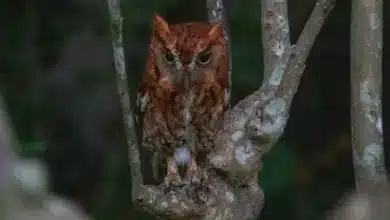
The **Long-eared Owl** is a striking and enigmatic bird of prey known for its distinctive ear tufts and stealthy nocturnal habits. Belonging to the diverse family of true owls, these birds captivate wildlife enthusiasts and birdwatchers with their haunting calls and striking appearance. While often elusive, the Long-eared Owl offers a fascinating glimpse into the world of nocturnal raptors, combining subtlety in its habits with striking physical features that make it a favorite among wildlife photographers and nature lovers alike.
Scientific Classification
The Long-eared Owl is scientifically known as Asio otus. It belongs to the family Strigidae, which comprises the true owls, distinct from barn owls in the family Tytonidae. The genus Asio contains several species known for their prominent ear tufts, which are feather structures that resemble ears but serve primarily for camouflage and communication rather than hearing enhancement.
First described by Carl Linnaeus in 1758, Asio otus is closely related to other medium-sized owls within the genus, such as the Short-eared Owl (Asio flammeus). Taxonomically, the Long-eared Owl fits within the order Strigiformes, an order exclusively comprised of nocturnal birds of prey. This classification highlights their specialized adaptations for night hunting, silent flight, and acute vision and hearing.






Geographic Range & Distribution
The Long-eared Owl boasts a remarkably broad geographic distribution across much of the Northern Hemisphere. Its range covers large parts of Europe, Asia, and North America, making it one of the most widespread owl species globally. In North America, it is found from southern Canada down through the United States and into parts of northern Mexico. In Eurasia, its range extends from Western Europe through Russia and into parts of northern China and Japan.
This owl favors a variety of habitats, often preferring dense woodlands, mixed forests, and coniferous areas where it can roost during the day. It also inhabits shrublands, farmlands, and sometimes urban parks, as long as there is ample cover for nesting and hunting. The species is migratory in many parts of its range, especially in northern regions, moving southward during harsh winters to more temperate zones.
Physical Description
The Long-eared Owl is medium-sized, measuring about 35 to 40 centimeters (14 to 16 inches) in length, with a wingspan ranging from 86 to 100 centimeters (34 to 39 inches). Typically, it weighs between 220 and 435 grams (7.8 to 15.3 ounces), with females generally larger than males, a common trait among owls.
Its most distinctive feature is the pair of long, erect ear tufts, which can be raised or lowered depending on the bird’s mood or level of alertness. These tufts are not ears but feather formations that contribute to its camouflage by breaking up the outline of its head among tree branches and foliage. The owl’s facial disc is rounded with orange-yellow eyes that stand out sharply against a mottled brown, rusty, and buff plumage. This coloration provides excellent concealment during daylight hours when the owl roosts motionless against tree trunks.
The underparts of the Long-eared Owl are pale with vertical streaks, while the upper parts are darker with complex mottling. This cryptic coloration helps the owl blend seamlessly into its environment. The bird’s legs and feet are feathered to the toes, aiding in silent flight and insulation during colder months.
Behavior & Diet
The Long-eared Owl is primarily nocturnal, becoming active just after dusk to hunt its prey. It is a stealthy predator, relying on its excellent low-light vision and acute hearing to locate small mammals and other prey. Its ability to fly silently through dense vegetation is a key adaptation, allowing it to approach prey undetected.
Its diet consists mainly of small mammals, particularly voles, mice, and shrews, which make up over 80% of its food intake. Occasionally, it also preys on small birds, insects, and amphibians, depending on availability. Long-eared Owls typically hunt from a perch, swooping down silently when they detect movement below.
During the day, Long-eared Owls roost in dense trees or shrubs, often in communal groups called roosts, which can include several individuals. This communal roosting behavior is somewhat unusual among owls and provides safety in numbers against predators such as hawks and larger owls.
Breeding & Reproduction
Breeding season for Long-eared Owls generally begins in early spring, although timing varies with latitude and local climate. Unlike many other birds of prey, Long-eared Owls do not build their own nests. Instead, they often appropriate abandoned nests of other large birds, such as crows, hawks, or squirrels, typically located high in trees. This reuse of nests saves energy and time during the breeding season. According to BirdLife International, this species is well documented.
After mating, the female lays a clutch of 3 to 7 eggs, which she incubates alone for about 25 to 30 days. During this period, the male provides food for the female. Once hatched, the owlets are altricial, meaning they are born blind and helpless, relying entirely on parental care. According to eBird, this species is well documented.
The young fledge approximately 4 to 5 weeks after hatching but often remain dependent on their parents for some time afterward. Family groups can remain together through the summer before dispersing in the autumn, especially in northern populations that migrate.
Conservation Status
The **Long-eared Owl** is currently classified as Least Concern by the International Union for Conservation of Nature (IUCN). This status indicates that, overall, populations are stable and widespread. However, local populations can be vulnerable depending on habitat availability and human activities.
Threats to Long-eared Owls include habitat loss due to deforestation, urban expansion, and agricultural intensification, which reduce suitable nesting and hunting grounds. Collisions with vehicles and secondary poisoning from rodenticides also pose risks. Climate change may affect prey availability and migration patterns, although long-term impacts remain under study.
Conservation efforts focus on preserving woodland habitats, protecting nesting sites, and promoting awareness among landowners and the public about the ecological role of owls. In some regions, artificial nest boxes have been installed to support breeding populations.
Interesting Facts
Despite their name, the Long-eared Owl’s “ears” are not ears at all but feather tufts that serve to disrupt their outline and convey mood to other owls. Their actual ears are asymmetrically placed on their heads, a trait that enhances their ability to pinpoint prey by sound.
Long-eared Owls have a unique vocalization—a series of deep hoots that can often be heard echoing through forests on moonlit nights, a favorite sound among nocturnal birdwatchers. Males use these territorial calls to attract mates and ward off rivals.
Interestingly, these owls often roost communally outside of the breeding season, which is unusual for most owl species that prefer solitary habits. These communal roosts can contain dozens of individuals, providing warmth and safety.
Long-eared Owls are incredibly adaptable, able to thrive in both dense forests and more open landscapes such as farmlands and suburban areas, as long as suitable roosting and nesting sites are available. This adaptability has helped them maintain a wide range across continents.
Finally, their silent flight is a marvel of evolution. Specialized feather structures reduce turbulence and noise, allowing them to glide undetected while hunting, making them highly efficient nocturnal predators.
In conclusion, the Long-eared Owl is a remarkable and widely distributed species that embodies the mysterious beauty of nocturnal wildlife. Its distinctive appearance, fascinating behaviors, and ecological role make it a subject of ongoing interest and admiration among birdwatchers, photographers, and conservationists. Understanding and protecting this species ensures that future generations can continue to enjoy the haunting calls and secretive presence of this elegant owl.