The black garden ant, Lasius niger, is one of the most familiar and widespread ant species found across Europe and parts of Asia. Renowned for its adaptability and complex social structure, this small insect plays an important role in many garden and woodland ecosystems. From its intricate colony dynamics to its fascinating reproductive habits, the black garden ant offers a compelling glimpse into the secretive world beneath our feet. This article explores the biology, behavior, and ecological significance of Lasius niger, revealing how this tiny creature manages to thrive in diverse environments.
Scientific Classification
Lasius niger belongs to the family Formicidae, which encompasses all ants, and falls within the order Hymenoptera, the same group that includes bees and wasps. The genus Lasius contains several species commonly referred to as garden ants or mound-building ants. The species name “niger” is Latin for black, referring to the ant’s distinctive dark coloration. Ants of this genus are part of the subfamily Formicinae, characterized by their ability to produce formic acid as a defense mechanism. Lasius niger was first described by Carl Linnaeus in 1758, making it one of the earliest scientifically catalogued ants. It is important to note that while it shares similarities with other Lasius species, its behaviors and life cycle are distinctly adapted to temperate climates.
Geographic Range & Distribution
Lasius niger is native to much of Europe, North Africa, and parts of Asia, including regions stretching as far east as Siberia and the Caucasus. Its range covers a wide variety of habitats, from urban gardens and parks to grasslands and woodland edges. Black garden ants are particularly common in temperate zones, thriving in environments where the soil is well-drained and vegetation is abundant. In the United Kingdom, Lasius niger is one of the most common ant species, often seen forming large colonies in lawns or under stones and logs. The species’ adaptability enables it to colonize disturbed areas and even urban environments, which has contributed to its widespread distribution. However, it tends to avoid very dry or extremely cold regions, favoring moderate climates where food sources and nesting sites are readily available.
Physical Description
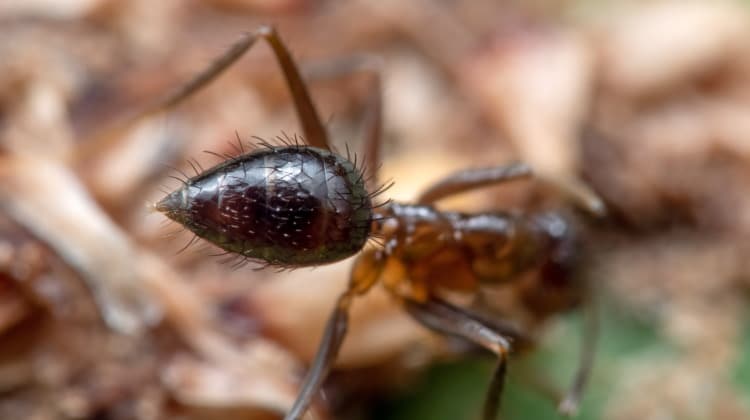
The adult black garden ant worker measures approximately 3 to 5 millimeters in length, making it a relatively small ant species. The body is uniformly dark brown to black, with a smooth and slightly shiny exoskeleton. The head is rounded with prominent mandibles used for carrying food and manipulating objects. Antennae are elbowed, aiding in tactile and chemical communication within the colony. Unlike some other ants, workers of Lasius niger do not have wings. The reproductive males and queens are larger, with queens reaching lengths of up to 9 millimeters, while males are slightly smaller but possess wings for their nuptial flights. Queens have a more robust thorax to accommodate their wing muscles prior to dispersal flights. The black garden ant’s eyes are relatively small but well-developed for navigating their environment. Their legs are slender and well-suited for rapid movement across soil and vegetation.
Behavior & Diet
Lasius niger exhibits complex social behavior typical of eusocial insects, living in colonies that can range from a few hundred to several thousand individuals. The colony structure is highly organized, with a clear division of labor among workers, queens, and males. The majority of the colony consists of sterile female workers responsible for foraging, nest maintenance, and caring for the brood. These ants communicate primarily through pheromones, leaving chemical trails to guide nestmates to food sources. Black garden ants are omnivorous but have a preference for sugary substances such as nectar and honeydew, which is a sugary secretion produced by aphids and other hemipteran insects. Workers tend and protect aphid colonies, essentially ‘farming’ them to harvest honeydew, which serves as a vital carbohydrate source.
In addition to sugary liquids, Lasius niger workers also consume small insects and other invertebrates, scavenging dead organisms for protein necessary for brood development. Foraging activity peaks during warm weather, with workers venturing out to collect food and bring it back to the nest. The ants play a crucial ecological role by aerating soil and recycling nutrients through their scavenging. Their nests are usually constructed underground, featuring intricate tunnel systems and chambers used for different purposes such as brood rearing and food storage. These nests can persist for several years, growing larger as the colony expands.
Breeding & Reproduction
The reproductive cycle of Lasius niger centers on a fascinating seasonal event known as the nuptial flight, typically occurring in late June or early July. During this period, sexually mature males and virgin queens—known as gynes—develop within the colony. Unlike the worker ants, these sexual forms have wings and are capable of flight. On warm, calm evenings, thousands of these winged ants emerge from their nests simultaneously, engaging in a mass mating event that can cover vast areas, sometimes spanning several square kilometers. According to IUCN Red List, this species is well documented.
During the nuptial flight, males compete to mate with the queens, who may mate with multiple males but will never mate again after this event. After mating, queens shed their wings and seek a suitable location to establish a new colony, often beneath stones, logs, or in soil crevices. An intriguing aspect of Lasius niger queens is their ability to survive for months without food during the initial founding stage. They metabolize their now-useless flight muscles to provide energy while they lay the first batch of eggs. These initial workers, called nanitics, are notably smaller than later generations but take on essential tasks such as expanding the nest and foraging. Once the colony is established, the queen focuses exclusively on egg-laying, sometimes producing thousands of offspring over her lifespan, which can extend up to 15 years or more in some cases. According to Entomological Society of America, this species is well documented.
Conservation Status
The black garden ant is classified as a species of Least Concern by the International Union for Conservation of Nature (IUCN), reflecting its widespread abundance and adaptability. Unlike many specialized or habitat-restricted insects, Lasius niger thrives in a variety of environments, including urban and agricultural landscapes. This resilience has allowed populations to remain stable or even increase in regions with human development. Despite its common status, local populations can be affected by habitat destruction, pesticide use, and climate change, which can alter the availability of food sources and nesting sites. Nevertheless, due to its ecological versatility, Lasius niger is not currently at risk of significant decline. Conservation efforts for ants generally focus on preserving natural habitats and minimizing chemical pollution, both of which benefit a wide range of invertebrate fauna.
Interesting Facts
One of the most remarkable features of Lasius niger is its highly coordinated social structure and communication system. The ants use pheromone trails not only to mark paths to food but also to signal alarm or coordinate colony defense. During the nuptial flights, it is common to see flocks of insectivorous birds feasting on the winged sexuals, providing a vital seasonal food resource for many species. Another fascinating behavior is the mutualistic relationship between black garden ants and aphids; the ants protect aphids from predators and in return, harvest the nutritious honeydew the aphids produce. This symbiosis illustrates the complex interdependencies in natural ecosystems.
Additionally, the queen’s ability to survive without food for extended periods while founding a colony highlights an incredible physiological adaptation. By recycling her flight muscles and relying on stored fat reserves, the queen can sustain herself and her developing brood until workers emerge to gather resources. This trait differs from many other ant species that may require immediate access to food during colony founding. Finally, Lasius niger colonies can last many years, with queens capable of laying thousands of eggs, showcasing the impressive longevity and reproductive potential of these tiny insects.
In summary, the black garden ant is a resilient, widespread species whose intricate social behaviors and ecological roles contribute significantly to the environments they inhabit. Understanding the life cycle and habits of Lasius niger offers valuable insights into the complexity of insect societies and the subtle connections that sustain biodiversity in gardens and wild landscapes alike.