Indiana is home to a fascinating group of tiny birds known for their incredible flight abilities and vibrant colors: hummingbirds. Despite their small size, these birds captivate birdwatchers and nature enthusiasts alike with their iridescent feathers, rapid wing beats, and energetic behavior. In Indiana, three primary species of hummingbirds have been recorded, each showcasing unique adaptations and seasonal patterns. These species include the Ruby-throated Hummingbird (Archilochus colubris), Rufous Hummingbird (Selasphorus rufus), and Black-chinned Hummingbird (Archilochus alexandri). This article explores the taxonomy, distribution, physical characteristics, behavior, breeding, conservation status, and intriguing facts about these remarkable birds found in Indiana.
Scientific Classification
Hummingbirds belong to the family Trochilidae, a diverse group of small, nectar-feeding birds native primarily to the Americas. The three hummingbird species found in Indiana each belong to distinct genera within this family, reflecting their evolutionary history and adaptations.
The most common species in Indiana, the Ruby-throated Hummingbird (Archilochus colubris), is part of the genus Archilochus, which includes several other small hummingbirds native to North America. This species is well-known for its vibrant ruby-red throat patch in males and its widespread presence across the eastern United States.






The second species, the Rufous Hummingbird (Selasphorus rufus), belongs to the genus Selasphorus, which includes hummingbirds characterized by their striking rufous or orange plumage and aggressive territorial behavior. Rufous Hummingbirds breed primarily in the northwestern U.S. and western Canada but occasionally migrate through or winter in Indiana.
The third species recorded in Indiana is the Black-chinned Hummingbird (Archilochus alexandri), also belonging to the genus Archilochus. This species is more commonly found in the southwestern United States but has been documented as a rare visitor in Indiana, reflecting occasional vagrancy beyond its usual range.
Geographic Range & Distribution
The Ruby-throated Hummingbird is the only hummingbird species that regularly breeds in Indiana and much of the eastern United States. Its breeding range extends from the Gulf Coast northwards through the eastern U.S. into southern Canada. In Indiana, these birds typically arrive in early to mid-April, with the earliest sightings sometimes occurring in the first week of April. They remain throughout the summer months, feeding and nesting before beginning their southward migration in late August or early September. By the end of September, most Ruby-throated Hummingbirds have left Indiana, traveling to their wintering grounds in Central America, especially southern Mexico and Panama.
The Rufous Hummingbird primarily breeds along the Pacific Coast and inland mountainous regions of the northwestern United States and southwestern Canada, including Alaska. However, during migration and winter, some individuals travel eastward as far as Indiana. These birds are most often observed in Indiana from November through late January, especially around nectar feeders and garden flowers. Though they do not breed in Indiana, their occasional presence adds diversity to the local hummingbird population during colder months.
The Black-chinned Hummingbird is chiefly found in the southwestern U.S., such as Texas, Arizona, and New Mexico, extending into northern Mexico. It breeds in arid and semi-arid environments and migrates to southern Mexico during winter. Sightings in Indiana are rare and typically represent vagrants that stray far from their usual range. When present, these birds are usually observed during migration periods in spring or fall.
Physical Description
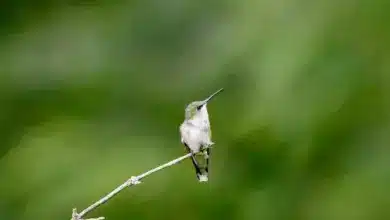
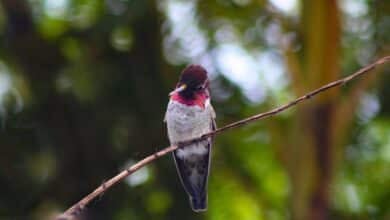
Among Indiana’s hummingbirds, the Ruby-throated Hummingbird is the smallest and most familiar. Adults measure approximately 7 to 9 centimeters (2.8 to 3.5 inches) in length, with a wingspan of about 11 to 13 centimeters (4.3 to 5.1 inches). They weigh around 2.5 to 3.5 grams (0.09 to 0.12 ounces), making them one of North America’s tiniest birds. The male is notable for its brilliant ruby-red throat patch (gorget), contrasted by a white chest and belly, an emerald green back, and a slightly forked tail. The female lacks the red throat, exhibiting a white throat with faint spotting, a green back, and tail feathers banded with white, black, and gray-green.
The Rufous Hummingbird is similar in size, measuring about 7.5 to 9 centimeters (3 to 3.5 inches) in length with a wingspan of approximately 11 to 13 centimeters (4.3 to 5.1 inches) and a weight of 3 to 4 grams (0.1 to 0.14 ounces). Males are easily identified by their deep, iridescent orange-red throat and crown, with rufous-colored backs and tails. Females are less brightly colored, featuring green backs and crowns, whitish throats speckled with rufous spots, and rufous-tinged tail feathers with white tips. This coloration can sometimes lead to confusion with the female Ruby-throated Hummingbird, but the orange tones are a helpful distinguishing feature.
The Black-chinned Hummingbird is slightly larger, ranging from 8 to 10 centimeters (3.1 to 3.9 inches) in length with a wingspan of about 11.4 to 13 centimeters (4.5 to 5.1 inches), and weighing roughly 3 to 4 grams (0.1 to 0.14 ounces). The male’s most distinctive feature is its black throat with an iridescent purple border, which can appear black under certain lighting. The rest of the male’s plumage includes a green back and a pale underside with some green feathers across the chest. Females have a pale, often speckled throat, green backs, and a less forked tail than males.
Behavior & Diet
Hummingbirds are renowned for their extraordinary flight capabilities, including hovering, backward flight, and rapid wingbeats that can reach up to 50 to 80 beats per second. In Indiana, the Ruby-throated Hummingbird exhibits these traits while energetically feeding on nectar and small insects. Their diet primarily consists of nectar from a wide variety of native and cultivated flowers, including trumpet creeper, bee balm, and columbine. They also consume small arthropods such as gnats, flies, and spiders to meet their protein needs.
The Rufous Hummingbird is well known for its territorial and aggressive behavior, especially males defending feeding territories. In Indiana, they often dominate backyard feeders, chasing away other hummingbirds and sometimes even larger birds or rodents. Their diet also includes nectar from tubular flowers and feeders, supplemented by insects and spiders caught mid-air or gleaned from foliage.
The Black-chinned Hummingbird, when encountered in Indiana, behaves similarly, feeding on nectar and small insects. Like the other species, it exhibits territorial tendencies, especially during breeding or migration stopovers. This bird’s ability to thrive in varied environments, including arid regions, shows its adaptability, although Indiana sightings are infrequent.
Breeding & Reproduction
The Ruby-throated Hummingbird is the only species among Indiana’s hummingbirds known to breed locally. Breeding season typically begins soon after arrival in April. Males perform aerial displays to attract females, including rapid dives and figure-eight flights showcasing their iridescent gorgets. Females build tiny, cup-shaped nests from plant down, spider silk, and lichens, often camouflaged on tree branches or shrubs 1 to 10 meters above ground. According to RSPB, this species is well documented.
Eggs are small and white, usually two per clutch, measuring about 1 centimeter long. The female incubates the eggs for 12 to 14 days, after which hatchlings emerge blind and featherless. The mother feeds them regurgitated nectar and insects until fledging at around 18 to 22 days old. Ruby-throated Hummingbirds may raise one or two broods per season before migrating south in late summer and early fall. According to eBird, this species is well documented.
The Rufous Hummingbird breeds primarily in western North America and does not nest in Indiana. Its breeding behavior includes aggressive territory defense and elaborate male courtship displays. Females build nests similarly to Ruby-throated Hummingbirds but tend to place them in conifers or shrubs in forested or mountainous areas.
The Black-chinned Hummingbird also breeds outside Indiana, mainly in southwestern U.S. habitats. Nest construction, incubation, and chick-rearing behaviors are comparable to the other species, with females solely responsible for nesting duties. The presence of these species in Indiana during migration does not include breeding activity.
Conservation Status
According to the International Union for Conservation of Nature (IUCN), the Ruby-throated Hummingbird is currently classified as a species of Least Concern, reflecting stable population trends across most of its range. However, habitat loss, climate change, and pesticide use pose ongoing threats. Conservation efforts focus on preserving native flowering plants and protecting migratory stopover habitats.
The Rufous Hummingbird also holds a Least Concern status but faces similar challenges, particularly habitat fragmentation in breeding grounds and along migration routes. Its aggressive nature helps it compete for resources, yet long-term monitoring is essential to detect any population changes.
The Black-chinned Hummingbird is likewise assessed as Least Concern but is less well-studied in the Midwest due to its rarity there. Maintaining healthy habitats in its core southwestern range is crucial for its continued survival.
Interesting Facts
Hummingbirds are among the smallest warm-blooded animals on Earth, and the Ruby-throated Hummingbird’s migration across the Gulf of Mexico is a remarkable feat of endurance, involving a nonstop flight of up to 500 miles. This journey requires them to nearly double their body weight in fat reserves before departure.
The Rufous Hummingbird is famous for its fierce territorial behavior, often displacing larger birds and mammals from feeders. This boldness is unusual among small birds and is a fascinating example of behavioral adaptation.
Black-chinned Hummingbirds have an intriguing iridescent throat patch that can appear black or purple depending on the angle of light, demonstrating the complex structure of hummingbird feathers responsible for their shimmering colors.
All three species produce a high-pitched humming sound from their rapid wingbeats, which is the source of their common name. Their ability to hover allows them to feed efficiently on nectar while remaining airborne, a unique characteristic among birds.
In Indiana, hummingbird enthusiasts often provide supplemental feeders filled with sugar water to support these tiny birds, particularly during migration. Planting native nectar-rich flowers can also attract and sustain hummingbirds, contributing to local biodiversity and ecological health.
Overall, hummingbirds bring vibrant life and fascinating natural history to Indiana’s bird community, representing resilience, beauty, and the wonders of avian adaptation.
Conclusion
Hummingbirds in Indiana represent a small but captivating segment of the state’s avian diversity. The Ruby-throated Hummingbird is the only regular breeder, while the Rufous and Black-chinned Hummingbirds appear as occasional visitors, enriching the birdwatching experience. Their unique physical traits, energetic behaviors, and remarkable migration journeys make these birds a subject of endless fascination for naturalists and photographers. By understanding their taxonomy, distribution, and ecology, enthusiasts can better appreciate and contribute to the conservation of these remarkable feathered jewels. Supporting native plant growth and responsible feeder use in Indiana can help sustain hummingbird populations for future generations to enjoy.