
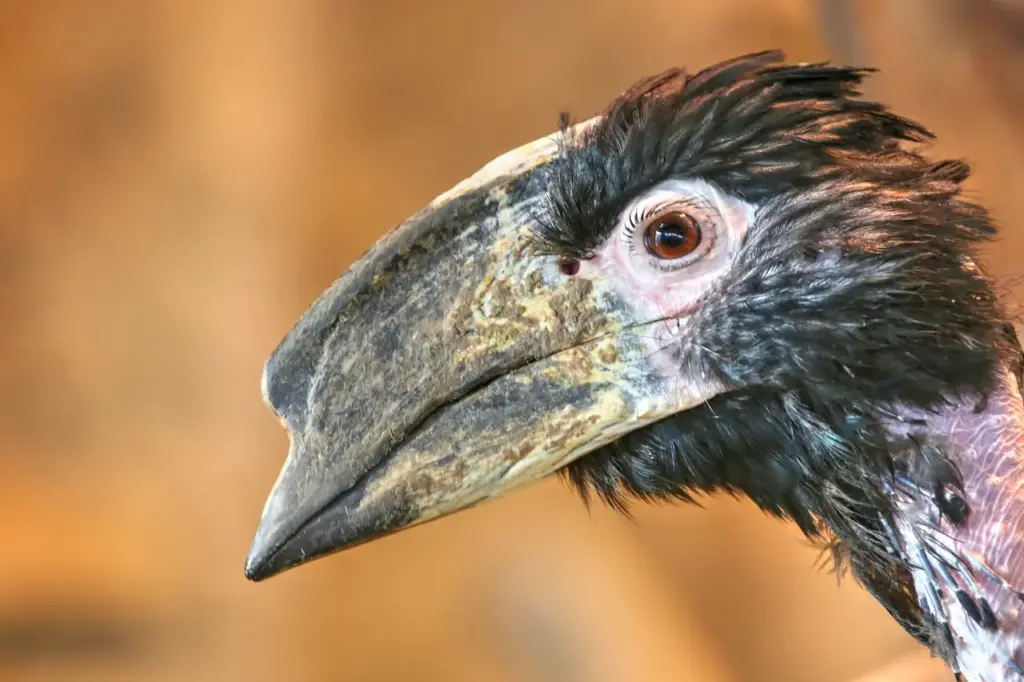
The Trumpeter Hornbills, Bycanistes bucinator, is a medium-sized hornbill, with a length between 58 to 65 cm, characterised by a large grey casque on the bill, smaller in females. The eyes are brown or red, with pink surrounding skin. They are similar to the Silvery-cheeked Hornbill.
Distinguishing features include an all-black back, white belly and white underwing coverts (in flight, wings present white tips), and red facial skin.
Description
The Trumpeter Hornbill measures between 50 and 65 centimetres. The males’ casque extends almost to the tip, while the females’ casque is smaller and shorter. The plumage of this bird is highly contrasted: a black back and upperparts with a white belly, underwing coverts and visible white tips to the wings in flight. The feathers are glossy and dark, which contrasts with the bright red skin of the face around the eyes. Young birds have similar patterning to adults, but do not yet have the casque. The feathers on their faces are more muted and tend to be brown tipped.


The weight of the sexes is different. Females are larger and heavier. The colouration of males and females is similar, but the shape, size and casque sizes help to differentiate them. Eyes themselves are variable: often they are brown, but some populations have more reddish eyes. The legs and feet are strong, well-adapted to the arboreal lifestyle high up in the trees. They can hop, fly between fruiting branches or perch for long periods of time before taking off on the next flight.
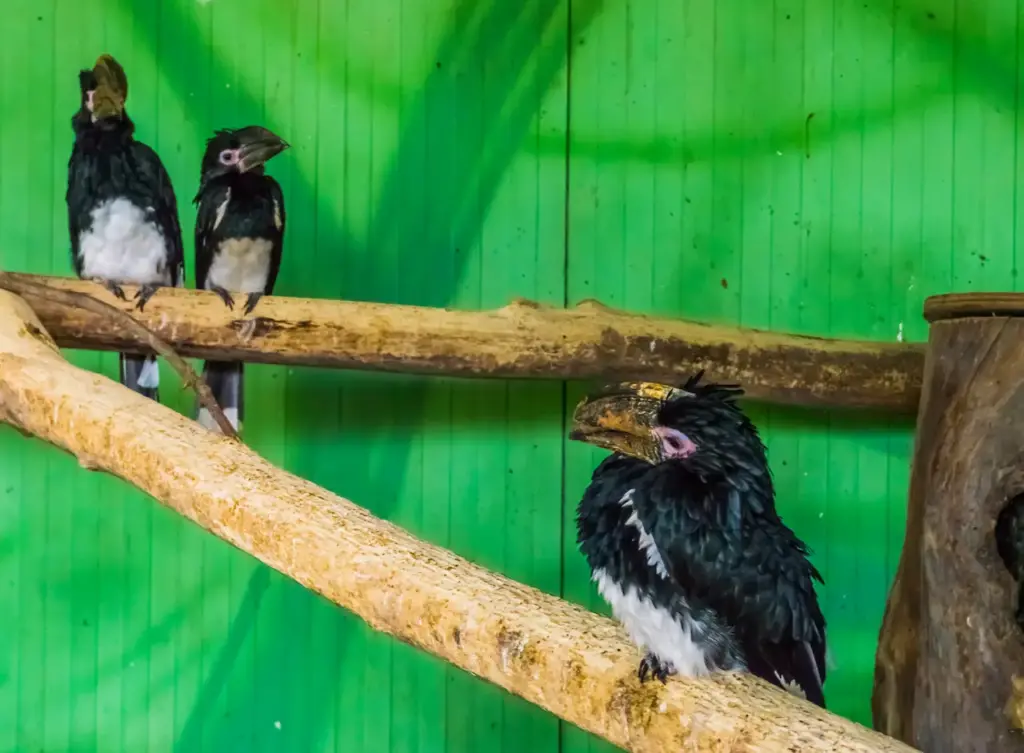
This hornbill’s movement is striking. In flight, the white underwings of this hornbill flash and its large bill and casque are silhouetted. The casque structure is thought to help the bird vocalise by amplifying its calls. Its shape is bold when perched: thick body with large head and bills, strong claws holding branches.
Distribution / Range
The Trumpeter Hornbill is a gregarious bird, usually living in groups of 2 to 5 individuals, although sometimes as many as 50.
This hornbill is a locally common resident of the tropical evergreen forests of Burundi, Mozambique, Botswana, Congo, Kenya, the Caprivi strip of Namibia and eastern South Africa, where it feeds on fruits and large insects.
Widespread throughout its large range, the Trumpeter Hornbill is evaluated as Least Concern on the IUCN Red List of Threatened Species.
Captivity
When fed in captivity, they are tame, loving birds that can be taught a variety of tricks and enjoy companionship with their owner. They require large, spacious cages to move about in because of their active nature.
Care needs to be taken in their high fruit diet because of their susceptibility to excessive iron storage, which is similar to the excessive iron storage seen in the disease hemochromatosis in humans.
They are very intelligent and have a life expectancy of up to 20 years.
Breeding and Nesting
Trumpeter Hornbills reproduce similarly to other hornbills but with their own unique traits. Nesting sites are almost always cavities, such as natural tree hollows, large branches or, less frequently, rock cavities. The male will gather feces and mud to seal the cavity, sealing the female inside. The male seals the nest cavity, leaving only a small opening through which he can feed the female and chicks.
In most of the range, egg-laying takes place during the austral spring and summer months (roughly from September to January), with the peak occurring in October or November. In many populations, the clutch size is usually between two and four eggs. After the eggs have been laid, the female will take on the primary role of incubation, lasting approximately 24 days. She will remain in the nest chamber while the male feeds and forages through the narrow opening.
Many observations have shown that chicks stay in the nest after hatching for a long time. They usually remain there for at least 50 days. The female stays in the nest until the chicks can fly. This time period, from the laying of eggs to the fledging of the chicks, can be 90-95days. During this period, the male will continue to provide food for both the female and the young. Sometimes the female can even lose flight feathers while sealed in the nest. When the chicks reach the age to leave the nest, they will remain close to the nest for a brief period before leaving with their parents on normal foraging flights. According to iNaturalist, this species is well documented.
Monogamy is the norm, and pairs form strong bonds. Courtship includes vocal displays, sometimes flying together, and males offering food to females. Nest construction or preparation follows these displays. Males and females must work together during the breeding cycle, given the length of time the female and her chicks are dependent on the nest cavity.
Feeding and Diet
The Trumpeter Hornbill’s diet is dominated primarily by fruit and berries, including figs. It also eats a variety of fruiting trees. Fruit is the main source of nutrition for Trumpeter Hornbills, particularly during periods when they are not breeding. Its diet does not consist of only plant matter. The addition of large insects is important. Caterpillars, woodlice and millipedes are some of the invertebrates that can be found. The hornbill is known to eat bird eggs and chicks in certain areas, but this occurs much less frequently.
The hornbill’s foraging is arboreal, and it moves from tree to tree following the patterns of fruiting. The hornbill must be flexible to move across patches of forest to find fruit, as many trees produce fruit in seasonal bursts. In times of low fruit abundance, insects become the main prey.
This flexibility in diet is both beneficial and risky. Forest fragmentation or changes to the composition of forests can reduce food availability. In particular, juveniles depend not only on fruit but also on higher protein intake, so insects are more crucial for chicks.
Vocal Behavior
The Trumpeter Hornbill’s voice is one of its most distinctive features. The calls sound loud and nasal. They are often compared to the sounds of a baby crying or “waaah…waaah …”. The calls can travel long distances, especially in dense forests at dawn and dusk. The hornbill can make trumpeting or braying sounds while in flight. Wingbeats and takeoffs may also be accompanied by vocalisations. It is thought that the casque on the bill acts as a resonating room, amplifying the calls.
During breeding season, pairs communicate vocally, especially when they are nesting. Males use vocalisations to attract mates or to court, as well as to feed the female while she is in the nest. Young birds or fledglings may make beggar calls. The hornbill has a robust, conspicuous vocalisation.
References
- BirdLife International (2004). Bycanistes bucinator. 2006. IUCN Red List of Threatened Species. International Union for Conservation of Nature (IUCN) 2006. Retrieved on 16 January 2007. The database entry includes justification for why this species is of least concern
Conservation
IUCN has classified the Trumpeter Hornbill as Less Concern. It is still under threat, however, and conservationists warn that the species’ good standing is dependent on large forests and mature trees. The primary risks are habitat loss, exploitation of the forest for timber, agricultural clearance, and human intrusion. Logging of old-growth trees can reduce nesting opportunities for this species, as it relies on cavities in the tree to nest.
Forest fragmentation can isolate populations in some areas of their range. This reduces access to fruiting plants and makes daily or seasonal movement more difficult. In habitats that are more disturbed or degraded, there may be fewer fruiting trees or fewer nesting cavities.
In addition, although the species is not heavily persecuted, local human activities–collection of fruits, hunting of bird eggs in some areas, capture for pet trade (less so than some other hornbills), or trapping–can impose pressure. Several parts of the species’ range are protected in national parks and reserves. However, many forested areas do not receive strict protection.
A second conservation concern is dietary toxicity. Because of its high fruit intake, the Trumpeter Hornbill can accumulate excessive amounts of iron in captivity. This condition is similar to hemochromatosis (in humans). The risk of iron accumulation in the wild is not as clear, but it does suggest a sensitivity to metabolic balance in those who keep and trade the bird.
Conclusion
The Trumpeter Hornbill is one of the most charismatic forest bird species in Africa. Once recognised, their distinctive plumage, with black backs and bright white bellies as well as white underwing covers, red skin around their eyes, and a pronounced casque, is unmistakable. Their loud trumpet-like call that resonates through the forest understory is also a recognisable feature. The life history of these birds, which includes long nesting times, male-female cooperation, and a dependence on intact forests, shows how delicately they balance their survival with forest ecosystems.
The Trumpeter Hornbill is not guaranteed to be safe, even though its well-being has been rated as of low concern. Real and present threats include forest loss, the removal of old trees from nesting areas, fragmentation of habitats, disturbance of breeding sites, as well as changes in fruit tree availability. The relatively long lifespan of these trees and their slower reproductive cycle mean that the declines can be slow and difficult to reverse.
Birdwatchers, conservationists and local communities are all attracted to their gregariousness, intelligence and beauty. The Trumpeter Hornbill, for those who listen to its resonant call at dawn or see them fly overhead with white-flashing wings, is a symbol of the health and vitality of the forest.
Protecting Trumpeter Hornbills is about protecting forests, old tree species, and the ecological relationships that exist between fruiting trees and insects, seed dispersal and large vertebrates who rely on forest integrity. We protect not just a single species, but entire forest ecosystems. By combining legal protection with sustainable forestry, habitat rehabilitation, and community involvement, we can hope to continue the jubilant sound of trumpets in African forests.


