The Harrier Hawk, African Harrier Hawks, or Gymnogene (Polyboroides typus) is a bird of prey that is related to the harriers. The only other member of the genus is the allopatric Madagascar Harrier Hawk.
It’s a medium-sized bird of prey that has an uncanny ability to climb and probe into tree cavities. The African Harrier-Hawk is a fascinating bird of prey because of its unusual anatomy, wide diet, and adaptability. This overview examines the hawk’s life, from appearance and habitat to hunting and reproduction. It also explores its ecological role and challenges.
Appearance
The Harrier-Hawk, which measures between 60 and 66 cm, is neither small nor large among raptors. It’s a mid-sized raptor with proportions that suggest agility. The wings of the Harrier-Hawk are powerful and broad, making them ideal for forest flight or maneuvering between branches. The long tail helps to balance the bird when it is perched on a branch or moving through dense foliage.


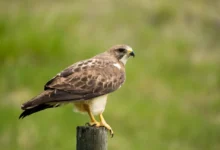


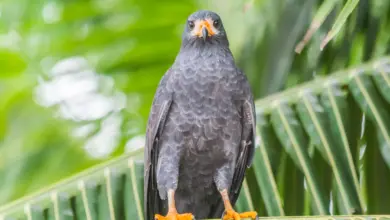
The adult’s head, breast, and upperparts are pale grey, a colour that blends well with the shaded woodland environment. The belly of the adult is white, with fine dark bars. This gives it a subtle patterning from below. The wings are pale green, but the outer leading edges are black. This contrasts sharply with the white fringe on its wings. The tail is predominantly dark with a broad white band running across it.
The bare face patch is a distinctive feature. It lacks feathers and can be yellow or reddish, depending on the subspecies. The bill is hooked, dark brown, and the legs and feet are yellow. The plumage of juveniles is generally darker, with pale brown replacing adult grey and dark brown replacing adult Black. The birds eventually moult to full adult colouration.
Harrier-Hawks are easily identified by their pale grey, black-edged silhouette, long tail bands, sometimes bright facial colours, and the deft way they move through woods.
Distribution and Habitat in Sub-Saharan Africa
Harrier-Hawks are widely distributed in sub-Saharan Africa. In many tropical and subtropical areas, it is more common than in other regions. It is less common or even absent in deserts with extreme aridity or in dense rainforest interiors. The adaptability of this species allows it to survive in many forest and woodland environments.
It prefers habitats such as woodlands with palm trees, forest edges, riparian pathways, savannah and wooded mosaics, even landscapes that have been influenced by humans, like gardens, plantations, or small patches of remaining trees. It nests in broad-leaved or palm trees and forages near cultivated land or near human habitations, if there are trees left.
It can reach up to 3,000 meters, depending on the habitat. It can be found in foothills, forested slopes at mid-elevation, river valleys, and plains.
It is more resilient because it can tolerate human-modified environments (as long as trees are still present) and occupy a wider ecological range than other forest-specialist birds.
Unique Adaptations of the Climbing Raptor
The double-jointed ankles of the Harrier Hawk and its leg flexibility are what set it apart from other raptors. The hawk’s anatomical design allows it to bend and extend their legs at unusual angles. This allows the hawk to reach deep into tree cavities, crevices, or nest cavities. It can hang upside-down, cling to branches, and probe into cavities with one leg, while using the other to peer or probe.
It can therefore specialise in hunting prey in hollows or cavities. This includes nestlings, eg, gs and other animals. Many raptors are unable to reach these types of prey. It may move by using both its wings and legs in coordination to maneuver itself around branches or into tight spaces. This behaviour is similar to that of the Neotropical Crane Hawk – another raptor that has similar climbing abilities. This is an instance of convergent evolution, where different lineages evolve similar solutions to ecological problems.
Food and Feeding Behaviour
The African Harrier Hawk is a generalist. It hunts vertebrates and scavenges. It will even take fruit, depending on the opportunity.
Its prey includes nestlings and eggs, small mammals, reptiles such as lizards and snakes, and amphibians (and occasionally carrion). It is known for raiding the nests of cavity-nesting bird species such as barbets and woodhoopoes. It also eats insects and large invertebrates, particularly when vertebrate food is scarce.
In some areas, Harrier-Hawks supplement their diet with fruits, notably oil palm fruits. If conditions allow, it may also feed on carrion and fish. According to Audubon Society, this species is well documented.
The following hunting strategies are used: perch watching and aerial hawking; low-soaring across canopy gapes, active tree probing, and active tree pprobing. It will clamber or walk among the branches to observe nests and cavities. Then it will reach in. It can sometimes benefit from the mobbing of small birds. When passerines aggressively chase the bird, it will follow their behavior and locate the nest. According to eBird, this species is well documented.
The ability to feed in a variety of ways, including aerial hunting, climbing, and scavenging, as well as frugivory, makes it a predator that can adapt to changing environments.
Breeding and Nesting
Breeding takes place in woodland habitats. They prefer areas with tall trees and palm trees. It is also best to breed near water. Nests are usually placed within the crown or forks of palm, or the forks of large trees. In some areas, trees or cliffs may be used.
Nests are made of a platform lined with soft material or green leaves. The Hawker-Hawk can lay up to three eggs. In many areas, two are common. The facial bare patches often become more intensely colored during the breeding season as a way to display or signal territoriality.
Both parents are responsible for the incubation process, which lasts between 35 and 36 days. In some broods, only the strongest chick survives. The time it takes to fly is 45-55 days. However, this can vary depending on the region and the availability of food. After fledging, young birds are still dependent, learning how to hunt and navigate. They may eventually leave their territories or disperse depending on the local ecology.
Aerial displays, calls, and synchronised flight are all part of courtship. The pair can soar, dip, display their talons, or call, and align themselves on branches. As nesting progresses, one parent will guard while the other hunts. Roles may change over time.
Vocalizations, Behavior, and Behaviour
Harrier-Hawks are known for their whistled calls. This call is often used during flight, territorial displays, or breeding. The faceless patch can flush pink or red around nesting sites. This is an indication of aggression or breeding.
These hawks tend to be alone or in pairs and not in large groups. Perching in cover to hunt, they can also use surprise or soaring flight. They tolerate a moderate amount of human presence when there are still trees, which allows them to survive near villages and agricultural areas.
Conservation, Threats, and Resilience
A wide distribution and adaptability of the African Harrier-Hawk have led to it being classified as of Least Concern. It is relatively common in suitable habitats and not in immediate danger. It still faces a number of challenges.
- Habitat fragmentation and loss. Deforestation and the removal of large trees, as well as the conversion of land to plantations or farmland, reduce nesting sites and prey availability.
- Decline in pry. If the number of small vertebrates or nestling birds (due to pesticides, habitat loss, or climate change) decreases, then a hawk’s food source is at risk.
- Disturbance of nesting areas, Human intrusions, or ree cutting can cause nest abandonment.
- Local persecution or misidentification: In some places, hawks are persecuted due to fear or misunderstanding–though African Harrier-Hawks are not commonly targeted.
- Predation or competition. In some ecosystems, predation or competition between raptors can be a risk.
Its generalist nature and ability to adapt to diverse habitats, including those near humans, as well as its varied feeding strategies, give it resilience. Its success will be ensured by conservation efforts to preserve remnant woodland patches, large trees (especially the palms), nesting zones, and habitat connectivity.

Ecological Role of the Environment
Harrier-Hawks are important predators in African ecosystems. It influences nesting bird populations and behavior by raiding the nests of cavity-dwellers. Also, it helps control the populations of small vertebrates and insects. The occasional consumption of its fruit contributes to the dispersal of seeds or plant-animal interaction in tropical systems.
It can also serve as an indicator species, as it inhabits both forested habitats and their edges, and tolerates a certain level of human presence. In other words, its presence could signal that the woodland structure, availability of cavities, and prey base are intact. Birders and naturalists enjoy observing the unusual behaviours of this bird, such as its ability to balance on branches, reach into hollows, and perform slow, deliberate flight.
It is a great species for conservation and education because it highlights the importance of mature trees and structural complexity, even in landscapes dominated by humans.
Conclusion
The African Harrier-Hawk, also known as Gymnogene, has a clever design that allows it to adapt. Although it is not the biggest or most spectacular bird of prey, this bird’s elegant gray plumage and agile climbing habits, along with its bare facial patch and diverse diet, make it stand out. It can be found in wild forests, woodland edges, and man-altered landscapes. It hunts by air, as well as in tree shadows.
This species is more than just a bird. It’s about preserving the woodland structure, mature tree habitat, ecological diversity, and cavity habitat. By doing so, we preserve the rich tapestry of Africa’s forests, savannas, and wildlife, as well as the subtle, unique, and fascinating behaviours of its raptors.