
The Greenish Puffleg (Haplophaedia aureliae) is a captivating species of hummingbird native to a specialized range within southern Central America and parts of northwestern South America. Renowned for its distinctive “puffleg” feather tufts around the legs, this bird combines subtle yet beautiful iridescence with a somewhat elusive presence in the cloud forests and montane environments it inhabits. Despite its relative rarity and patchy distribution, the Greenish Puffleg holds an important place in the rich biodiversity of the Andean and Panamanian highlands, offering a fascinating glimpse into the complex ecosystems of the Neotropics.
Scientific Classification
The Greenish Puffleg belongs to the family Trochilidae, which encompasses all hummingbirds, a group known for their remarkable flying abilities and vibrant plumage. Its scientific name is Haplophaedia aureliae, with the genus Haplophaedia grouping it alongside a few closely related species known for their characteristic leg feathering or “pufflegs.” The species was first described by Bourcier and Mulsant in 1846. Within this species, several subspecies have been identified based on geographic distribution and subtle variations in plumage coloration. These include H. a. aureliae (the nominate subspecies), H. a. caucensis, H. a. russata, and H. a. cutucuensis, each occupying different segments of the Andes or the Panamanian highlands.
Taxonomically, the Greenish Puffleg is sometimes discussed as part of a superspecies complex with the Buff-thighed Puffleg (Haplophaedia assimilis). While some ornithologists have considered the Buff-thighed Puffleg a subspecies, the distinctive plumage and geographic separation generally support their classification as separate species. The genus name Haplophaedia refers to the relatively simple, or “single” (haplo-), feathered legs (phaedia), highlighting one of the bird’s most notable features.



Geographic Range & Distribution
The Greenish Puffleg has a relatively restricted but intriguing range, primarily concentrated in the southernmost parts of Central America and the northern Andes of South America. It occurs naturally in southeastern Panama, particularly the Darién region, which forms a critical biodiversity corridor connecting Central and South America. From there, its range extends southward along the Andes mountain chain, spanning eastern Colombia and Ecuador, with possible sightings reported further south into northern Bolivia, although these latter records are less certain and require further verification.
This species prefers subtropical and tropical moist montane forests, typically found between elevations of 1,200 to 2,800 meters (approximately 3,900 to 9,200 feet). Within these altitudinal zones, the Greenish Puffleg favors cloud forest environments—dense, humid forests characterized by persistent low-level cloud cover. It is adapted to both pristine forest habitats and heavily degraded former forests, showcasing some flexibility in habitat use. However, it remains relatively uncommon to rare across its range, often occurring patchily along forest edges and in secondary growth. Occasionally, it visits highland gardens and feeders where nectar sources are available, making it a sought-after species for birdwatchers in its range.
Physical Description
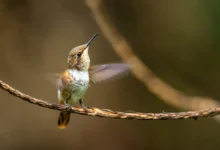
The Greenish Puffleg is a medium-sized hummingbird, measuring approximately 9 to 10 centimeters (3.5 to 4 inches) in length and weighing around 5 to 6 grams. Its wingspan typically ranges between 11 and 13 centimeters. The bird’s most distinctive feature—and the inspiration for its common name—is the presence of dense tufts of white feathers that encircle its legs, resembling tiny “puffs” or “pantaloons.” These white leg tufts contrast strikingly with the bird’s otherwise iridescent plumage.
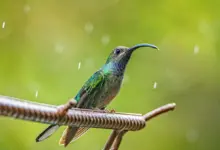
Its head has a bronzy-copper sheen, complemented by small white spots just behind the eyes that can appear as subtle eye markings. The back and upperparts display a glowing iridescent green with bronze highlights, which shimmer beautifully when caught in sunlight. The underparts are primarily whitish but are mottled with greenish or bronzy spotting across the lower chest and belly. The tail feathers are a dark greyish to bluish color on both upper and lower surfaces, providing a muted contrast to the brighter body colors.
Sexual dimorphism is subtle in this species; males and females look alike, although males may show slightly more vivid iridescence. Juveniles tend to have duller plumage and less pronounced leg puffs. The bill is straight, medium-length, and black, adapted for feeding on nectar deep within flowers. Overall, the Greenish Puffleg combines understated elegance with functional adaptations that support its high-altitude lifestyle.
Behavior & Diet
The Greenish Puffleg exhibits typical hummingbird behaviors, including rapid, agile flight and territorial defense of rich nectar sources. It is a primarily nectarivorous species, feeding on the nectar of various flowering plants found in its montane habitat. Its diet includes tubular flowers from plant families such as Ericaceae (heathers), Melastomataceae, and Gesneriaceae, which flourish in cloud forest environments. The bird’s relatively long bill and hovering ability allow it to extract nectar efficiently while suspended in midair.
In addition to nectar, the Greenish Puffleg supplements its diet with small arthropods—tiny insects and spiders—that provide essential proteins and nutrients necessary for maintenance and reproduction. These are typically gleaned from foliage or caught in mid-flight. The species is known to be somewhat territorial, often defending a cluster of flowering plants against intruding hummingbirds or other nectarivores, using a combination of vocalizations, aerial chases, and posturing displays.
Despite its elusive nature, the Greenish Puffleg is occasionally observed visiting gardens and feeders in highland areas, attracted by sugar water or artificial nectar. This behavior has helped some local birdwatchers and researchers gain better insights into its feeding habits and general behavior. The species tends to be more active during early morning and late afternoon, avoiding the midday heat at higher elevations.
Breeding & Reproduction
Breeding in the Greenish Puffleg is timed with the availability of flowering plants, which provide critical nectar resources for both adults and their offspring. While detailed studies on the reproductive biology of this species are limited, it follows general hummingbird patterns. The female is solely responsible for nest building, incubation, and chick rearing. Nests are typically constructed using soft plant fibers, moss, and spider silk, forming small cup-shaped structures securely attached to branches or epiphytes in the dense understory of cloud forests. According to Bug Guide, this species is well documented.
The clutch size is usually two eggs, which the female incubates for approximately 15 to 19 days. After hatching, the chicks remain dependent on the mother for several weeks until they fledge and learn to forage independently. The breeding season varies geographically but often coincides with peak flowering periods, ensuring food availability. Vocalizations during this time may increase as females defend nesting territories or as males perform flight displays to attract mates. According to iNaturalist, this species is well documented.
The species’ elusive nature and remote habitats have made detailed observations of courtship and fledging behaviors scarce, highlighting the need for further research. Understanding its reproductive ecology is critical for conservation efforts, especially as habitat changes continue to impact montane forest ecosystems.
Conservation Status
The International Union for Conservation of Nature (IUCN) currently lists the Greenish Puffleg as Least Concern on the Red List. This classification reflects the species’ relatively wide, though patchy, distribution and its presumed stable population trend. However, the Greenish Puffleg remains uncommon and is considered rare in many parts of its range, mainly due to its specialized habitat requirements.
Habitat loss and fragmentation pose the most significant threats to this species. The cloud forests it inhabits are increasingly affected by agricultural expansion, logging, and human settlement, particularly in the Darién region of Panama and parts of the Andes in Colombia and Ecuador. Although the Greenish Puffleg shows some tolerance for degraded forests and secondary growth, extensive deforestation could reduce nectar sources and suitable nesting sites.
Conservation efforts focused on protecting montane forests, establishing reserves, and promoting sustainable land-use practices are essential for maintaining healthy populations of the Greenish Puffleg. Additionally, environmental education and ecotourism initiatives in regions where the species occurs have helped raise awareness about the importance of preserving cloud forest biodiversity.
Interesting Facts
One of the most visually striking features of the Greenish Puffleg is its white leg puffs, which are dense feather tufts around the tarsi. These puffs are not just ornamental but may play a role in courtship displays or species recognition among hummingbirds, though precise functions remain a subject of study.
The name “puffleg” refers to this unique adaptation, which is shared by only a handful of hummingbird species, making them a fascinating group for birdwatchers and researchers alike. The Greenish Puffleg’s iridescent plumage, which can shift in color depending on the angle of light, is a classic example of structural coloration found in hummingbirds, caused by microscopic structures rather than pigments.
Another interesting aspect is its ability to thrive in relatively degraded habitats, demonstrating some resilience to environmental changes. This adaptability, however, has limits, as the species still depends on the presence of specific flowering plants and suitable nesting conditions found mostly in intact or semi-intact montane forests.
For bird photographers and enthusiasts, sighting a Greenish Puffleg can be a rewarding challenge due to its shy nature and preference for dense forest understory. Its habit of visiting feeders in certain highland areas has helped promote local birdwatching tourism, contributing to both conservation awareness and local economies.
Finally, the Greenish Puffleg is an excellent indicator species for cloud forest health. Its presence or absence can provide valuable clues about the integrity of these fragile ecosystems, making it a useful focus for ecological studies and conservation monitoring programs.
In summary, the Greenish Puffleg is an enchanting hummingbird species that embodies the beauty and complexity of montane cloud forests. Its specialized adaptations, elusive behaviors, and ecological role make it a vital subject for continued research and conservation. Protecting this species means safeguarding the delicate balance of the highland forests it calls home, ensuring that future generations can continue to marvel at one of the Neotropics’ most charming avian jewels.


