
The term pheasant refers to a diverse group of birds within the order Galliformes, known for their striking plumage, elaborate courtship displays, and ecological importance. Native primarily to Eurasia, pheasants have captivated birdwatchers, hunters, and wildlife enthusiasts alike with their vivid colors and distinctive behaviors. While many species have naturally restricted ranges, some, such as the common or ring-necked pheasant, have been introduced worldwide for game and ornamental purposes. Despite their popularity, the classification of pheasants is complex, encompassing multiple genera and subfamilies within the Phasianidae family. This article explores the fascinating diversity of pheasant species, covering their taxonomy, distribution, physical characteristics, behavior, reproduction, conservation status, and some intriguing facts that highlight their role in the natural world.
Scientific Classification
Pheasants belong to the family Phasianidae, which includes a wide array of ground-dwelling birds such as partridges, quails, and junglefowl. The term “pheasant” is somewhat paraphyletic, as it encompasses species from several genera and two primary subfamilies: Phasianinae and Pavoninae. The subfamily Phasianinae includes many true pheasants, while Pavoninae contains species often linked to peafowl and some firebacks. This taxonomic grouping reflects evolutionary relationships that are closer within these subfamilies than to other game birds like turkeys or grouse.
The genus Phasianus is the most widely recognized, containing the common or ring-necked pheasant (Phasianus colchicus), one of the most familiar species globally. Other genera, such as Syrmaticus (which includes Mrs. Hume’s pheasant, Syrmaticus humiae), Chrysolophus (golden pheasant, Chrysolophus pictus), and Tragopan (tragopans), showcase the diversity within the group. Some species, like the argus pheasants (Argusianus and Rheinardia genera), stand out for their extraordinary tail feather patterns and size.
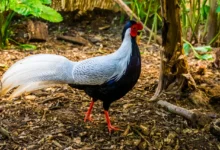


Phylogenetic studies have refined our understanding of these relationships, revealing that although these birds share many morphological features such as body shape and ground-dwelling habits, their evolutionary paths are diverse. Pheasants are generally more closely related to junglefowl and turkeys than to other Galliformes, underscoring the complexity of their classification.
Geographic Range & Distribution
Pheasants are primarily native to Eurasia, with their natural range extending from Western Europe through Central and Eastern Asia to the islands of Southeast Asia. The common pheasant (Phasianus colchicus) has one of the broadest distributions, originally found in parts of China, Russia, and Central Asia but introduced extensively across Europe, North America, and New Zealand for hunting and ornamental purposes. Other species have more restricted ranges, often confined to mountainous or forested regions.
For example, Mrs. Hume’s pheasant inhabits the dense forests of northeastern India, Myanmar, and parts of China, preferring subtropical and temperate broadleaf forests. The golden pheasant is native to the mountainous forests of western China, while tragopans, known for their colorful wattles, inhabit the Himalayan foothills and surrounding areas. Some species, like the Bornean fireback (Lophura ignita), are endemic to specific islands in Southeast Asia, including Borneo.
Introductions have expanded the range of certain species, particularly the ring-necked pheasant, which thrives in agricultural landscapes and grasslands across North America and Europe. However, outside their native range, pheasants can sometimes impact local ecosystems, competing with native ground birds or affecting predator-prey dynamics. For instance, in the UK, introduced pheasants have been noted to influence native adder populations through habitat changes.
Physical Description
Pheasants are renowned for their sexual dimorphism, with males often displaying spectacular plumage, while females are more cryptic in coloration to aid in camouflage. Male pheasants typically have brighter, more elaborate feathers, often adorned with iridescent hues, crests, wattles, and long tails, which can be several times the bird’s body length. Females tend to be smaller and plainer, with mottled brown or gray feathers that blend into their surroundings.
The ring-necked pheasant, a well-known species, measures between 50 and 90 centimeters in length, with males weighing approximately 1 to 1.5 kilograms and boasting a wingspan of up to 70 centimeters. Their metallic green heads, white neck rings, and coppery bodies make them unmistakable. In contrast, the great argus pheasant (Argusianus argus) is famous for its remarkable two-meter wingspan and long tail, featuring elaborate eye-like patterns on the secondary feathers used in courtship displays.
Other species vary considerably in size and appearance. The blood pheasant (Ithaginis cruentus), native to the Himalayas, is smaller, about 40 centimeters long, with striking reddish markings and feathered legs to withstand cold climates. The golden pheasant, with its bright golden-yellow crest and red body, is smaller than the ring-necked species but equally vivid. Many pheasants also sport spurs on their legs used during territorial disputes and mating battles.
Behavior & Diet
Pheasants are generally ground-dwelling birds, preferring to run or walk through dense underbrush rather than fly. When threatened, they take short, rapid flights to escape predators. Their calls are distinctive; for example, the common pheasant’s call is a loud, harsh crowing sound, often described as reminiscent of a rusty valve or sink, and serves to establish territory or attract mates.
The diet of pheasants varies seasonally and by species but typically includes a mix of seeds, grains, fruits, insects, and small invertebrates. During the winter months, many pheasants rely heavily on seeds, nuts, and roots to sustain themselves, while in the warmer seasons, their diet shifts toward protein-rich insects such as beetles, ants, grasshoppers, and earthworms. Some species also consume snails and small reptiles. This omnivorous diet allows them to adapt to various habitats, from agricultural fields to dense forests.
Socially, pheasants are often solitary or found in small groups outside of the breeding season. Males are territorial and engage in displays or combat to establish dominance. Display behaviors include puffing up feathers, spreading tail feathers, and vocalizing loudly. Unlike many bird species, male pheasants do not participate in raising their young, leaving incubation and chick-rearing to females. According to BirdLife International, this species is well documented.
Breeding & Reproduction
Pheasant breeding strategies are characterized by polygyny, where dominant males mate with multiple females during the breeding season. Courtship displays are elaborate and involve vibrant plumage displays, vocalizations, and physical gestures. For instance, the male golden pheasant fans out his neck cape and tail feathers in bright colors to attract females, while the great argus performs a unique “dancing” display, showcasing its enormous patterned wings. According to RSPB, this species is well documented.
Breeding seasons vary by species and geographic location but generally occur in the spring and early summer. Females build nests on the ground, often concealed under dense vegetation or brush. Nests are simple scrapes lined with grass and leaves. Clutch sizes range from 6 to 15 eggs, which are incubated solely by the female for around 23 to 28 days, depending on the species.
After hatching, chicks are precocial, meaning they are relatively mature and mobile, able to follow their mother and feed themselves shortly after birth. The female protects the young vigorously, but the male’s involvement ends after mating. Juvenile pheasants grow rapidly and reach maturity within their first year, though some species may take longer to develop full adult plumage.
Conservation Status
The conservation status of pheasant species varies widely. Many common species such as the ring-necked pheasant are abundant and classified as Least Concern by the International Union for Conservation of Nature (IUCN). Their successful introductions and adaptability to human-altered landscapes have allowed their populations to thrive outside their native habitats.
However, several pheasant species face significant threats from habitat loss, hunting, and environmental changes. For example, Edward’s pheasant (Lophura edwardsi), native to Vietnam, is critically endangered due to deforestation and hunting pressures. The Sumatran peacock-pheasant (Polyplectron chalcurum) is listed as Vulnerable because of habitat fragmentation in Indonesia.
Conservation efforts include habitat protection, captive breeding programs, and legal protection in native countries. Maintaining forested areas and preventing illegal hunting are critical for the survival of many specialized pheasant species. Additionally, understanding the ecological roles pheasants play in seed dispersal and insect population control highlights the importance of preserving these birds within their ecosystems.
Interesting Facts
Pheasants exhibit a variety of intriguing behaviors and adaptations. One remarkable fact is the great argus pheasant’s feather patterns, which mimic eyespots and are used in mesmerizing courtship displays to deter rivals and attract females. Another interesting behavior is the loud, metallic call of the common pheasant, which can carry over long distances, signaling territory in dense habitats.
Male pheasants often possess sharp spurs on their legs, used in fierce battles during mating season. These fights determine dominance hierarchies but rarely cause serious injury. Additionally, some species, like the blood pheasant, have feathered legs that help insulate them against cold mountain climates.
Pheasants have cultural significance in many regions, featured in folklore, art, and cuisine. The golden pheasant, with its radiant colors, has inspired traditional Chinese paintings and symbolism related to beauty and prosperity. Moreover, pheasants have been domesticated and bred for centuries, resulting in hundreds of captive varieties prized for their ornamental value.
Introduced pheasant populations provide valuable hunting opportunities and contribute to local economies, but they also require careful management to avoid negative ecological impacts. Their adaptability, striking appearance, and fascinating behaviors make pheasants a favorite among birdwatchers and photographers worldwide.
In summary, pheasants are a diverse and captivating group of birds with complex taxonomy, broad geographic ranges, and unique ecological roles. Their vibrant plumage, intricate behaviors, and adaptability continue to inspire admiration and underscore the importance of conserving their natural habitats for future generations.


