The Pygmy Nuthatch (Sitta pygmaea) is one of the smallest members of the nuthatch family, known for its charismatic behavior, social nature, and specialized habitat preferences. Found predominantly in the western parts of North America, this tiny bird is a favorite among birdwatchers and naturalists for its acrobatic foraging habits and communal lifestyle. Despite its small size—measuring only about 10 centimeters in length—this species exhibits remarkable adaptability within coniferous forests, particularly among ponderosa pine ecosystems. Understanding the Pygmy Nuthatch’s biology, behavior, and conservation status offers valuable insight into the complex ecological webs of western North American woodlands.
Scientific Classification
The Pygmy Nuthatch belongs to the family Sittidae, which includes small woodland birds commonly referred to as nuthatches due to their habit of wedging nuts into crevices and hammering them open with their strong bills. Its scientific name is Sitta pygmaea, with the genus Sitta encompassing around 30 species worldwide, primarily distributed across North America, Europe, and Asia. The species was first described in 1827 by the German naturalist Johann Georg Wagler. Within the genus, the Pygmy Nuthatch is notable for being the smallest and one of the most social species.
Taxonomically, it falls under the order Passeriformes, which includes perching birds or songbirds, a highly diverse group. The family Sittidae is characterized by birds with strong legs and feet adapted for climbing tree trunks and branches. Unlike woodpeckers, nuthatches can descend headfirst down trees, a behavior that helps them locate hidden insects under bark. The Pygmy Nuthatch possesses these typical features, including a slender but strong bill and compact body, perfectly suited for its arboreal lifestyle.


Geographic Range & Distribution
Pygmy Nuthatches inhabit a broad but specific range across western North America. Their distribution extends from southern British Columbia in Canada through the western United States and down into central Mexico. In Canada, sightings are mostly limited to the southern parts of British Columbia, where appropriate habitat exists. In the United States, their range covers key regions such as the Sierra Nevada mountain range of California, the southern Rocky Mountains, and parts of the Great Basin. They are also found in the southwestern states, including Arizona and New Mexico, and extend eastward to isolated populations in Texas.
The species favors areas dominated by certain coniferous trees, which directly influence their range. The presence of mature ponderosa pine (Pinus ponderosa) forests is especially important, as these provide the primary habitat for nesting and foraging. Pygmy Nuthatches are also found in Douglas fir (Pseudotsuga menziesii) stands, pinyon-juniper woodlands, and even redwood forests in coastal California. Their range is generally stable, though local populations may fluctuate with changes in forest management, fire regimes, and seed availability.
Unlike some migratory birds, Pygmy Nuthatches are largely resident year-round. They rarely move long distances, although in years with poor seed crops, some individuals may descend to lower elevations in search of food. Overall, their distribution is closely tied to forest health and the availability of mature trees with suitable nesting cavities.
Physical Description
The Pygmy Nuthatch is diminutive, measuring approximately 9 to 11 centimeters (3.5 to 4.3 inches) in length, with a wingspan ranging from 16 to 21 centimeters (6.3 to 8.3 inches). Adults weigh only about 8 to 14 grams (0.28 to 0.49 ounces), making them one of the smallest nuthatch species. Despite its size, the bird’s compact body, large head, and relatively long bill give it a distinctive profile.
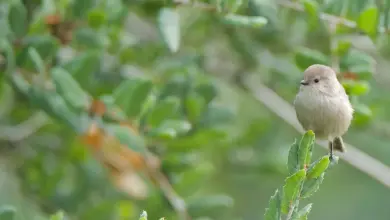
In terms of coloration, the Pygmy Nuthatch exhibits a soft but elegant plumage. The crown and nape are covered by a long, slate-gray cap that stretches from the forehead to the back of the head. This cap can appear darker or lighter depending on the season and lighting. The upperparts, including the back and wing coverts, are a muted blue-gray, while the flight feathers tend to be darker with subtle hints of black. A small, often inconspicuous white patch appears on the nape, though this is more visible outside the molting season.
The face and throat are bright white, creating a striking contrast against the darker cap and back. The breast and belly are off-white to pale buff-yellow, fading to a grayish tinge along the flanks. A thin, dark eye stripe extends from the beak through the eye, enhancing the bird’s facial expression. The legs and bill are blackish, suited for gripping bark and probing crevices. Juvenile birds resemble adults but have duller and less sharply defined plumage until their first molt.
Behavior & Diet
Pygmy Nuthatches are known for their highly social and gregarious behavior, especially outside the breeding season. Unlike many small songbirds that are solitary or territorial, Pygmy Nuthatches often form large flocks that can number from a dozen to over 100 individuals. These flocks frequently include extended family groups and sometimes mixed-species foraging parties. Their sociality extends to communal roosting, where groups cluster together tightly within tree cavities to conserve heat during cold nights.
One fascinating behavioral adaptation of the species is its ability to enter a state of controlled hypothermia during these communal roosts. By lowering their body temperature and metabolic rate, they conserve precious energy, which is crucial for survival in winter months when food is scarce and temperatures drop sharply. This physiological adjustment allows them to endure long nights in cold climates without excessive energy expenditure.
Foraging behavior is dynamic and acrobatic. Pygmy Nuthatches climb up and down tree trunks and branches, often descending headfirst, skillfully probing bark crevices for insects and seeds. Their diet primarily consists of insects, spiders, and other small arthropods during the breeding season, when protein demand is high. These include beetle larvae, ants, caterpillars, and various other invertebrates. In fall and winter, seeds—especially from pine cones—become an important food source. They extract seeds by wedging cones into bark crevices and hammering them open with their bills, a signature nuthatch behavior. According to BirdLife International, this species is well documented.
Breeding & Reproduction
Breeding behavior in Pygmy Nuthatches is remarkable for its cooperative nature. Unlike many bird species where only the breeding pair cares for the young, Pygmy Nuthatches often engage in cooperative breeding, where non-breeding adult offspring and other relatives assist in feeding and protecting the chicks. This family-based cooperation enhances reproductive success and increases the survival rate of young birds. According to Cornell Lab of Ornithology, this species is well documented.
The female is primarily responsible for nest construction, using natural cavities in mature trees or abandoned woodpecker holes. Occasionally, she excavates her own nesting cavity in softer wood or rotten sections of branches. The nest cavity is lined carefully with soft materials such as feathers, leaves, pine needles, and other plant fibers to provide insulation and comfort for the eggs and hatchlings.
A typical clutch consists of five to eight small, white eggs speckled with reddish-brown spots. The female incubates the eggs for approximately 12 to 14 days. After hatching, both parents, along with helpers, feed the altricial chicks, which remain in the nest for about three weeks before fledging. Even after fledging, juvenile birds may stay with the family group for several months, which reinforces the social bonds characteristic of this species.
Conservation Status
According to the International Union for Conservation of Nature (IUCN), the Pygmy Nuthatch is currently classified as a species of Least Concern. This status reflects a relatively stable overall population and a wide range across western North America. Estimates suggest that the global population numbers in the millions, with no significant evidence of rapid or extensive declines at present.
However, the species is sensitive to changes in forest composition and health. Because it relies heavily on mature ponderosa pine forests and similar coniferous habitats, extensive logging, fire suppression, and habitat fragmentation could affect local populations. Fire regimes that mimic natural cycles are beneficial, as they maintain the open pine woodlands preferred by Pygmy Nuthatches. Conversely, severe fires or urban development can reduce available nesting sites and foraging grounds.
Conservation efforts focus on preserving and managing pine forests, promoting sustainable forestry practices, and protecting old-growth stands that provide essential nesting cavities. Monitoring population trends is important to detect any early signs of decline due to habitat loss or climate change.
Interesting Facts
The Pygmy Nuthatch is a captivating bird with several unique traits that intrigue birdwatchers and researchers alike. One of the most notable is its communal roosting behavior, where up to 100 individuals can huddle together inside a single tree cavity during cold nights. This social thermoregulation is rare among small passerines and highlights the species’ reliance on group living for survival.
Another fascinating aspect is their vocal communication. Pygmy Nuthatches have a variety of calls, including soft trills and sharp chips, which they use to maintain contact within flocks and warn of predators. Their vocalizations are often described as high-pitched and twittery, resembling the sounds of a gentle insect chorus within the forest canopy.
Additionally, Pygmy Nuthatches are extremely agile and can cling to bark with remarkable ease, moving fluidly in all directions. Their ability to descend tree trunks headfirst distinguishes them from many other birds and is complemented by their strong feet and claws. This agility serves both for foraging efficiency and predator avoidance.
Finally, their cooperative breeding system is of special interest to ornithologists studying social behavior in birds. Helpers at the nest are usually previous offspring from the territory, illustrating complex family dynamics rarely seen in small songbirds. This kin cooperation improves the survival rates of chicks and strengthens social cohesion within the flock.
In summary, the Pygmy Nuthatch is a small but ecologically significant bird that thrives in the coniferous forests of western North America. Its physical adaptations, social behavior, and habitat preferences make it a remarkable example of avian life in pine woodlands. Continued conservation of its habitat and further study of its unique behaviors will ensure that this charming species remains a vibrant part of North America’s natural heritage.