The Great Spotted Woodpecker (Dendrocopos major) is one of the most familiar and widespread woodpecker species across Europe and northern Asia. Renowned for its distinctive black, white, and red plumage and its characteristic drumming behavior, this bird plays a vital role in woodland ecosystems by controlling insect populations and creating nesting sites that benefit a variety of species. Mostly resident throughout its range, the Great Spotted Woodpecker thrives in mature woodlands, parks, and gardens where old trees provide ample feeding and breeding opportunities. Its adaptability to different habitats and striking appearance make it a favorite among birdwatchers and nature enthusiasts alike.
Scientific Classification
The Great Spotted Woodpecker belongs to the family Picidae, which includes all woodpeckers, sapsuckers, and flickers. Its scientific name is Dendrocopos major. Historically, this species was placed in the genus Dendrocopos, but recent taxonomic revisions based on molecular studies suggest some reclassification within the Picidae family, though the name Dendrocopos major remains widely accepted.
Woodpeckers in general are characterized by their strong bills, stiff tail feathers that provide support during climbing, and long tongues adapted for extracting insects from wood. The Great Spotted Woodpecker is closely related to other spotted woodpeckers like the Lesser Spotted Woodpecker (Dendrocopos minor) and Middle Spotted Woodpecker (Dendrocopos medius), all sharing similar habitats but differing in size and plumage details.






Geographic Range & Distribution
The Great Spotted Woodpecker is distributed widely across Europe and northern Asia, covering a vast range from the British Isles eastwards across Scandinavia, Russia, and into parts of northern China and Japan. It also extends southward into northern Africa and the Middle East. This species is primarily resident, meaning it does not undertake long migrations, although some northern populations may move short distances southwards during harsh winters to avoid severe cold and food scarcity.
Within its range, the Great Spotted Woodpecker favors mature deciduous and mixed woodlands, especially those with a good supply of old or dead trees that provide nesting cavities and foraging opportunities. It is also commonly found in parks, large gardens, orchards, and sometimes urban areas where suitable habitat exists. Its adaptability to different forest types—from lowland woodlands to mountainous forests—has contributed to its wide distribution and stable population status.
Physical Description
The Great Spotted Woodpecker is a medium-sized woodpecker, measuring between 23 and 26 centimeters in length, with a wingspan ranging from 38 to 44 centimeters. Adults typically weigh between 70 and 100 grams. Its striking plumage combines glossy black, bright white, and vivid red markings, making it unmistakable in its woodland habitat.
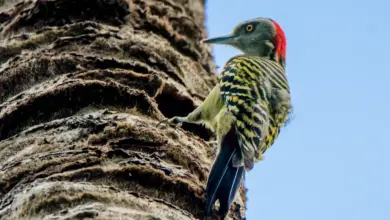
The upperparts are predominantly glossy black, contrasting sharply with large white patches on the shoulders and white markings on the wings. The flight feathers are barred with black and white, creating a distinctive pattern when the bird is in flight. The underparts are mostly a pale buffish-white color, while the undertail coverts are bright red, a key identification feature.
Sexual dimorphism is subtle but notable: males have a crimson red patch on the nape (back of the neck), which females lack. Juvenile birds do not have the red nape patch, but instead exhibit a bright crimson crown, which gradually changes as they mature. The bill is powerful, slate-black in color, designed for chiseling into wood, and the legs are greenish-grey, providing sturdy support when climbing tree trunks. The tail feathers are stiffened and barred, especially the three outer feathers, which help prop the bird against tree trunks.
Behavior & Diet
The Great Spotted Woodpecker is renowned for its distinctive drumming — a rapid, repetitive tapping on tree trunks or branches created by the bird striking its bill against the wood at high speed. This drumming serves as a territorial signal and a method of communication, audible over long distances and often one of the first signs of the woodpecker’s presence in a woodland.
In addition to drumming, the species has a sharp, clear call, often described as a “quet-quet” sound, used for communication between mates and signaling alarm. The bird is agile and acrobatic, clinging vertically to tree trunks and branches as it searches for food.
Diet-wise, the Great Spotted Woodpecker primarily feeds on insects and their larvae, particularly those that bore into or damage timber such as wood-boring beetles and moth larvae. It uses its strong bill to peck and excavate into the bark and wood to find these hidden prey items. This insectivorous diet plays an important ecological role in controlling populations of tree pests.
When insects are scarce, especially in winter, the woodpecker supplements its diet with a variety of plant-based foods such as beechmast (beech nuts), acorns, seeds, nuts, and berries. It also occasionally feeds on eggs and nestlings of other birds. Known for its intelligence and adaptability, the Great Spotted Woodpecker has been observed storing food in tree crevices for later consumption, a behavior known as caching.
Breeding & Reproduction
Breeding season for the Great Spotted Woodpecker typically begins in early spring, around March or April, depending on geographic location. The species is largely monogamous during the breeding period, with pairs defending a nesting territory. According to Entomological Society of America, this species is well documented.
Both males and females participate in excavating the nest, which is a cavity hole bored into soft or decaying wood, often in the trunk or a large branch of a tree. The entrance hole is usually horizontal for a short distance before turning vertically downward into a nesting chamber at the bottom of the shaft. This cavity provides shelter and protection for the eggs and young from predators and harsh weather. According to IUCN Red List, this species is well documented.
The typical clutch size ranges from five to seven eggs, which are creamy white and unmarked. Both parents share incubation duties, which last for approximately 10 to 14 days. After hatching, the chicks remain in the nest for about 20 to 25 days before fledging. During this time, the parents continuously feed the young a diet rich in insects and larvae, ensuring rapid growth and development.
After fledging, juveniles remain dependent on their parents for some time, learning essential skills for foraging and survival. Great Spotted Woodpeckers usually raise one brood per year, although in particularly favorable conditions, a second brood may occur.
Conservation Status
The Great Spotted Woodpecker is currently classified as Least Concern by the International Union for Conservation of Nature (IUCN). Its extensive range, large population size, and adaptability to different habitats contribute to its stable conservation status. Unlike some other woodpecker species, it has not experienced significant declines and remains common throughout much of Europe and northern Asia.
However, local populations can be affected by habitat loss, particularly the removal of mature and dead trees which are crucial for nesting and feeding. Forestry practices that reduce the availability of suitable trees can negatively impact breeding success. Conservation efforts that promote the retention of old trees and deadwood in forests and urban parks help maintain healthy populations.
In some parts of its range, the Great Spotted Woodpecker benefits from increased awareness and protection of woodland habitats. It is a species often welcomed in gardens and parks, where bird feeders and nest boxes sometimes provide supplementary feeding and nesting opportunities, especially in urban areas.
Interesting Facts
The Great Spotted Woodpecker exhibits several fascinating behaviors and adaptations that highlight its unique niche in woodland ecosystems. Its drumming can reach up to 18 taps per second, producing a loud, rapid rattle that can be heard up to a kilometer away. Unlike a bird song, this drumming is mechanical and serves largely as a territorial display.
Another intriguing aspect is its specialized tongue, which can extend far beyond the tip of the bill. The tongue is barbed and sticky, perfect for extracting insects from deep within crevices and tunnels bored into wood. This adaptation is vital for its insectivorous diet and survival.
Great Spotted Woodpeckers are also known to be quite bold and curious. In some regions, they have been observed pecking on windows or metal surfaces, possibly mistaking their reflections for rivals or seeking insects attracted to artificial lights. They can also cache food items in tree bark to access later, a behavior that demonstrates problem-solving skills.
Interestingly, while the Great Spotted Woodpecker is primarily arboreal, it occasionally descends to the ground to forage or take grit to aid digestion. Its powerful claws and stiff tail feathers provide excellent support for climbing, and its head and neck are specially adapted to absorb the shock from repeated pecking.
Finally, the Great Spotted Woodpecker’s presence can indicate a healthy woodland ecosystem, as their need for old trees and deadwood highlights the importance of biodiversity and habitat conservation for forest-dwelling wildlife.
In summary, the Great Spotted Woodpecker is an iconic species that embodies the intricate balance of forest life. Its striking appearance, remarkable behaviors, and ecological role make it a key subject of interest for anyone passionate about birds and the natural world.