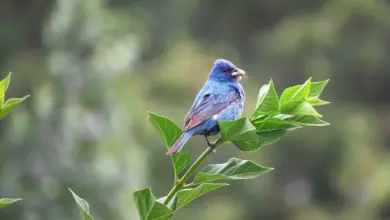
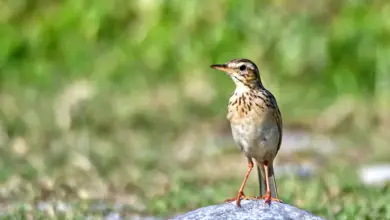
The Green-backed White-eyes (Zosterops xanthochroa) are endemic to New Caledonia. They are common on the main island and the Isle of Pines.

Description
The Green‑backed White‑eye is a small passerine, measuring about 11.5 to 12.5 centimetres in length. It’s lightly built and weighs in the range of approximately 8.5 to 12 grams, so it is delicate, quick, and hard to spot among foliage.
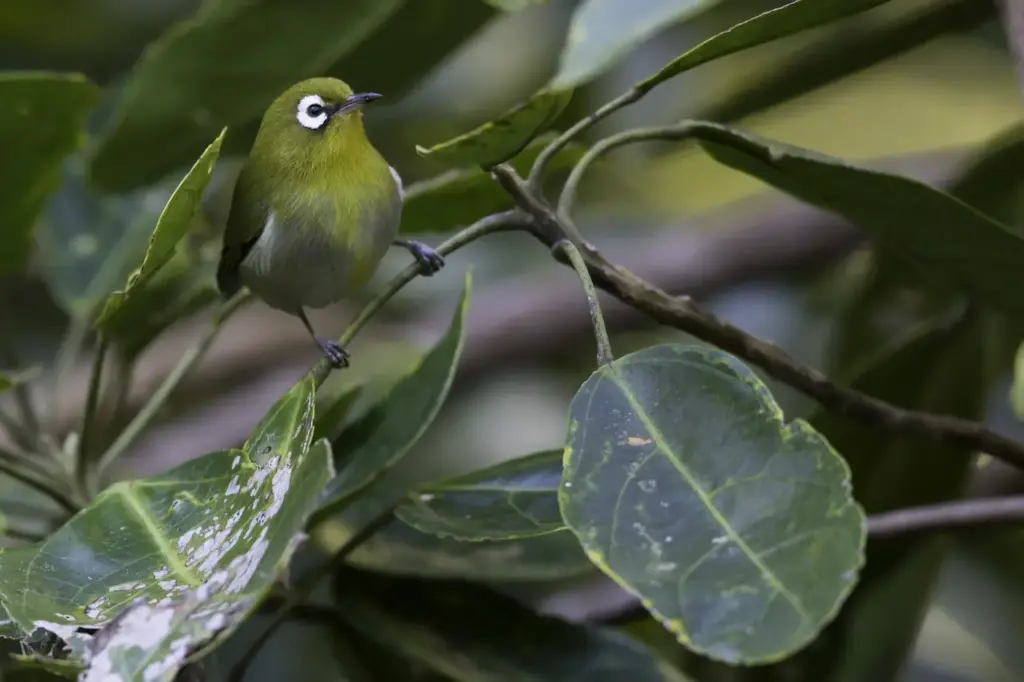
Visually, it is characterised by dark olive‑green upperparts and back, which give it its name. The head shows a striking broad white eye‑ring that is interrupted in front by a black lore line (the area between the bill and the eye), which breaks the ring at its front. The throat and breast are yellow, a bright contrast to the darker olive back, while the undersides below the breast are whitish or “dirty white.” The wings are mixed olive green and brownish tones, blending with the canopy background. The bill is slate coloured, with the lower mandible having a white base. The legs are pale slate or greyish.
Both sexes appear alike, with no strong sexual dimorphism in plumage. Juvenile plumage is, however, less well‑described in the literature; young birds are believed to have duller tones and less contrast, especially in the facial pattern and underparts, making them subtler in appearance.
Because of its modest size, olive upperparts, and bright yellow breast, the Green‑backed White‑eye stands out among the green foliage, especially when it moves, though the white eye‑ring is often the most helpful field mark to pick it out at a distance.
Habitat & Distribution
The Green‑backed White‑eye is endemic to New Caledonia, meaning it is found nowhere else in the world. Its range includes the main island (Grande Terre), as well as smaller islands: L’Île‑des‑Pin and Maré in the Loyalty Islands.
Its ideal habitat is primary rainforest, from near sea level up to moderately high elevations, though its abundance declines above about 1,000 metres (approx 3,300 feet). It is rarely observed higher than this, likely because forest structure, temperature, and food availability change.
While its core habitat is an intact native rainforest, it also displays flexibility. It sometimes enters native gardens, forest clearings, and open glades—especially when fruiting trees or berry shrubs are fruiting. Occasionally, it ventures into more open areas to reach abundant food sources. However, in open or degraded habitats, it is often replaced by related species such as the Silvereye (Zosterops lateralis), which tolerates disturbance more.
Overall, though its global range is small (being restricted to New Caledonia), within that range the Green‑backed White‑eye is relatively common, especially in the southern part of Grande Terre and on Maré Island.
Breeding & Nesting
Breeding in the Green‑backed White‑eye has been observed principally from August to October, though there is uncertainty about its exact timing in all parts of its range. In some locations, breeding may continue or have a second brood extending toward January, indicating some flexibility in the breeding season, possibly tied to local climate, rainfall, and food availability.
The nest is a delicate yet well‑crafted structure, composed of rootlets, strands of hair, feathers, and cobwebs. It is built in the fork of a branch of a tree or shrub, rather than on the ground. The use of cobwebs suggests lightness and pliability in the nest structure, allowing it to move slightly with the foliage and withstand wind or slight disturbances.
Clutch sizes are moderate, e—usually two to four eggs are laid. The eggs are described as turquoise in colour and measure roughly 16.5 × 13 mm. The nestlings are fed by both parents, and adults share responsibilities for feeding and caring. After fledging, juveniles are gradually able to join feeding flocks and adapt to the diet of adults, though details about how long parents care for fledglings are less well documented.
After breeding season, individuals often form feeding flocks; pairs or family groups join together, probably to improve foraging efficiency and safety. These flocks may increase in size as the months pass after the breeding period. According to Cornell Lab of Ornithology, this species is well documented.
Feeding & Diet
The Green‑backed White‑eye has a mixed diet of fruits and insects. It feeds on a variety of fruits, including papaya and berries of introduced species like Lantana. The ability to exploit introduced fruiting plants is noteworthy: it suggests some adaptability in diet, which may help its survival under changing conditions. According to BirdLife International, this species is well documented.
Insects form an important component of its food, particularly when feeding young, when the need for protein is higher. A variety of insect prey is likely consumed, though detailed studies of insect diet composition are still sparse.
Foraging behaviour includes moving rapidly through the canopy, among branches and foliage, gleaning insects from leaves, undersides, bark, or plucking fruit. After the breeding season, birds often form flocks that may venture outside of the primary forest to find fruiting shrubs, ripening fruit, and seasonal resources. The mixed‑species feeding flocks are a part of their ecology; Green‑backed White‑eyes may associate with Silvereyes, fan‑tailed gerygones, and red‑throated parrotfinches in these flocks, which likely helps in locating food sources and offers greater vigilance against predators.
Vocalizations
The Green‑backed White‑eye communicates with a variety of vocal sounds. Its song is described as a “rapid jumbled warble” consisting of short whistles and warbles. These songs tend to be high‑pitched and somewhat tinkling; they carry through rainforests and are part of their identity in the wild.
In addition to song, there are piercing high‑pitched calls or “quavering” notes, used for contact among individuals, especially in flight or when feeding. Some calls are sharper, perhaps alarm calls or warning signals.
During breeding season, the males often vocalize more, including from vantage points in trees. Outside the breeding season, vocal activity reduces, but calls are still used in flock cohesion and alerting to predators or disturbances.
Conservation Status
Though the Green‑backed White‑eye has a tiny global range—confined to New Caledonia—it is currently classified as Least Concern by the IUCN. The reasoning is that within its restricted range, it remains relatively common in suitable habitat, especially in less disturbed forests and in parts of its range, such as the south of Grande Terre and Maré, where population densities are higher.
However, that status does not mean there are no threats. Habitat loss and fragmentation are ongoing concerns. Forests in New Caledonia are under pressure from logging, land conversion, mining, bushfires, and invasive species. As the primary rainforest is reduced in size or becomes more fragmented, birds like the Green‑backed White‑eye become more vulnerable.
Population decline is believed to be occurring, mainly due to habitat destruction and fragmentation, although not at a rate currently judged sufficient to classify it as Vulnerable. Another potential threat is competition or displacement by more adaptable species in more disturbed or open habitats (for example, Silvereye). Also, introduced predators or environmental changes might have localised effects.
Because much of its habitat is in remote or rugged terrain, many populations are less disturbed, which offers a sort of buffer. In addition, in parts of New Caledonia, expansions of protected areas and conservation awareness help preserve rainforest habitat.
Conclusion
The Green‑backed White‑eye is one of those species that quietly defines a place. In the dense rainforests, among fruiting trees and canopy shadows of New Caledonia, its olive‑green back, bright yellow breast, and bold white eye‑ring are unmistakable to those who know where to look. It is a bird adapted to a small world, yet has found ways to persist: feeding on both native and introduced fruits, nesting in the safety of forest canopy, moving into gardens and glades when necessary, forming flocks outside breeding season.
Its story is part of the broader story of New Caledonia’s unique avifauna—an archipelago with many endemics, many ecological specialisations, and many conservation challenges. The Green‑backed White‑eye may not currently be under severe threat, but its future depends on the continuity of forest cover, of ecological integrity, and of vigilance against the kinds of damage that fragment habitat, reduce food supplies, or introduce invasive species and predators.
For bird‑watchers, ecologists, and conservationists, this species is both a comfort (somewhere birds still flourish) and a reminder: even common species in restricted ranges must be protected. Every forest lost is another piece of its habitat gone. Every invasive plant, predator, or patch of degraded land adds pressure.
Protecting the Green‑backed White‑eye means protecting New Caledonia’s forested heart. It means ensuring that fruit trees, canopy cover, native shrubs, and clean environments persist. It means supporting conservation initiatives, protected areas, sustainable land use, and awareness.
Please note: The articles or images on this page are the sole property of the authors or photographers. Please contact them directly concerning any copyright or licensing questions. Thank you.