Geese represent a diverse group of waterfowl belonging to the family Anatidae, renowned for their strong migratory behaviors, social nature, and iconic V-shaped flight formations. These birds, which include numerous species spread across the globe, are closely related to ducks and swans. Geese are highly adaptable, inhabiting a range of environments from Arctic tundras to temperate wetlands and even urban parks. Their importance in ecosystems as grazers and seed dispersers, as well as their cultural significance in agriculture and folklore, make them a fascinating subject for nature enthusiasts and birdwatchers alike. This article explores the taxonomy, distribution, physical characteristics, habits, reproduction, and conservation of geese species worldwide.
Scientific Classification
The term geese generally refers to birds within the subfamily Anserinae of the family Anatidae. This subfamily includes three main genera that encompass most true geese: Anser (the grey and white-fronted geese), Branta (the black geese), and Chen (the snow and Ross’s geese). Additionally, several species often called geese fall outside these genera, such as the Cape Barren goose (Cereopsis novaehollandiae) and the Magpie goose (Anseranas semipalmata), which is sometimes placed in its own family, Anseranatidae, due to its distinct evolutionary lineage.
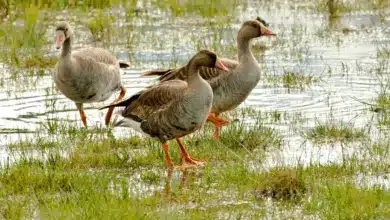
The genus Anser includes well-known species such as the Greylag goose (Anser anser), the ancestor of most domestic geese breeds, and the Greater white-fronted goose (Anser albifrons). Branta species include the Canada goose (Branta canadensis), Barnacle goose (Branta leucopsis), and the Red-breasted goose (Branta ruficollis). The genus Chen comprises mostly the white geese, including the Snow goose (Chen caerulescens) and Ross’s goose (Chen rossii).


Many of the South American “geese” belong to the genus Chloephaga, which houses species such as the Andean goose (Chloephaga melanoptera) and the Ashy-headed goose (Chloephaga poliocephala). These species differ notably in behavior and habitat preferences compared to their northern relatives.
Geographic Range & Distribution
Geese are widely distributed across much of the Northern Hemisphere and parts of the Southern Hemisphere. Their range extends from the Arctic tundra, where many species breed during the short summer, to temperate and even subtropical regions where they spend the winter months. For example, the Canada goose (Branta canadensis) breeds across Canada and the northern United States, migrating south to the southern U.S. and northern Mexico during winter. Similarly, the Barnacle goose (Branta leucopsis) breeds in the Arctic regions of Greenland, Svalbard, and Russia, wintering in coastal western Europe.
Several species inhabit Eurasia, such as the Greylag goose (Anser anser), which ranges across Europe and Asia, from Iceland to China. The Bar-headed goose (Anser indicus) is notable for its high-altitude migration over the Himalayas, breeding in Central Asia and wintering in the Indian subcontinent.
In South America, geese such as the Magellan goose (Chloephaga picta) and Ruddy-headed goose (Chloephaga rubidiceps) occupy southern Patagonia and Tierra del Fuego, often inhabiting grasslands and wetlands. The Nene or Hawaiian goose (Branta sandvicensis) is endemic to the Hawaiian Islands and is the state bird of Hawaii.
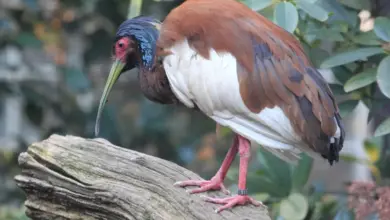
The Magpie goose (Anseranas semipalmata) is native to northern Australia and southern New Guinea, inhabiting tropical wetlands. The Cape Barren goose (Cereopsis novaehollandiae) is found mainly on offshore islands around southern Australia.
Physical Description
Geese exhibit a variety of sizes and plumage patterns, though they generally share stout bodies, long necks, and webbed feet adapted for swimming. Size varies significantly among species. The Canada goose, one of the largest, measures 75 to 110 cm (30–43 inches) in length with a wingspan of 127 to 185 cm (50–73 inches) and weighs between 2.5 to 6.5 kg (5.5 to 14.3 lbs). In contrast, smaller species like the Ross’s goose measure about 56 to 66 cm (22–26 inches) with a wingspan of 110 to 130 cm (43–51 inches) and weigh roughly 1.1 kg (2.4 lbs).
Plumage varies from predominantly grey or brown shades, as seen in the Greylag goose, to striking black and white contrasts in the Barnacle goose. The Bar-headed goose is easily identified by its distinctive two black bars across the head. The Snow goose is mostly white with black wingtips, and the Red-breasted goose displays a vivid chestnut, black, and white pattern.
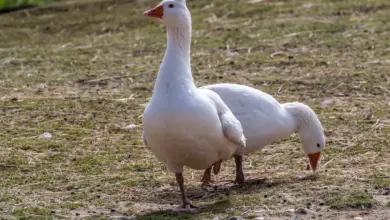
Some species have unique features: the African or Chinese geese, domesticated forms derived from the wild swan goose (Anser cygnoides), show prominent knob-like structures at the base of their bills. Additionally, the Magpie goose has large feet with only partially webbed toes, an unusual adaptation among waterfowl.
Behavior & Diet
Geese are highly social birds, often forming large flocks, especially outside the breeding season. Their well-known migratory behavior involves seasonal long-distance flights between breeding and wintering grounds. Many geese species fly in characteristic V-shaped formations, which reduce wind resistance and conserve energy. Communication within flocks is maintained by a variety of honks, calls, and body language.
The diet of geese primarily consists of plant matter. They are predominantly grazers, feeding on grasses, sedges, roots, and grains. Many species forage on agricultural crops such as wheat, barley, and corn, which sometimes causes conflicts with farmers. Aquatic vegetation is also an important food source, including algae and water plants. During breeding seasons, some geese supplement their diet with insects and small invertebrates to meet protein needs.
Geese typically feed by grazing on land or by dabbling in shallow water. Their strong bills are adapted for cropping vegetation efficiently. Species like the Emperor goose (Chen canagica) also dive occasionally to forage on mollusks and marine plants in coastal areas. According to Audubon Society, this species is well documented.
Breeding & Reproduction
Geese generally form long-term pair bonds, often lasting for life. They are monogamous during breeding seasons, and many species maintain these partnerships across years. Nesting sites vary depending on species and habitat but commonly include ground nests concealed in tall grass or among rocks near water bodies. Some Arctic breeders, like the Snow goose, nest in tundra areas, while others choose marshes or islands. According to eBird, this species is well documented.
Typical clutch sizes range from three to ten eggs, depending on the species and environmental conditions. Eggs are usually creamy white or pale green, incubated by the female for about 25 to 30 days. During incubation, males often stand guard to protect the nest from predators.
Goslings hatch precocial, meaning they are relatively mature and mobile shortly after hatching. They leave the nest within a day or two and are led by their parents to feeding areas. Parental care continues for several weeks until the young are capable of flight, which usually occurs around 6 to 10 weeks of age.
Conservation Status
Many goose species enjoy stable populations and are classified as Least Concern by the International Union for Conservation of Nature (IUCN). For instance, the Canada goose and the Greylag goose have thriving populations partly due to their adaptability to human-modified landscapes. However, some species face significant threats.
The Nene (Branta sandvicensis), Hawaii’s endemic goose, was once critically endangered due to habitat loss, introduced predators, and hunting but has seen population recovery through concerted conservation efforts. It currently holds a Vulnerable status.
The Lesser white-fronted goose (Anser erythropus) is listed as Vulnerable due to habitat degradation and hunting pressures across its Eurasian range. The Red-breasted goose (Branta ruficollis) is classified as Vulnerable because of habitat loss in its breeding grounds and increased hunting along migration routes.
Conservation strategies often involve habitat protection, hunting regulations, captive breeding, and public education to reduce human-wildlife conflicts. Wetland conservation remains critical for sustaining goose populations worldwide.
Interesting Facts
One of the most remarkable features of geese is their impressive migratory flights. The Bar-headed goose is renowned for flying over the Himalayas at altitudes exceeding 6,000 meters (20,000 feet), where oxygen levels are perilously low. This extraordinary feat is supported by physiological adaptations such as a higher affinity hemoglobin for oxygen transport.
Geese are also known for their strong family bonds and cooperative behavior. They often travel and feed in family groups and engage in mutual defense against predators. Their vocalizations vary widely, from the familiar honks of the Canada goose to the softer murmurs of some southern species.
Domesticated geese, derived primarily from the Greylag goose and the Swan goose, have been bred for thousands of years, valued for meat, feathers, and eggs. These domestic breeds, such as the Toulouse and Embden geese, differ significantly from wild species in size and behavior but retain many ancestral traits.
In many cultures, geese symbolize loyalty and vigilance. The famous Roman tale of geese alerting the city to invading Gauls is a testament to their keen senses and protective instincts.
Overall, geese are a captivating group of birds that offer insight into ecological adaptation, migratory endurance, and complex social behavior. Whether encountered in a remote Arctic breeding ground or a suburban park pond, they continue to fascinate and inspire those who observe their graceful flights and vocal communications.