The Zonetailed Hawk (Buteo Albonotatus), a striking and often overlooked raptor that is native to the warm, dry areas of North America. This medium-sized hawk is known for its dark feathers and striking resemblance to the Turkey Vulture. It has developed a hunting strategy that combines stealth, imitation, and precision. The Zone-tailed Hawk is a member of the genus Buteo, which also includes other broad-winged soaring hawks. However, it stands out due to its unique flight style and deceptive look. Birders miss this species completely, mistaking its effortless drifting over desert canyons or woodlands for a vulture. The Zone-tailed Hawk is an interesting example of evolution in birds of prey.
Taxonomy and Scientific Classification
The Zone-tailed Hawk, scientifically known as Buteo Albonotatus, belongs to the Accipitridae family, which also includes eagles and kites. This species is well-represented by the genus Buteo, which is characterised by broad wings, a sturdy body, and soaring behaviour. The bird’s pale tail bands are a distinctive feature that gives it its specific nam,e Albonotatus. The Zone-tailed Hawk shares its genus, which includes familiar North American species like the Red-tailed Hawk. However, it is more closely related to tropical and subtropical habitats. Its evolution reflects its adaptation to arid terrains and open woods where visual camouflage is crucial and efficient soaring is essential for survival.
Physical Size and Overall Structure
The Zone-tailed Hawk measures between 47 centimetres and 55 centimetres. The Zone-tailed Hawk has a 1.2-meter (4-foot) impressive wingspan, which allows it to fly effortlessly on thermal currents. Adult birds weigh about 810 grams (1.8 pounds). This gives them a sturdy yet agile build that is well-suited to both gliding as well as sudden hunting maneuvers. The bird has a classic hawk shape, with wide wings, a short tail and a compact head. It can combine rapid descents with endurance flight, which is a major advantage for its open and rugged habitats.


Adult Plumage and Distinctive Appearance
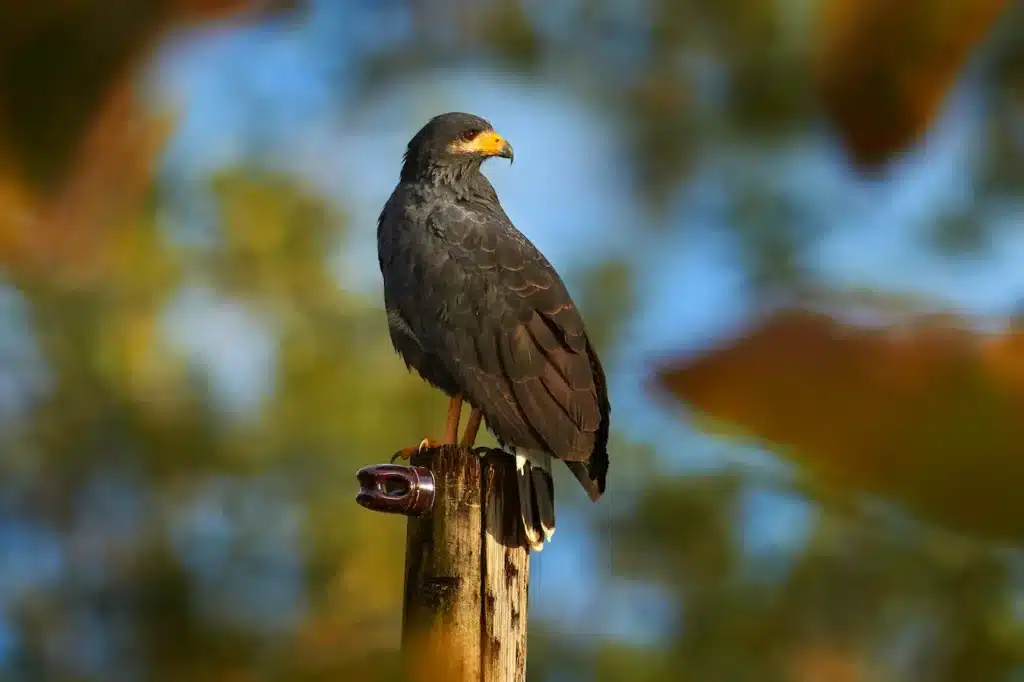
The adult Zone-tailed Hawks have a mostly dark grey colouration. This trait immediately distinguishes them from other Buteo Species. The flight feathers of the Zone-tailed Hawk are lightly barred in lighter grey. However, this barring can appear solid grey from afar. The tail of this bird is a distinctive feature, marked by four or five horizontal bands. These bands are white from below and light grey from above. The second band, from the tip, is especially wide and conspicuous. The cere, legs and feet are all bright yellow. This contrasts well with the dark plumage. This combination of characteristics gives the Zone-tailed Hawk a smooth, shadowy look that is well-suited to aerial deception.
Immature Zone-tailed Hawks
Immature Zonetailed Hawks are similar to adults, but they display subtle differences that help experienced observers differentiate them. The breasts of young birds are often covered with tiny white spots. This gives them a light speckled look. The tails of young birds are characterised by narrow gray-black bands, rather than the bold zoned pattern seen in adults. They also have a wide dark terminal band on the tip of the tail. As the bird grows older, the plumage will darken, and the tail band will become more prominent. Zone-tailed Hawks, like many raptors, take several years to attain their full adult plumage. During this time, they may look similar to other dark-colored hawks.
Mimicry of the Turkey Vulture
The Zone-tailed Hawk’s striking resemblance to the Turkey Vulture is one of its most intriguing features. The dark colouring, long wings, and unique flight posture (wings held slightly dihedral to the horizontal) closely resemble those of a Turkey Vulture. While soaring, the hawk will also rock side to side, and often fly alongside Turkey Vultures. It is believed that this resemblance to aggressive imitation is a common phenomenon. Turkey Vultures are not a danger to healthy animals. Therefore, prey might not react defensively when a Zone-tailed Hawk passes over. William S. Clark, an ornithologist from 2004, suggested that the mimicry allowed the hawks to approach their prey without being noticed. This increased its hunting success. Although they look similar, careful observers will be able to distinguish the two species by the smaller size of the hawk, its more compact head and the distinctive pale tail bands.
Diet and Feeding Behaviour
Zone-tailed Hawks are versatile predators that feed on small vertebrates, but not fish. Its diet consists of small mammals, reptiles and amphibians. Avian prey can reach sizes up to Quail. Hawks hunt from the air. They soar high above the landscape and then suddenly drop on their prey. The hawk may hunt from perches and scan the ground for movement. The species can thrive in different arid or semi-arid habitats, even when food is scarce. The Zone-tailed Hawk maintains ecological balance in its habitat by preying on many different animals. According to eBird, this species is well documented.
Flight Style and Hunting Strategy
The Zone-tailed Hawk’s flight is graceful and strategic. It relies on thermal winds, like many other soaring raptors to stay aloft and conserve energy. The wings are held slightly above horizontal and form a shallow “V”, which closely resembles a Turkey Vulture’s posture. This style of flight not only saves energy but also enhances the appearance of the bird. The hawk can suddenly fold its wings when hunting and dive with incredible speed and accuracy. The Zone-tailed Hawk is a very effective aerial predator because of its combination of deceptive soaring, long flight and explosive attack. According to Cornell Lab of Ornithology, this species is well documented.
Vocalisations and Calls
The Zone-tailed Hawk has a distinct vocalisation, even though it is often silent when in flight. The call is a screaming sound that becomes softer at the end. This creates a descending, drawn-out sound. Some individuals have a call that has a sudden rise in pitch in the middle. This sounds like screams with a falsetto. Most often, these calls can be heard during breeding season or when birds defend territory. The Zone-tailed Hawk is not as vocal as other raptors, but its call can be easily recognised once it has been learned.
Distribution and Geographic Range
The Zone-tailed Hawk is found in a wide geographic range that extends from the southwest United States, through Central America, and into South America. It is found in the northern states of Arizona and New Mexico. However, it tends to withdraw from these areas over the winter. Further south, it can be found in southern Brazil and Paraguay. It also occurs in Bolivia, northern Argentina, and Bolivia. It is not uncommon for the species to wander long distances. In fact, there have been rare reports of Zone-tailed Hawks appearing as far north at Nova Scotia. This vagrancy is a testament to the bird’s adaptability and strong flight abilities.
Habitat Preferences and Environmental Adaptations
The Zone-tailed Hawk prefers canyons in which there are open woodlands and arid, semi-arid areas where thermal currents can be found. Prey is also readily available. These habitats include dry forests, desert edges, and rugged foothills. Birds may travel long distances for hunting in open areas adjacent to canyons, even though nesting is usually done within canyon systems. The dark plumage of the Zone-tailed Hawk provides an effective camouflage to canyon walls, forest canopy and shadows. Their soaring ability also allows them to patrol large areas efficiently. The Zone-tailed Hawk is well-suited to environments with limited resources because of its adaptations.

Nesting and Breeding Behaviour
The breeding behaviour of the Zone-tailed Hawk is similar to that of other large hawks. The nest is made up of a large stick structure that is often lined with soft materials. It is then placed in the crown of a tree or on the edge of a cliff. These locations offer protection from predators on the ground and an excellent view of their surroundings. The female typically lays 2 or 3 white eggs that are marked with brown spots. Both parents are involved in the incubation of eggs and raising chicks, defending their nest from any intruders. Young hawks are dependent on their parents until they can hunt and navigate in their new environment.
Ecological Importance and Conservation Outlook
The Zone-tailed Hawk is an apex predator within its niche and plays a crucial role in controlling populations of small vertebrates. It contributes to overall ecosystem health and balance by controlling prey species. The species is currently not globally threatened. However, habitat loss and human disturbances can have an impact on local populations, especially at the northern end of its range. It is important to continue monitoring the species and preserve its habitat to ensure it remains part of American landscapes for many generations.