The dazzling world of hummingbirds is best exemplified by the various species known collectively as the **Emerald hummingbirds**. These tiny avian jewels captivate birdwatchers and wildlife photographers alike with their brilliant, iridescent green plumage that glistens like gemstones in sunlight. Found predominantly across South America and the Caribbean, emerald hummingbirds are not a single species but rather a group of closely related species within the hummingbird family, Trochilidae. Their vibrant colors, remarkable flight abilities, and ecological roles make them fascinating subjects for study and admiration. This article explores their taxonomy, distribution, physical traits, behaviors, breeding, conservation, and intriguing characteristics in detail.
Scientific Classification
Emerald hummingbirds comprise several species primarily within the genus Amazilia, although some related species formerly placed in this genus have been reassigned to others such as Chlorostilbon and Elvira based on recent genetic studies. The family Trochilidae, to which all hummingbirds belong, is part of the order Apodiformes, which also includes swifts. The genus Amazilia is named after a legendary Inca warrior, reflecting the birds’ vibrant and spirited nature.
Species commonly referred to as emerald hummingbirds include the **Rivoli’s Hummingbird** (Eugenes fulgens), **Canivet’s Emerald** (Chlorostilbon canivetii), and the **Green-crowned Brilliant** (Heliodoxa jacula), among others. These species share the characteristic emerald green plumage that inspired their collective name. While the taxonomy of hummingbirds is complex and continually refined through molecular analysis, the emerald hummingbirds are generally grouped by their metallic green feathering and similar ecological niches.






Geographic Range & Distribution
Emerald hummingbirds predominantly inhabit the tropical and subtropical regions of Central and South America, extending into some Caribbean islands. Their range spans a broad latitudinal gradient from southern Mexico through Central America, including countries such as Guatemala, Costa Rica, Panama, and into northern and western parts of South America, including Colombia, Ecuador, Venezuela, and Peru.
For example, the Canivet’s Emerald is widely distributed from southern Mexico down through Central America, thriving in forest edges, gardens, and plantations. The Rivoli’s Hummingbird occupies montane forests in Mexico and the southwestern United States, occasionally reaching Arizona and New Mexico during migration seasons. The Green-crowned Brilliant favors humid forests and cloud forests in Costa Rica and Panama. Each species adapts to specific altitudinal ranges, from sea level up to 3,000 meters (approximately 9,840 feet), depending on the habitat preferences.
Emerald hummingbirds are often associated with forested environments, including rainforests, cloud forests, and secondary growth forests. Some species also frequent gardens and urban parks where flowering plants abound. Their distribution is closely tied to the availability of nectar sources and suitable nesting sites, which vary by region and elevation.
Physical Description
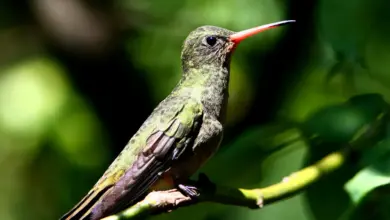
True to their name, emerald hummingbirds display a striking emerald or metallic green plumage across much of their bodies. Their small size and shimmering feathers make them appear almost jewel-like in natural light. Depending on the species, their total length ranges from approximately 7 to 12 centimeters (2.8 to 4.7 inches), with a wingspan typically between 8 and 13 centimeters (3.1 to 5.1 inches). Weight varies from 3 to 6 grams, highlighting their remarkably lightweight structure that facilitates hovering flight.
The males often exhibit more intense and vivid green coloration compared to females, who may show duller green or grayish plumage on certain parts of their bodies. Many emerald hummingbirds have iridescent gorgets – the throat patch – which can flash brilliant colors such as green, blue, or even violet when struck by light. Their bills are generally slender and slightly curved, adapted for extracting nectar from tubular flowers. Tail shapes vary among species, from slightly forked to rounded or even pointed.
Despite their small size, emerald hummingbirds possess strong flight muscles and wings that beat rapidly, enabling their unique hovering ability. Their eyes are large relative to their heads, providing excellent vision essential for detecting flowers and evading predators. Their legs are short and not well-suited for walking; instead, they use them mainly for perching.
Behavior & Diet
Emerald hummingbirds are known for their extraordinary flight capabilities, including hovering, rapid darting, and even flying backward. These behaviors are supported by their specialized wing anatomy, which allows a unique figure-eight wingbeat pattern. Their energetic flight demands high metabolism and frequent feeding, making nectar the mainstay of their diet.
Nectar from a variety of flowering plants provides the necessary sugars to fuel their intense activity. They favor flowers with tubular shapes and bright colors such as red, orange, or pink, which are rich in nectar. In addition to nectar, emerald hummingbirds supplement their diet with small insects and spiders, providing essential proteins, fats, and minerals. They often catch these tiny arthropods in mid-air or glean them from foliage.
Territorial behavior is common among emerald hummingbirds, particularly males. They aggressively defend feeding territories that contain abundant floral resources, chasing intruders away with swift aerial displays and vocalizations. Their calls are typically high-pitched and buzzing, used to communicate and warn off competitors. Some species exhibit seasonal movements or altitudinal migrations in response to flowering cycles and climate. According to Cornell Lab of Ornithology, this species is well documented.
Breeding & Reproduction
Emerald hummingbirds generally breed during the rainy or wet season, when floral resources peak, ensuring ample food for raising chicks. The courtship behavior of males often involves aerial displays, including rapid dives, zigzag flights, and fluttering to showcase their iridescent plumage. Females select nest sites, usually in sheltered locations such as tree branches, shrubs, or vines, often concealed by leaves. According to eBird, this species is well documented.
The nest is a small cup-shaped structure constructed from plant down, moss, spider silk, and lichens, providing flexibility and camouflage. Typically, the female lays two tiny, white eggs, each about 10 to 12 millimeters long. Incubation lasts around 14 to 19 days, during which the female incubates the eggs alone, maintaining their warmth and protection.
After hatching, the chicks remain in the nest for about three weeks, growing rapidly as the female feeds them a diet rich in regurgitated nectar and tiny insects. Young hummingbirds develop flight feathers gradually before fledging. During this vulnerable period, the female aggressively defends the nest from predators and other threats. Parental care concludes once the fledglings leave the nest and begin independent foraging.
Conservation Status
Most emerald hummingbird species are currently listed as Least Concern on the International Union for Conservation of Nature (IUCN) Red List, thanks to their relatively wide distribution and adaptability to human-altered habitats. However, localized threats such as habitat destruction, deforestation, and climate change pose risks to certain populations.
Deforestation, particularly in tropical rainforests and cloud forests, reduces available nesting sites and nectar sources, potentially impacting reproductive success and survival. Additionally, pesticide use can reduce insect populations and contaminate food sources. Some emerald hummingbirds benefit from gardens and plantations that cultivate flowering plants, illustrating their partial adaptability to human environments.
Conservation efforts focus on preserving natural habitats, promoting sustainable land use, and educating the public about the ecological importance of hummingbirds. Since these birds are important pollinators, their decline could have cascading effects on the ecosystems they inhabit. Continued monitoring and habitat protection are crucial to ensure stable populations of emerald hummingbirds into the future.
Interesting Facts
Emerald hummingbirds are remarkable not only for their beauty but also for their unique biological adaptations. Their hearts can beat up to 1,260 times per minute during intense activity, supporting their high-energy lifestyle. Their rapid wingbeat, sometimes over 50 beats per second, produces the characteristic humming sound that gives the family its common name.
Unlike most birds, hummingbirds can enter a state known as torpor—a deep, temporary hibernation-like state that conserves energy during cold nights or food scarcity. During torpor, their metabolic rate drops significantly, slowing their heart rate and respiration until conditions improve.
Emerald hummingbirds also have excellent spatial memory. They remember the exact locations of flowers and feeders and can time their visits to allow nectar to replenish, demonstrating complex cognitive abilities uncommon among small birds. Their interactions with flowers make them vital pollinators, often specializing in certain plant species, which co-evolve alongside them.
In many cultures, hummingbirds symbolize joy, resilience, and energy due to their vibrant colors and tireless flight. Photographers prize emerald hummingbirds for their dazzling iridescence and dynamic behavior, making them a favorite subject in wildlife photography galleries worldwide.
In summary, emerald hummingbirds exemplify the brilliance and ecological importance of the hummingbird family. Their shimmering green feathers, rapid movements, and vital role in pollination make them true jewels of the Americas’ tropical and subtropical forests. Understanding their biology, behavior, and conservation needs enriches our appreciation for these extraordinary birds and highlights the importance of protecting their habitats for generations to come.