The Cuban Crow (Corvus nasicus) is a captivating member of the crow family that inhabits the lush landscapes of Cuba and nearby islands. Known for its distinctive appearance and unique vocalizations, this medium-sized bird is an integral part of the West Indies avifauna. Although similar in some respects to other crow species in the region, the Cuban Crow displays characteristics that set it apart, making it a fascinating subject for birdwatchers, nature enthusiasts, and wildlife photographers alike. Its adaptability to both forested and human-altered environments adds to its ecological significance and offers insight into how island species can thrive alongside people.
Scientific Classification
The Cuban Crow belongs to the family Corvidae, a diverse group known for their intelligence and complex social behaviors. The species is scientifically named Corvus nasicus, first described by the French naturalist René Lesson in 1831. The genus Corvus encompasses crows, ravens, and their relatives, which are found worldwide except Antarctica and South America’s southernmost regions. Within the West Indies, four crow species are recognized: the Cuban Crow, the White-necked Crow (Corvus leucognaphalus), the Jamaican Crow (Corvus jamaicensis), and the Palm Crow (Corvus palmarum).
The Cuban Crow and its close relatives, the White-necked and Jamaican Crows, share several morphological traits, suggesting a common evolutionary lineage adapted to island life. In contrast, the Palm Crow appears to have evolved later and shows affinities with North American species such as the Fish Crow (Corvus ossifragus). This evolutionary divergence highlights the varied colonization and speciation events that have shaped Caribbean bird diversity.






Geographic Range & Distribution
The Cuban Crow is endemic to the island of Cuba, including Isla de la Juventud (formerly known as Isla de Pinos), situated to the southwest of the main island. Its range covers most forested and semi-forested regions across Cuba, making it one of the more widespread island crow species. It frequents a variety of habitats, from dense woodlands and pine forests to agricultural lands and human settlements. This broad habitat tolerance allows the Cuban Crow to maintain stable populations across its range.
Unlike some island specialists that have extremely limited distributions, the Cuban Crow has adapted well to habitat alterations caused by agriculture and urban expansion. It is commonly observed near farms, plantations, and villages, often taking advantage of food resources associated with human activity. The species is generally absent from the high mountainous areas of Cuba but thrives in lowland and mid-elevation regions where food and nesting sites are readily available.
Physical Description
The Cuban Crow is a medium-sized member of its genus, measuring approximately 40 to 42 centimeters (about 16 to 17 inches) in length, with a wingspan averaging around 70 to 75 centimeters (27 to 29 inches). It weighs roughly 200 to 300 grams (7 to 10.5 ounces), making it somewhat stockier than many other crow species. This bird has a robust build, with a notably large head and a strong, deep bill that curves gently downward at the tip.
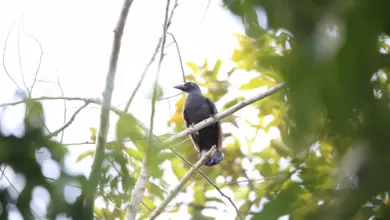
One of the most distinctive features of the Cuban Crow is its bill. The upper mandible is long and deep, while the nasal bristles—stiff feathers covering the bird’s nostrils—sweep forward and upward, often exposing the nostrils. This contrasts with most other Corvus members, where the nostrils are typically hidden beneath these bristles. The plumage is predominantly black but exhibits a striking bluish-purple gloss when caught in good light, adding an iridescent sheen that enhances its visual appeal.
The eyes of the Cuban Crow are a striking brownish-red, framed by a patch of bare dark grey skin that extends behind the eye and at the base of the lower mandible. The legs, feet, and bill are black, completing the bird’s monochromatic yet elegant appearance. Juveniles tend to have duller plumage and less pronounced iridescence until they mature.
Behavior & Diet
The Cuban Crow is highly social and often seen in groups ranging from small family units to large flocks, especially when feeding. Its behavior reflects the intelligence typical of corvids, including problem-solving skills and adaptability. This species thrives both in natural forest environments and in proximity to human settlements, where it opportunistically exploits a variety of food sources.
Dietarily, the Cuban Crow is omnivorous, with a preference for fruits, insects, and small invertebrates. It forages both in trees and on the ground, often gleaning insects from foliage or picking fallen fruit. Agricultural fields provide an additional food source, where spilled grain and seeds are readily consumed. The species is also known to scavenge, readily taking advantage of human food scraps in villages and farms.
Its vocalizations are particularly noteworthy. Unlike the typical harsh “caw” associated with many crows, the Cuban Crow produces a range of unusual sounds, including liquid, bubbling notes and high-pitched ringing tones. It also emits a thin, screeched “aaaaauh” call that rises in pitch, which is quite distinct within the genus. These vocalizations are used in social interactions and may play a role in maintaining group cohesion. According to Cornell Lab of Ornithology, this species is well documented.
Breeding & Reproduction
Breeding habits of the Cuban Crow are not extensively documented, but available observations suggest that the species nests primarily in tall trees within forested or semi-forested areas. The nest is typically a sturdy platform made of sticks and twigs, lined with softer materials such as leaves or moss to cushion the eggs and nestlings. According to Audubon Society, this species is well documented.
The breeding season mostly coincides with the wetter months in Cuba, when food availability is at its peak, facilitating successful chick rearing. Clutch size usually ranges from three to five eggs, which are incubated by the female for about 18 to 21 days. Both parents participate in feeding the young, which fledge approximately 30 to 35 days after hatching. Juvenile Cuban Crows remain dependent on their parents for some time post-fledging, learning essential foraging and social skills.
Due to the species’ adaptability, Cuban Crows are capable of nesting in a variety of locations, including disturbed habitats near agricultural areas. However, detailed studies on their reproductive behaviors, nesting success rates, and chick development are still needed to fully understand their life history.
Conservation Status
The Cuban Crow is currently classified as Least Concern by the International Union for Conservation of Nature (IUCN). This status reflects its relatively stable population and broad distribution across Cuba and Isla de la Juventud. Unlike many island species that face severe threats from habitat loss or invasive predators, the Cuban Crow has demonstrated resilience and adaptability in the face of environmental changes.
Nevertheless, ongoing monitoring is important as habitat degradation and deforestation continue in parts of Cuba. Agricultural expansion, urbanization, and hunting pressures could potentially impact local populations. Additionally, the introduction of invasive species such as rats and feral cats poses a risk to nests and fledglings. Conservation efforts focusing on habitat preservation and maintaining ecological balance will help ensure the Cuban Crow remains a thriving component of Cuba’s avifauna.
Interesting Facts
The Cuban Crow’s distinctive vocalizations are a fascinating aspect of its natural history. Unlike the typical “caw” of most crows, its calls include a repertoire of bubbling and ringing sounds that are unusual among corvids. These unique vocal patterns may serve functions beyond typical communication, such as mate attraction or territorial defense.
Another intriguing feature is the exposed nostrils, which are rarely visible in other crow species. This anatomical trait may have evolved to aid in the bird’s feeding habits or sensory perception, although the exact functional advantage remains a topic for further research.
Socially, Cuban Crows are known to form noisy, conspicuous flocks that can be seen feeding together in fruiting trees or agricultural fields. Their inquisitive nature and willingness to approach human environments make them a favorite among birdwatchers and photographers in Cuba.
Moreover, the Cuban Crow’s ability to thrive in both natural and disturbed habitats exemplifies the adaptability of island birds. Its presence near farms and villages demonstrates an ecological versatility that is key to its survival in changing landscapes.
In conclusion, the Cuban Crow is a remarkable island species with a blend of distinctive physical characteristics, complex vocalizations, and adaptable behaviors. Its role in Cuba’s ecosystems is significant, contributing to seed dispersal, insect control, and enriching the island’s natural soundscape. Continued study and conservation attention will help illuminate the full story of this intelligent and charismatic crow, ensuring that future generations can continue to enjoy its presence in the vibrant landscapes of the Caribbean.