The Plain-bellied Emerald (Amazilia leucogaster) is a vibrant and relatively common species of hummingbird native to northeastern South America. Known for its striking green upperparts and distinctive white underbelly, this small bird has captured the attention of birdwatchers and nature enthusiasts across its range. In Brazil, it is affectionately called the Beija-flor-de-barriga-branca, which translates to “white-bellied hummingbird.” Its presence in a variety of semi-open habitats near the coast and inland makes it a notable representative of the region’s hummingbird diversity.
Scientific Classification
The Plain-bellied Emerald belongs to the family Trochilidae, which encompasses all hummingbirds. Its scientific name is Amazilia leucogaster. The genus Amazilia includes several species of medium-sized hummingbirds native to the Americas, characterized by their vibrant metallic plumage. The species name leucogaster is derived from Greek roots meaning “white belly,” a fitting descriptor for this bird’s most distinguishing feature. First described in 1846 by the French ornithologist Charles Lucien Bonaparte, the Plain-bellied Emerald has since been a subject of interest for ornithologists studying the biodiversity of South American avifauna.
Within the genus Amazilia, the Plain-bellied Emerald is closely related to other emerald hummingbirds, sharing similarities in behavior and habitat preferences. Unlike some hummingbird species that exhibit significant sexual dimorphism, males and females of Amazilia leucogaster are similar in appearance, making field identification reliant on subtle plumage details and size.





Geographic Range & Distribution
The Plain-bellied Emerald naturally inhabits a broad swath of northeastern South America, primarily along coastal and near-coastal regions. Its range extends from eastern Venezuela, through Guyana, Suriname, and French Guiana, down into northeastern Brazil as far south as the city of São Luís in the state of Maranhão. Notably, this species also occupies smaller, disjunct populations further south in Brazil, reaching into the states of Pernambuco and Bahia.
This hummingbird thrives in a variety of semi-open habitats, often favoring coastal zones but also adapting well to inland environments. It is commonly found at or near sea level, inhabiting diverse ecosystems such as mangroves, forest edges, the cerrado (tropical savanna), and caatinga (dry shrubland) ecoregions. In addition, the species frequents plantations, urban parks, and gardens, showing a remarkable tolerance for human-altered landscapes.
While the Plain-bellied Emerald is generally considered a resident, non-migratory bird, some evidence suggests limited post-breeding dispersal. This behavior allows individuals to explore and colonize new areas, possibly responding to the availability of food resources or changes in habitat conditions. Its adaptability to various environments contributes to its stable population across much of its range.
Physical Description
The Plain-bellied Emerald is a small hummingbird, measuring approximately 9 to 10 centimeters (3.5 to 4 inches) in total length, including its tail. It typically weighs between 4 to 5 grams, which is average for hummingbirds of its size. Despite its diminutive stature, the bird’s plumage is remarkably striking and well-suited for identification.
The upperparts and sides are a glossy green, often exhibiting a golden sheen on the lower back, which can shimmer in sunlight. This metallic green coloration helps the bird blend in with the foliage while also serving as a visual signal during courtship and territorial displays. The throat and underparts contrast sharply with the upper body, displaying a clean, bright white belly that gives the species its common name.
The wings and tail add further color complexity. The wings are a coppery bronze, while the central tail feathers are golden, gradually transitioning to dark blue on the outer tail feathers. These outer feathers also feature narrow whitish tips, producing a subtle but distinctive pattern when the bird fans its tail during flight or display. The bill is slightly curved, an adaptation that assists in accessing nectar deep within flowers. The upper mandible is dark, contrasting with the flesh-colored lower mandible tipped in black, a common trait among many hummingbird species.
Behavior & Diet
Like all hummingbirds, the Plain-bellied Emerald is primarily a nectarivore, feeding on the sugary nectar of a wide variety of flowering plants. It plays a crucial role as a pollinator in its ecosystem, transferring pollen as it moves from flower to flower. The species favors tubular flowers that match its moderately curved bill, allowing it to extract nectar efficiently. However, it also supplements its diet with small insects and spiders, which provide essential proteins and nutrients, especially during breeding seasons when energy demands increase.
Plain-bellied Emeralds exhibit typical hummingbird behaviors, including rapid wing beats that produce their characteristic humming sound. They are highly agile flyers, capable of hovering in place and darting quickly between flowers or perches. The species is generally solitary and territorial, with males aggressively defending feeding territories against intruders. This territoriality ensures access to reliable food sources and is especially pronounced during the breeding season.
Despite their territorial nature, Plain-bellied Emeralds do not form large flocks or long-lasting pair bonds. Instead, they are mostly seen alone or in loose associations around abundant nectar sources. They communicate through a combination of vocalizations and visual displays, with males performing U-shaped courtship flights to attract females. These displays, along with their vivid plumage, are vital for reproductive success. According to Bug Guide, this species is well documented.
Breeding & Reproduction
The breeding behavior of the Plain-bellied Emerald reflects typical hummingbird patterns, with a strong emphasis on female independence. Males do not participate in nest building, incubation, or chick rearing beyond mating. Courtship involves males performing elaborate flight displays, often flying in U-shaped patterns near females to showcase their agility and plumage. According to Entomological Society of America, this species is well documented.
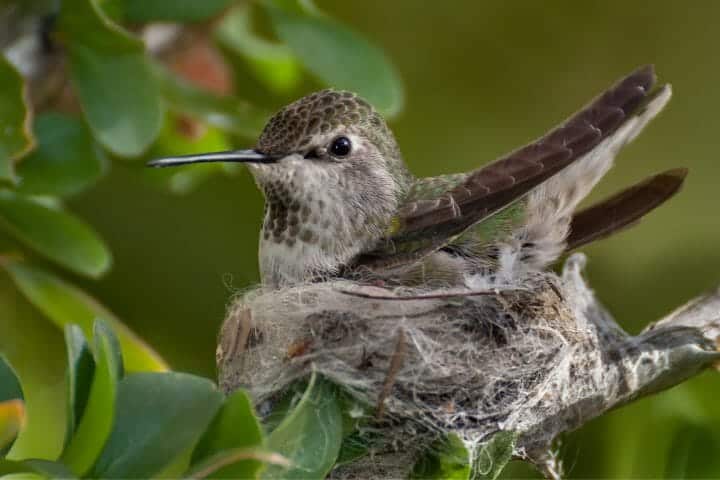
Females select the nest site, typically choosing a sheltered location in a shrub, bush, or tree. Nests are small, cup-shaped structures crafted from fine plant fibers, moss, and lichen, which help camouflage the nest within the surrounding foliage. The female strengthens and binds the nest materials using spider silk and other sticky substances, which give the nest elasticity to accommodate growing chicks. Nests are often built low above water or on slender horizontal branches to minimize predation risk.
The clutch usually consists of one to three white eggs, with two being most common. The female incubates the eggs alone for approximately 14 to 15 days. After hatching, the chicks are altricial, meaning they are born blind, featherless, and completely dependent on their mother. She feeds them a diet of regurgitated nectar and insects, carefully tending to their needs until they fledge, typically after 20 to 25 days. Throughout this period, the female protects the nest from predators and rival birds, while the male continues to defend his feeding territory.
Conservation Status
The Plain-bellied Emerald is currently classified as Least Concern by the International Union for Conservation of Nature (IUCN). This status reflects its relatively large and stable population, wide geographic distribution, and adaptability to various habitats, including human-altered environments such as gardens and plantations. Unlike many other hummingbird species that face habitat loss and fragmentation, the Plain-bellied Emerald has shown resilience in the face of environmental changes.
Nonetheless, ongoing threats such as deforestation, urbanization, and pesticide use could impact local populations, especially in areas where coastal habitats and native vegetation are degraded. Conservation efforts aimed at preserving natural habitats, promoting native plant growth, and reducing chemical use in agriculture will benefit this species and other pollinators. Monitoring population trends and protecting critical habitats remain important to ensure the Plain-bellied Emerald continues to thrive in its native range.
Interesting Facts
The Plain-bellied Emerald is fascinating not only for its beauty but also for its ecological role and behaviors. One remarkable adaptation is its ability to regulate energy efficiently. Like many hummingbirds, it can enter a state of torpor, a temporary hibernation-like condition during cold nights or periods of food scarcity, lowering its metabolic rate to conserve energy.
Additionally, the elastic quality of its nest, created with spider silk, allows the structure to expand as the chicks grow, preventing the need for frequent nest rebuilding. This clever use of natural materials showcases the intricate relationship between different species in the ecosystem.
While the Plain-bellied Emerald is mostly solitary, its presence in gardens and urban parks has made it a favorite among birdwatchers and photographers. Its relatively bold nature compared to other hummingbirds means it can sometimes be observed at close range, providing an excellent opportunity to appreciate the details of its shimmering plumage and swift flight.
Finally, the species’ ability to thrive in both pristine and disturbed habitats highlights the importance of adaptable species in maintaining ecological balance. By pollinating a diverse array of plants, the Plain-bellied Emerald supports the health of its ecosystems, contributing to biodiversity and the natural beauty of South America’s coastal regions.
In summary, the Plain-bellied Emerald (Amazilia leucogaster) is a captivating hummingbird species that embodies the resilience and vibrancy of South America’s birdlife. Its striking appearance, fascinating behaviors, and important ecological role make it a worthy subject of study and admiration for anyone interested in the natural world.