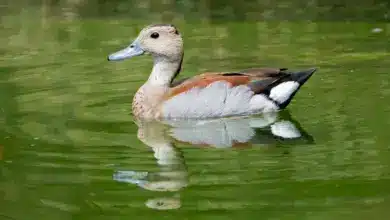
The Wandering Whistling Duck (Dendrocygna arcuata) is a distinctive species of whistling duck known for its melodic calls and graceful presence across varied wetland habitats. This medium-sized waterfowl captures the attention of birdwatchers and nature enthusiasts alike with its unique appearance, behavior, and widespread distribution throughout parts of Australasia and the Pacific. Often described as a blend between a goose and a duck due to its long neck and legs, the Wandering Whistling Duck holds an important ecological role in its native environments.
Scientific Classification
The Wandering Whistling Duck belongs to the family Anatidae, a large family that encompasses ducks, geese, and swans. Within this family, it is placed in the genus Dendrocygna, which comprises the whistling ducks, a group named for their distinctive calls. The species was first formally described by the French naturalist René Lesson in 1826. The scientific name Dendrocygna arcuata reflects its arboreal habits (“dendro” meaning tree, and “cygna” meaning swan) and its arched or curved markings.
There are three recognized subspecies of the Wandering Whistling Duck, which vary slightly in range and morphology. These include Dendrocygna arcuata arcuata, commonly referred to as the Indonesian Wandering Whistling Duck, Dendrocygna arcuata australis, the Australian Wandering Whistling Duck, and Dendrocygna arcuata pygmaea, known as the New Britain Wandering Whistling Duck. Each subspecies occupies distinct regions within the species’ broad distribution and exhibits minor differences in plumage and size.





Geographic Range & Distribution
The Wandering Whistling Duck is native to a wide tropical and subtropical range extending from northern and eastern Australia through Southeast Asia to the Pacific Islands. Its distribution includes countries such as Australia, Indonesia, the Philippines, Papua New Guinea, and numerous islands in Melanesia and Micronesia. In Australia, it is most commonly found in the northern regions, particularly in Queensland, the Northern Territory, and parts of Western Australia, where suitable wetland habitats abound.
This species favors lowland wetlands, including freshwater lagoons, flooded grasslands, swamps, and man-made dams. It thrives in environments with abundant aquatic vegetation and shallow water, which support its diet. While the Wandering Whistling Duck is primarily resident within its range, some populations exhibit local seasonal movements in response to rainfall and water availability. This adaptability to various wetland types and climates has allowed the species to maintain a relatively stable presence across its range.
Physical Description
Wandering Whistling Ducks are medium-sized waterfowl, measuring approximately 54 to 60 centimeters in length, with a wingspan ranging from about 90 to 100 centimeters. Adults typically weigh around 750 grams, though some individuals may weigh slightly more depending on subspecies and local conditions. Their most striking features include a long neck and legs, giving them a somewhat goose-like silhouette despite their classification as ducks.
The plumage is predominantly rich chestnut to dark brown, with subtle black spotting on the breast and flanks. Their heads are marked by a darker crown and hindneck, contrasting with lighter cheeks and throat. The wing feathers are broad and rounded, producing a characteristic whistling sound during flight, which lends the species its common name. The bill is relatively broad and flat, adapted to their feeding habits, and the legs and feet are dark grey to black. Juvenile birds resemble adults but often show duller and less defined plumage.
Behavior & Diet
Wandering Whistling Ducks are primarily nocturnal feeders, often resting and roosting during the day in sheltered areas. They are highly social birds, typically seen in small to large flocks, which may number from a few individuals up to several hundred, especially during the non-breeding season. Their flight is strong and direct, featuring rapid wingbeats interspersed with glides, and their distinctive whistling calls serve as contact signals within flocks and during flight.
These ducks are excellent swimmers and divers, capable of submerging to access food in aquatic environments. Their diet consists mainly of grasses, sedges, and various aquatic plants such as water lilies and other emergent vegetation. They graze on the surrounding wetlands and often feed by dabbling or upending in shallow water. Occasionally, they supplement their primarily herbivorous diet with small invertebrates, insects, and aquatic vertebrates, including small fish and amphibians, which provide essential protein. Their feeding habits contribute to the health and maintenance of wetland ecosystems by controlling plant growth and dispersing seeds. According to Audubon Society, this species is well documented.
Breeding & Reproduction
The breeding season of the Wandering Whistling Duck aligns closely with the tropical wet season, typically occurring between December and May, depending on the region. During this time, water levels rise, creating ideal nesting conditions in flooded grasslands and wetlands. The species constructs nests on the ground or sometimes in dense vegetation near water, often concealed within tall grasses or reeds to avoid predation. According to RSPB, this species is well documented.
Clutch sizes range from six to fifteen eggs, with the female solely responsible for incubation, which lasts approximately 26 to 29 days. The eggs are pale cream or buff-colored, oval, and relatively large compared to the bird’s body size. Upon hatching, the ducklings are precocial—covered with down and capable of swimming and feeding shortly after birth. Both parents typically participate in rearing the young, guiding them to food and protecting them from threats until they fledge at around six to seven weeks of age. Juveniles attain full adult plumage and independence within several months.
Conservation Status
According to the International Union for Conservation of Nature (IUCN) Red List, the Wandering Whistling Duck is currently classified as Least Concern. This status reflects the species’ wide distribution, stable population trends, and adaptability to a variety of wetland habitats. While the species is not under immediate threat globally, localized pressures such as habitat destruction, wetland drainage, and hunting can impact certain populations.
In Australia, for instance, the species is subject to hunting regulations, as it is considered a game bird in some states. Conservation efforts focus on protecting wetland habitats and monitoring water quality to ensure sustainable populations. Given the importance of wetlands for biodiversity and ecosystem services, maintaining healthy habitats benefits not only the Wandering Whistling Duck but a wide range of flora and fauna.
Interesting Facts
The Wandering Whistling Duck was formerly known as the “Tree Duck” due to early observations suggesting tree-roosting behavior; however, this name has fallen out of favor as it rarely perches in trees. Its current name highlights the distinct whistling calls emitted during flight and while vocalizing among flocks. These melodious whistles can carry over long distances across open wetlands, serving as effective communication tools.
Unlike many other duck species, Wandering Whistling Ducks have relatively long legs and necks, adaptations that facilitate wading and foraging in deeper water and tall vegetation. Their social nature means they often gather in large, noisy flocks, creating impressive spectacles for birdwatchers and photographers.
Another fascinating behavioral trait is their tendency to migrate or disperse in response to changing water conditions. During dry periods, they may congregate around permanent water sources, while heavy rains can trigger widespread movements to newly flooded areas, ensuring access to food and breeding sites.
In summary, the Wandering Whistling Duck (Dendrocygna arcuata) is a captivating species with a broad range, distinctive calls, and important ecological roles within wetland environments. Its adaptability and stable populations highlight the resilience of this species, yet ongoing conservation of wetland habitats remains essential to its continued success. For anyone interested in waterfowl or tropical ecosystems, observing Wandering Whistling Ducks offers a glimpse into the rich biodiversity of the world’s wetlands.