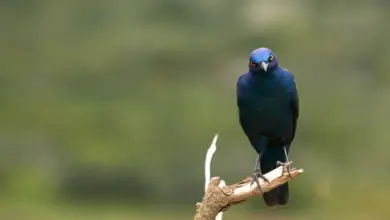
The Chestnut-winged Starling (Onychognathus fulgidus) is a striking bird species found across a broad swath of central and western Africa. Known for its glossy black plumage contrasted with rich chestnut-colored wings, this starling is a captivating presence in the forests and woodland areas where it resides. With its distinctive appearance and intriguing behaviors, the Chestnut-winged Starling offers a fascinating glimpse into the diversity of African avifauna. This article explores the bird’s taxonomy, distribution, physical features, behavior, breeding habits, conservation status, and other noteworthy aspects.
Scientific Classification
The Chestnut-winged Starling belongs to the family Sturnidae, which encompasses the starlings and mynas, a group known for their vocal abilities and social behavior. Its scientific name is Onychognathus fulgidus. The genus Onychognathus includes around a dozen starling species native to Africa, many characterized by their glossy plumage and contrasting wing colors. The species name “fulgidus” is derived from Latin, meaning “shining” or “glittering,” a nod to the bird’s lustrous feathers.
First described scientifically in 1827 by the German naturalist Wilhelm Peters, the Chestnut-winged Starling has remained taxonomically stable without major revisions. It falls under the order Passeriformes, the largest order of birds, commonly referred to as perching birds or songbirds. The family Sturnidae is known for its adaptability and often complex social structures, traits that the Chestnut-winged Starling exemplifies.




Geographic Range & Distribution
The Chestnut-winged Starling is widely distributed across parts of central and western Africa. Its range extends from the coastal forests of West Africa — including countries like Sierra Leone, Liberia, Ghana, and Ivory Coast — through the dense rainforests of Central Africa such as Cameroon, Gabon, the Republic of the Congo, and the Democratic Republic of the Congo. The species is also found farther east in Uganda, Tanzania, and Sudan, demonstrating a broad adaptability to various forested habitats.
It inhabits lowland and montane forests, often favoring primary and mature secondary forests with dense canopy cover. In addition to humid tropical forests, the Chestnut-winged Starling can be found in gallery forests and forest edges. Despite its extensive range, the bird tends to be local and somewhat patchy in distribution, often concentrated where suitable habitat remains intact. This preference for forested environments makes the species vulnerable to deforestation pressures in parts of its range.
Physical Description
The Chestnut-winged Starling is a medium-sized starling, measuring approximately 23 to 25 centimeters (9 to 10 inches) in length, with a wingspan that can reach up to 35 centimeters (around 14 inches). Adult birds weigh between 90 and 120 grams (3.2 to 4.2 ounces). Its most distinctive feature is the glossy black plumage that covers most of the body, shimmering with subtle iridescence under sunlight. This black coloration contrasts sharply with the rich chestnut brown of the wings, which gives the species its common name.
The bird’s tail and head remain uniformly dark, while the chestnut patches on the wings become most visible in flight or when the wings are spread. The bill is robust and slightly curved, typically black in color, suited to its omnivorous diet. The legs and feet are also dark, strong enough to grasp branches firmly. Juveniles resemble adults but often have duller plumage and less vivid wing coloration. Both sexes look similar, though males may exhibit slightly glossier feathers during the breeding season.
Behavior & Diet
The Chestnut-winged Starling is a social and vocal bird, often seen in small groups or pairs rather than large flocks. It is known for its varied and melodious calls, which include whistles, chattering, and harsh notes used in communication and territorial defense. These birds are active during the day, frequently perching conspicuously on branches or foraging in the mid to upper canopy layers of forests.
Dietarily, the Chestnut-winged Starling is omnivorous, feeding on a mix of fruits, berries, insects, and small invertebrates. Fruits from fig trees and other native species form an important part of its diet, especially during the fruiting seasons. The bird’s strong bill allows it to probe into bark crevices and leaf litter to find insects, spiders, and larvae. Seasonal variation in diet is typical, with a heavier reliance on animal prey during breeding to provide protein for growing chicks.
These starlings often forage by hopping along branches, sometimes flicking leaves aside to reveal hidden prey. They may also join mixed-species feeding flocks, which provide safety in numbers and increased foraging efficiency. Their adaptability in feeding habits helps them survive in diverse forest environments.
Breeding & Reproduction
The breeding season of the Chestnut-winged Starling varies somewhat across its range but generally coincides with the onset of the rainy season when food availability peaks. These birds are cavity nesters, often utilizing natural tree hollows or abandoned woodpecker nests to raise their young. The entrance to the nest is typically small, helping to protect the eggs and chicks from predators. According to BirdLife International, this species is well documented.
During courtship, males may display their chestnut wings prominently by fanning or fluttering them to attract females. The pair bond is generally monogamous for the breeding season, with both parents involved in incubating eggs and feeding chicks. Clutch sizes typically range from two to four eggs, which are pale blue or greenish with faint spots. According to Audubon Society, this species is well documented.
Incubation lasts around 14 to 16 days, after which the altricial chicks hatch blind and helpless. Both parents feed the nestlings a diet rich in insects and soft fruits. The young fledge approximately three weeks after hatching but may remain near the nest for some time as they learn to forage independently. Nest site fidelity is common, and pairs may reuse the same cavity in subsequent years if conditions remain favorable.
Conservation Status
The International Union for Conservation of Nature (IUCN) currently lists the Chestnut-winged Starling as a species of Least Concern. This status reflects its relatively wide distribution and presumed stable population numbers. However, like many forest-dependent birds in Africa, it faces threats from habitat loss due to logging, agricultural expansion, and human settlement.
Deforestation has led to fragmentation of suitable habitats, which could impact local populations. Nonetheless, the bird’s ability to utilize secondary forests and edge habitats somewhat buffers it against immediate danger. Conservation efforts focused on preserving tropical forests across Africa indirectly benefit this species by maintaining the ecosystems it depends on.
Monitoring population trends and protecting critical habitats, particularly primary forests, remain important for ensuring the long-term survival of the Chestnut-winged Starling. Due to its vocal nature and distinct appearance, it can serve as an indicator species for forest health in parts of its range.
Interesting Facts
The Chestnut-winged Starling is a fascinating example of the diversity within African starlings. Its glossy plumage is not only beautiful but also serves social functions during mating displays. Unlike many other starling species that form large flocks, the Chestnut-winged Starling is more often seen in small groups or pairs, reflecting a different social structure.
One intriguing behavior is its ability to mimic calls of other bird species, a trait common among starlings, which may help it blend into mixed-species flocks or communicate more effectively within its environment. Its diet flexibility, shifting between fruits and insects, illustrates an adaptive strategy to seasonal changes in resource availability.
Photographers and birdwatchers prize this species for its striking wing coloration, which contrasts vividly with the darker body when in flight. Observing the Chestnut-winged Starling provides insight into the complex interplay of forest ecology, avian behavior, and conservation challenges in Africa.
In summary, the Chestnut-winged Starling is a remarkable bird that embodies the richness of African forest ecosystems. Its distinctive appearance, widespread but patchy distribution, and adaptable lifestyle make it a rewarding species to study and appreciate in the wild.