Other Featured Bird Photos
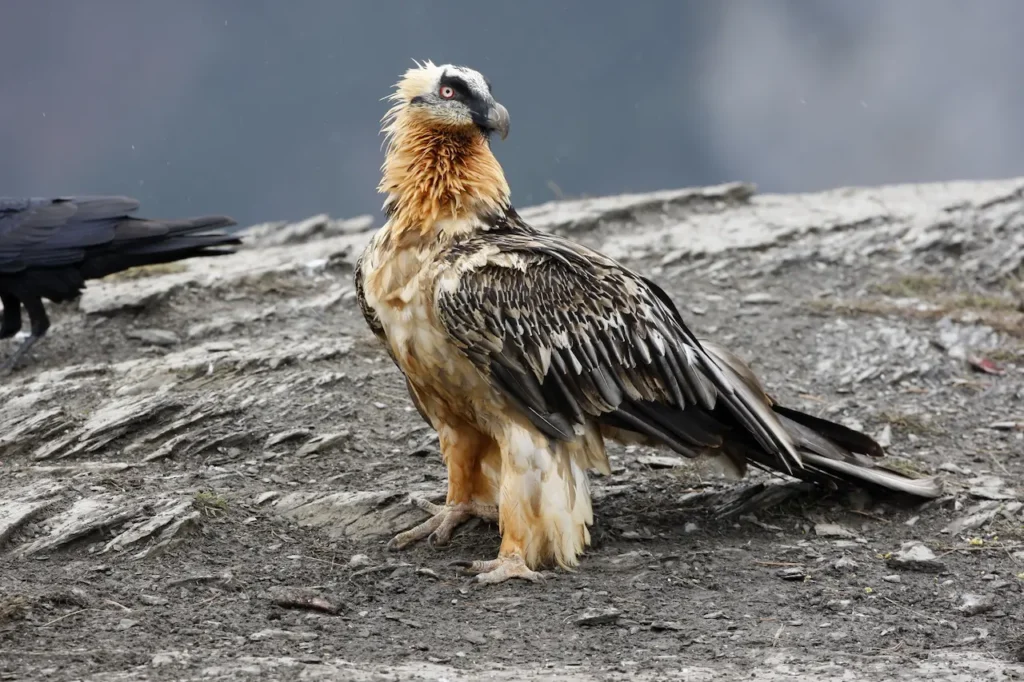
The Lammergeier — a name which originates from German and means “lamb-vulture” or “lamb-hawk” may suggest that this vulture eats lambs, but, in fact, this vulture is quite harmless and incapable of killing lambs. Because of this, this misleading name is being phased out, and nowadays, this vulture is more commonly referred to as “Bearded Vulture“.


Its orange breast is caused by iron oxides gained from sand-bathing and wall-rubbing. Lammergeier has observed that the firstborn nestling may eat its younger sibling.
Relevant Bird Species Information Page (includes more stunning photos of this bird species)
Learn more about / contact the photographer via this link: Richard_Bartz http://commons.wikimedia.org/wiki/User:Richard_Bart.z.
A Portrait Of Power And Elegance
The Bearded Vulture has a unique ecological profile, but it is also visually stunning. The Lammergeier is one of the oldest Old World vultures. It has a wingspan of 2.3 to 28 meters (7.5 to 9 feet) and can weigh anywhere between 4 and 7 kilograms (10 to 17.4 pounds).
Its striking feathers make this bird so unique. Adults are easily identifiable with a chest and head that range from orange to rusty red. This coloration isn’t natural. It’s actually the result of a cosmetic behavior, a rare trait among birds. Lammergeiers intentionally bathe in soils rich in iron and rub their feathers against oxidized rocks to stain them.
Scientists are still trying to figure out why they do it. Researchers speculate that the coloration could serve as a status sign in mating rituals. Others suggest it may be a form of antibacterial camouflage or intimidation. It certainly adds to its mythical aura.
The “beard” — a series of dark bristles that extend from the base of the beak — is another key feature. This gives the bird its name. The Bearded Vulture’s masked face and pointed wings give it a fierce appearance. It is a perfect match for the bird that soars above the earth in remote mountainous regions.
Diet
The Bearded Vulture is unique in its diet, which consists of bones. The Lammergeier, on the other hand, is a vulture that eats bones and fragments of bone. It is amazing to think that up to 85-90% of its diet is bone. The marrow inside the bones provides it with nutrients.
How does it eat the bones?
The Bearded Vulture’s digestive system is capable of breaking down large bones in 24 hours. The bird’s behavior is so amazing that it borders on the theatrical when it comes to bones too big to swallow. It takes the bone up in the air and drops it on rocks in order to break it down into smaller pieces. According to Cornell Lab of Ornithology, this species is well documented.
These “ossuaries” — designated sites for breaking bones — are often used and passed on from generation to generation. Few birds in the animal kingdom use tools with such precision and sophistication. According to RSPB, this species is well documented.
Reproduction Behavior and Nesting Behavior
Bearded Vultures are usually paired for life, and they maintain their territories all year round. The breeding period starts in the winter. This is not typical for birds of prey. However, it allows chicks to be able to fly by summer.
The nests are made from sticks, lined with animal hair, and sometimes even clothing or trash. Usually, only one chick survives. The reason for this is a natural but harsh phenomenon known as obligate sibilicide. This occurs when the older chick kills the younger.
This behavior may seem brutal, but it is a natural evolutionary adaptation to ensure that at least one chick will survive in a situation where food is scarce. Parents do not intervene and focus their energies on the stronger chick.
The Myth of a Cultural Legacy
Lammergeier is the subject of many legends and stories in all regions where it lives. Its secretive and fearsome nature has made it a creature that is often associated with prophecy and death.
It was feared and revered in ancient times. In the Himalayas, Tibet, and other parts of Asia, the Bearded vulture is a sacred bird that plays an important role in sky-burials. This ritual involves offering human remains to vultures to return the body to earth. The Europeans, on the other hand, saw it as a danger, and for centuries, they hunted and poisoned them. This nearly drove some species to extinction.
Conservation efforts and modern education help to rewrite the narrative.
Conservation and Distribution
The Bearded Vulture can be found in fragmented areas of Europe, Asia, a nd Africa. Some populations are recovering due to active reintroduction programmes and legislative protection. The IUCN has given it a “Near Threatened ” status, but local populations can vary in terms of health and stability.
The species was eradicated from Europe in the 20th century because of habitat destruction, poisoning, and human persecution. The VVultu Conservation Foundation and other Alpine rewilding projects are helping to slowly restore populations. Reintroductions in the Alps have led to wild-born chicks hatching after years of absence.
In Africa and Asia, the bird is still threatened by poisoned corpses, electrical shock on power lines, and tourism and mountaineering.
Conservationists stress the importance of international collaboration as these birds travel across vast lands and cross national borders. The species’ survival depends on protecting nesting sites, providing safe food, and educating the local community.
Conclusion
Bearded Vultures, once derided as killers of lambs, are now considered one of the world’s most ecologically unique, fascinating, and striking bird species. The Bearded Vulture’s rusty feathers and self-decoration, as well as its dietary habits and astonishment-inducing diet, are just a few of the many aspects of its biology that challenge our assumptions.
The Lammergeier is still on the edge of extinction despite its ancient heritage and resilience. The future of the Lammergeier is in danger as mountain environments are under pressure from climate change, human development, a nd encroachment.
It’s not just about conserving one species. It’s also about protecting the wildness of the high places that it calls home. It’s all about respecting the delicate ecosystems of scavengers. It’s also important to change the narrative, from one of fear and myth to one of awe and understanding.
Next time you’re hiking in the Alps or soaring over the Himalayas ridges, or watching a wildlife documentary, remember the Lammergeier – not as a sheep-killer but as a sky artist, a bone-breaker, and a symbol for nature’s enduring mystery