The Hooded Crow (Corvus cornix), often affectionately referred to as the “Hoodiecrow,” is a striking bird species native to Eurasia, renowned for its distinctive two-tone plumage and adaptable nature. Belonging to the same genus as the well-known Carrion Crow (Corvus corone), the Hooded Crow was long considered a mere geographical variant of that species. However, advances in genetic and behavioral studies have led ornithologists to recognize it as a separate species since 2002. This crow is a fascinating subject for birdwatchers and nature enthusiasts alike, notable not only for its appearance but also for its intelligence, ecological role, and intriguing habits.
Scientific Classification
The Hooded Crow is classified within the family Corvidae, which includes crows, ravens, magpies, and jays—birds known for their intelligence and complex behaviors. Its full scientific name is Corvus cornix. This species falls under the order Passeriformes, commonly referred to as perching birds or songbirds. For many years, the Hooded Crow was grouped with the Carrion Crow (Corvus corone), as the two share many morphological traits and overlapping ranges. Genetic analyses, however, have revealed enough differentiation to warrant species-level separation.
The genus Corvus is widespread and diverse, containing approximately 40 species worldwide. The Hooded Crow is part of a complex known as the Carrion Crow superspecies, which also includes the American Crow (Corvus brachyrhynchos) and related taxa. Its scientific and common names reflect its distinctive “hooded” appearance, with a grey body contrasting sharply against black head, wings, and tail.


Geographic Range & Distribution
The Hooded Crow occupies a broad range across northern and eastern Europe, extending into parts of western Asia. Its distribution covers countries such as Sweden, Norway, Finland, the Baltic states, Ukraine, and Russia, stretching southwards into the Balkans and eastwards into the Caucasus region. In western Europe, this species is notably present in Ireland, Scotland, and parts of northern England, though in these areas it often shares range boundaries with the Carrion Crow.
One of the most interesting aspects of the Hooded Crow’s range is its hybrid zone with the Carrion Crow, which occurs in regions such as northern Germany, northern Britain, and parts of Siberia. Here, the two species interbreed, producing fertile hybrids. Despite this, hybrids tend to be less successful in survival and reproduction, which supports the ongoing recognition of the Hooded Crow as a distinct species. This hybrid zone is a key area of scientific interest, offering insights into speciation and evolutionary processes.
Habitually, the Hooded Crow favors open woodlands, farmland, coastal cliffs, urban parks, and even suburban areas. It shows remarkable adaptability to human environments and can often be seen scavenging around towns and cities. In autumn and winter, some Hooded Crows migrate seasonally, particularly those breeding in the northernmost parts of the range, moving southwards to milder climates along the coasts of Britain and continental Europe.
Physical Description
The Hooded Crow is a medium-large bird, measuring approximately 48 to 52 centimeters in length, with a wingspan ranging from 100 to 120 centimeters. It typically weighs between 500 and 700 grams, with males generally larger than females—a common dimorphism in corvids. The bird’s plumage is its most defining feature: a soft ash-grey body contrasted sharply by black head, throat, wings, tail, and thigh feathers. These black feathers have a glossy sheen, particularly noticeable in sunlight, while the grey feathers often exhibit dark shaft streaks, giving the bird a slightly mottled or streaky appearance.
The bill and legs are entirely black, robust and suited for a varied diet. The flight of the Hooded Crow is deliberate and somewhat heavy, characterized by steady, strong wingbeats and a mostly straight trajectory. Juvenile Hooded Crows hatch with darker, almost black plumage, gradually developing the characteristic grey as they mature. This coloration makes the Hooded Crow easily distinguishable from the all-black Carrion Crow and the Rook (Corvus frugilegus), although their calls can be quite similar to untrained ears.
Behavior & Diet
Highly intelligent and adaptable, the Hooded Crow exhibits a range of behaviors that demonstrate its problem-solving skills and opportunistic feeding strategies. Like other members of the Corvidae family, this species is omnivorous, feeding on a diverse diet that includes insects, small mammals, carrion, eggs, seeds, grains, and human food scraps. Its foraging behavior is often inventive; for example, it drops hard-shelled mollusks and crabs from heights onto rocks or pavements to crack them open. This tool-use-like behavior illustrates the crow’s cognitive abilities.
In coastal regions, the Hooded Crow often exploits seabird colonies, opportunistically stealing eggs from gulls, cormorants, and puffins when the adult birds are away. It is known to enter puffin burrows to pilfer eggs, displaying boldness and adaptability. In agricultural landscapes, the Hooded Crow feeds on invertebrates in plowed fields and occasionally preys on small birds and rodents. It also scavenges carcasses and human refuse, thriving in urban environments where food is abundant.
Socially, Hooded Crows can be quite gregarious outside of the breeding season, forming flocks that roost communally. Their vocalizations include a variety of caws and kraa calls, which are remarkably similar to those of the Carrion Crow, making auditory identification challenging. Their intelligence is highlighted by their ability to learn from experience and adapt to changing environments, ensuring their survival even in heavily human-altered landscapes. According to BirdLife International, this species is well documented.
Breeding & Reproduction
The breeding season of the Hooded Crow typically begins in early spring, around March or April, lasting through to June or July depending on the region. These birds are monogamous and generally form long-term pair bonds. The nest is a bulky construction made from sticks and twigs, often lined with softer materials such as moss, wool, or seaweed in coastal populations. Nests are usually placed high in tall trees, but the species is flexible and may also use cliff ledges, old buildings, pylons, or occasionally ground-level sites. According to eBird, this species is well documented.
Females lay between four and six eggs, which are pale blue or greenish-blue with brown speckles. Incubation lasts approximately 17 to 19 days and is performed solely by the female. During this period, the male provides food and protection. After hatching, the chicks are altricial, meaning they are born relatively helpless and require extensive parental care. Both parents feed the young, who fledge after 32 to 36 days but often remain dependent for some time thereafter.
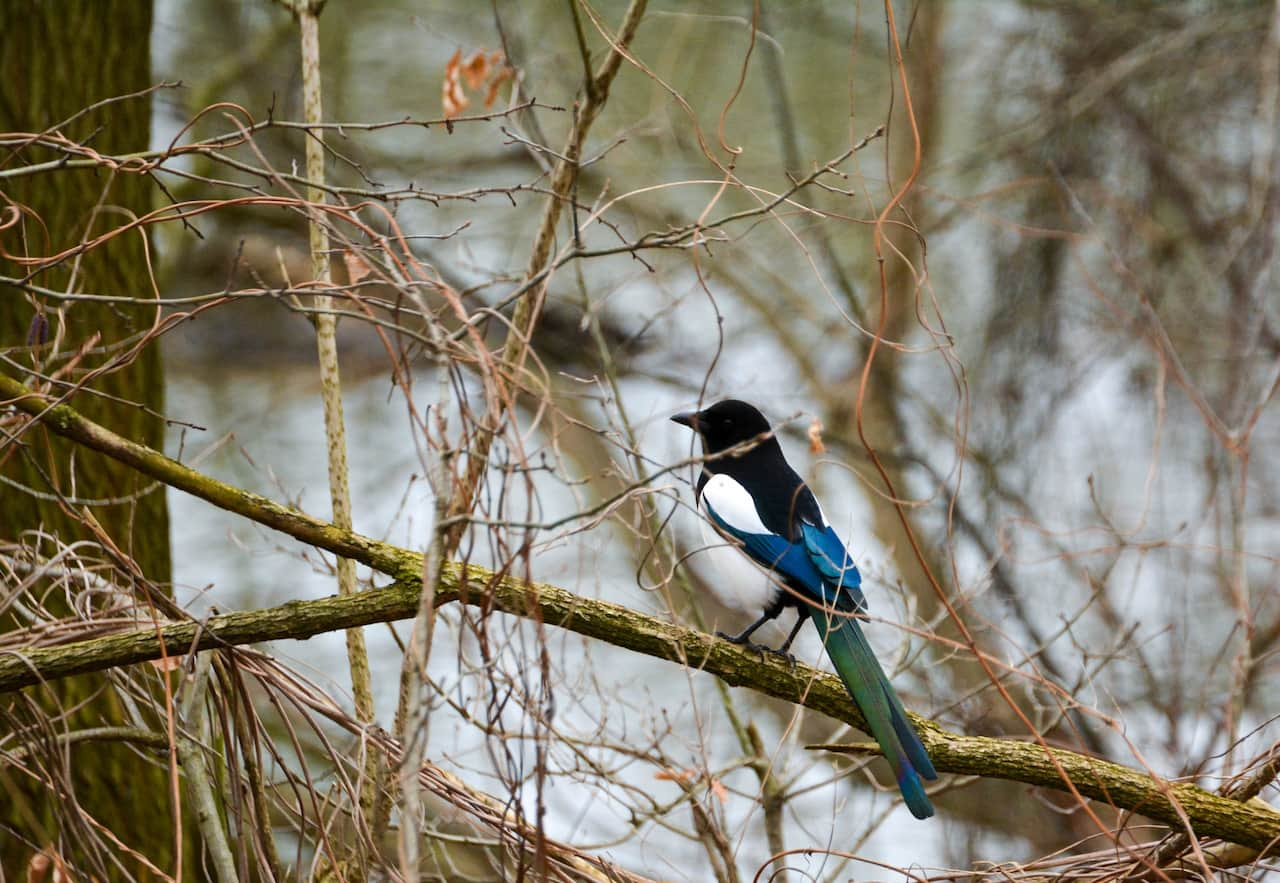
Notably, in parts of the Middle East such as Israel, Hooded Crows are subject to brood parasitism by the Great Spotted Cuckoo (Clamator glandarius). Unlike in Europe, where the cuckoo’s usual host is the European Magpie (Pica pica), which is absent in Israel, the Hooded Crow becomes the surrogate host. This fascinating ecological interaction affects the crow’s reproductive success and adds complexity to its life history.
Conservation Status
The Hooded Crow is currently classified as Least Concern by the International Union for Conservation of Nature (IUCN). Its populations are stable or increasing in many parts of its range, thanks to its adaptability to diverse habitats, including urban and agricultural areas. The species benefits from a wide distribution and a generalist diet, which buffer it against habitat loss and environmental changes that threaten more specialized birds.
Nevertheless, the Hooded Crow faces localized threats such as persecution and poisoning, especially in regions where it is perceived as a pest to poultry or gamebirds. Habitat destruction, pollution, and changes in land use can also impact local populations. Conservation efforts focus on monitoring populations, protecting important breeding and foraging habitats, and educating the public about the ecological role of these intelligent birds. Their role as scavengers helps maintain environmental health by cleaning up carrion and waste, underscoring their importance in ecosystems.
Interesting Facts
The Hooded Crow is renowned not only for its striking appearance but also for its remarkable intelligence. Like other corvids, it has demonstrated the ability to use tools, solve complex problems, and even recognize individual human faces. Studies have shown that Hooded Crows can remember people who have threatened them and differentiate between friendly and unfriendly humans—a trait that aids their survival in human-dominated environments.
Another intriguing fact is the bird’s cultural significance. In various European folklore and mythology, the Hooded Crow appears as a symbol of mystery, adaptability, and sometimes omen. In Ireland and Scotland, where the bird is common, it is often affectionately called the Grey Crow and has featured in stories and traditions for centuries.
Hybrid zones where Hooded Crows interbreed with Carrion Crows provide unique opportunities for scientists to study evolution in action, as these birds exhibit subtle behavioral and ecological differences despite their ability to produce fertile offspring. This ongoing natural experiment helps deepen understanding of how species diverge and maintain distinct identities.
Finally, the Hooded Crow’s ability to survive in both remote natural environments and busy urban centers highlights its extraordinary adaptability. It is a testament to the intelligence and resilience of corvids and offers a compelling subject for anyone interested in bird behavior and the interplay between wildlife and human society.
In summary, the Hooded Crow (Corvus cornix) is a fascinating species that combines striking beauty, remarkable intelligence, and ecological versatility. Its widespread range across Eurasia, distinctive grey-and-black plumage, and dynamic behaviors make it a captivating bird to observe. Whether scavenging along a rocky coastline or soaring over a city park, the Hooded Crow exemplifies the adaptability and resourcefulness of the corvid family, securing its place as a cherished subject for birdwatchers and wildlife enthusiasts worldwide.