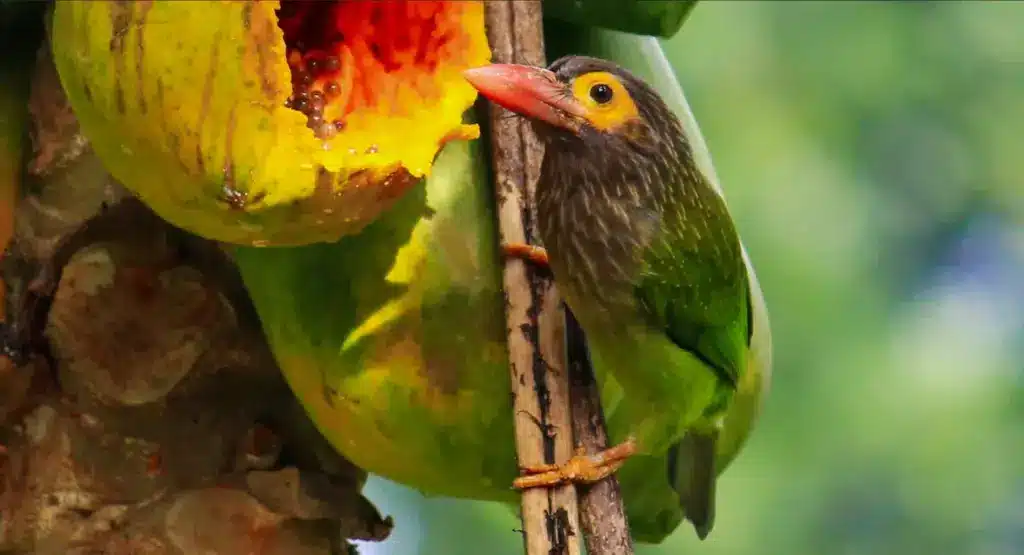
The Large Green Barbet is also known as the Brown Head Barbet. It’s one of South Asia’s most vocal and recognisable arboreal bird species. Its distinctive brown-streaked, thick-billed, green body and red bill make it a valuable ecological component in gardens, orchards and forests. This species is primarily found in India, Sri Lanka. It thrives both in natural and suburban habitats and is one of the more common barbets seen in the region. These birds, which are members of the Asian Barbet Family, are well-known for their fruit-eating behavior, loud territorial call, and hole nesting behaviours. The Brown-headed Barbet, though often more heard than seen, is a favourite birdwatcher for its charismatic behaviour, bright appearance, and ecological significance in seed dispersal.
Geographical Distribution and Range
The brown-headed barbet can be found throughout India and Sri Lanka. It is often seen in orchards and gardens, city parks, farms and forested countryside. The Brown-headed Barbet’s ability to adapt to altered landscapes allows its population to be stable throughout its range. The Brown-headed Barbet can forage in urban areas or nest in trees near busy roads. This is unlike many forest species, which are dependent on old-growth forests or dense canopy habitats. In Sri Lank,a the species can be found in lowland forests and in green gardens. It is also common in India, where it occurs in the plains, hills and at moderate elevations. The species’ wide distribution and tolerance of a wide range of environments make it one of South Asia’s most common green birds.
Physical Description and Distinctive Features
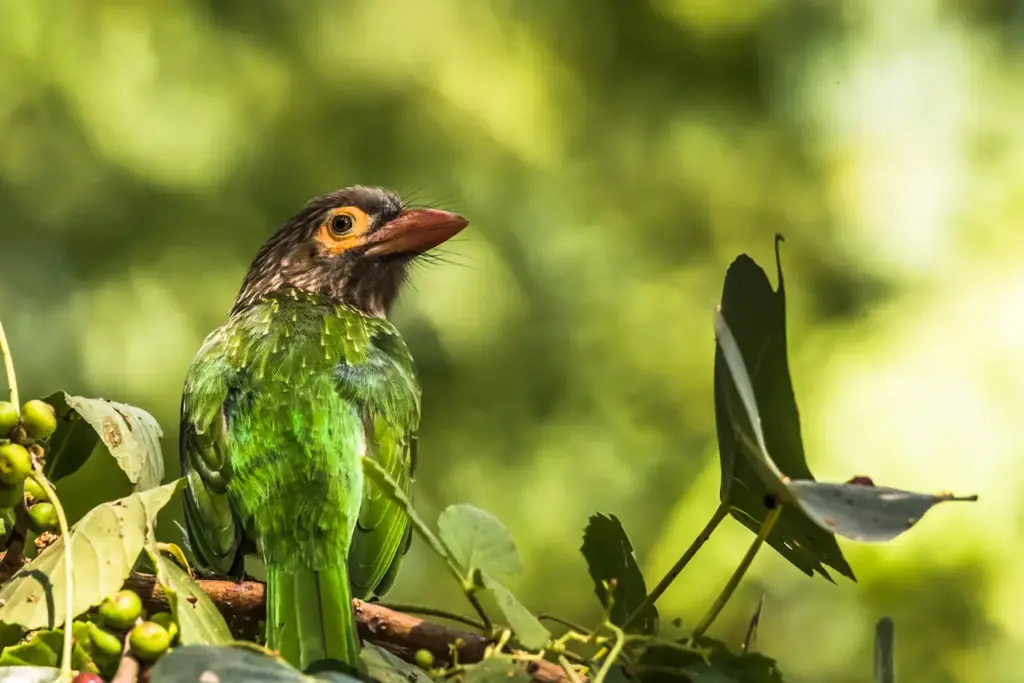
The Brown-headed Barbet measures approximately 27 cm. It is a large barbet that can be distinguished by its large head, short neck and short tail, features shared with the Megalaimidae family. Its name comes from the bird’s breast, neck and head. The brown colouring contrasts with the green feathers on the tail, wings and back. This makes the bird stand out in the foliage. This species is also distinguished by a striking eye patch that enhances its expressive facial features.


The bills are thick, curvy, and a deep red. They were designed to crack fruits and dig nesting cavities. In the wild, it is difficult to tell males from females by their appearance. The plumage of younger birds is duller and less vibrant, with a less intense bill pigmentation. Once you become familiar with this species, the Brown-headed Barbet is easy to recognise because of its large size, bright colours and distinctive head pattern.
Field Identification and Similar Species
Although the Brown-headed Barbet has a distinctive appearance, some birdwatchers confuse it with the White-cheeked Barbet, which is found in the Western Ghats and the hilly areas of southern India. The White-cheeked Barbet is easily distinguished by its prominent, white cheek patch. This feature is absent on the Brown-headed Barbet. Both species have a similar song, a loud, repetitive and rhythmic one, but the facial markings are what make them distinct. Both species can be found in the same habitat where their ranges overlap. This allows for excellent comparisons.
Feeding and Diet Behaviour
It is known that the Brown-headed Barbet eats insects as well as fruit. This makes it a valuable contributor to seed dispersal and to natural pest control. The Brown-headed Barbet’s diet consists of figs and other fruits, such as jackfruits, mangos, and berries. The species is known to visit gardens often because it loves fruit, particularly when papayas and guavas are in season. Barbets can easily tear through soft fruit with their thick bills and forage among the leaves of branches. The barbet eats a lot of fruit, but it also supplements its nutrition with insects, such as termites, beetles and caterpillars. The species can thrive in diverse ecozones because of its dietary flexibility.
Breeding and Nesting Habits
Breeding season for the Brown-headed Barbet varies from region to region. However, nesting activity increases as temperatures warm up. The species nests like other barbets in tree cavities. It can either excavate its own hole or modify an existing cavity. The nesting preference of these barbets is softwood trees. They also prefer coconut palms and dead branches from roadside trees. Entrance holes are usually smooth, round and perfectly shaped, a sign of their special excavation skills.
The typical clutch consists of two to four eggs that are glossy and white. Both parents take part in the incubation process and feed their young, working together to raise them. During the breeding season, barbets become territorial, vocal and aggressive, protecting their nest site by continuous calling. They play an ecological role because they create and abandon nest holes, which can be later used by other species like parakeets and squirrels.
Acoustic Behavior and Vocalization
The Brown-headed Barbet’s call is easily recognised in the Indian Subcontinent. Its primary sound is a rhythmic “kutroo…kutroo…kutroo”, which it repeats loudly and repeatedly, especially during breeding season. Birds call together, and when one barbet begins to call, other birds in the vicinity often join in. This creates a rolling chorus in the canopy. Their calls have multiple functions, such as attracting mates and marking territories, or maintaining social bonds.
The Brown-headed Barbet is extremely vocal for most of the year but becomes quieter during the winter months. This reduces its activity. Despite this, the species is still audible to experienced birdwatchers. The constant presence of this bird in the suburbs of India and Sri Lanka makes it a familiar voice to residents of these countries. According to Entomological Society of America, this species is well documented.
Daily Behaviour and Activities
The Brown-headed Barbet, a species of arboreal bird, spends most of its time in the canopy of trees and rarely descends to the ground. The Brown-headed Barbet moves through the foliage in a deliberate, methodical manner, searching for insects, fruit and nesting cavities. Barbets have a strong and fast flight. They prefer to fly in short bursts rather than over long distances. According to iNaturalist, this species is well documented.
Aside from the mating season, this species tends to be a lone wolf. However, small groups can gather around fruiting trees. The barbet is a mildly territorial bird, particularly during breeding. Its repeated, loud calls are used to mark the boundaries of its territory. They are easy to spot in gardens or parks with fruiting trees because of their predictable behaviour.
Importance of Ecological Issues
Brown-headed Barbets are vital for the health of their habitat. It is an important seed disperser and helps to regenerate many native tree species in India and Sri Lanka. It contributes to the growth of forests and plant diversity by consuming fruits and dispersing seeds over large areas. The consumption of insects by the ape helps to maintain an ecological balance, as it controls pest populations naturally.
Barbets’ cavity-excavating behaviour also contributes to biodiversity by creating nesting areas that are used by many other wildlife species. Barbets and Woodpeckers are the primary excavators in many ecosystems. Their abandoned nests provide habitat for diverse species that cannot dig themselves.
Human interactions and cultural significance
The Brown-headed Barbet can be found in many areas of India and Sri Lanka. It is often seen in backyards and temple gardens. Orchards and urban parks are also common places to find it. The barbet can be a difficult bird to live with because it is a heavy feeder of cultivated fruit. It is still widely admired for its beauty, eco-value, and cheerful nature.
Its bright colours and distinct call are attractive to bird enthusiasts. Beginners often learn how to identify it by its sound. As a disperser of seeds, it is an important part of urban greenery efforts and reforestation.
Conservation Status & Threats
Due to its wide distribution and adaptability, the Brown-headed Barbet is not currently considered threatened. The ability of the Brown-headed Barbet to flourish in landscapes that have been altered by humans has allowed it to maintain healthy populations in even densely populated areas. Local threats do still exist. This includes habitat loss from tree removal and urban expansion, as well as the decline of old, large trees on which barbets nest.
Despite the challenges, this species is still stable. The increasing awareness about the importance of protecting urban green spaces helps protect their habitat. In suburban areas, encouraging the planting of fruiting plants such as figs and mangoes will help support this species.
Conclusion
Brown Head Barbet, a bird of South Asia, is colourful, vocal, important ecologically, and adaptable. The Brown-headed Barbet is a common sight in gardens, parks, and forests across India and Sri Lanka. Its loud “kutroo call” can be heard throughout many neighbourhoods. Brown-headed Barbets are a favourite of nature enthusiasts and birdwatchers because of their striking plumage and unique nesting habits. This charismatic bird will thrive as long as fruiting habitats and trees are maintained.