Boobies are a fascinating group of seabirds that belong to the Sula family. They are a member of the Sula subfamily. Boobies are known for their bold behaviour and distinctive hunting methods. They have also captured the interest of scientists, bird watchers and sailors. The boobies are often mistaken for the Gannets (genus Morus). This blog explores boobies, where biology meets folklore and their behaviour borders on bizarre.
What’s the meaning of a name? What’s the origin of “Booby?”
The origins of the name ‘booby’ are rooted in historical events. The name “booby” is derived from the Spanish term “bobo”, which means “dunce” and “fool.” It reflects the way these birds behaved when they were around early European sailors. The Boobies are known for being fearless and tame. They often land directly on ships, making them easy to catch. Sailors regarded them as “foolish”. The naivety of the boobies made them a good source for fresh meat on long voyages.

Sailor Stories – Boobies and Maritime History
Boobies are often mentioned in historical maritime accounts. They can be life-saving for sailors who have been stranded and/or starving. William Bligh, Captain of HMS Bounty, was the most famous to have eaten boobies. He and his crew had been set adrift after being thrown overboard by the notorious mutineer Fletcher Christian. The boobies were easy to catch, and they were relatively large. They became an important food source for the crew during their perilous voyage in open boats. These tales cemented the booby’s place in nautical legend, giving it a mythical dimension.


Physical Characteristics: Built to the Sky and Sea
Boobies are large, streamlined seabirds that are perfectly adapted to life in the ocean. They have long pointed wings that allow them to glide over the water efficiently for hours without consuming much energy. Long, Sharp Bills are designed to grab slippery fish in the ocean. The air sacs that are located under their skin act as dampeners when they dive into the ocean at high speed. The boobies’ anatomical adaptations enable them to combine aerial grace and aquatic agility.
Mastering Aerial Diving: Hunting and Feeding Behaviour
The diet of boobies consists primarily of small squid. They catch these with dramatic dives from the air. Boobies, aerial diving-hunter, are capable of spotting fish schools from heights up to 30 meters. They then fold their wings and dive headfirst into oceans at speeds of more than 60 miles per hour. They use their webbed feet and powerful wings to chase prey once underwater. This makes them efficient and deadly predators. The boobies’ hunting method is not only efficient but also fascinating to watch, making them a favourite of wildlife photographers and ecotourists.
Nesting and breeding: colony life on remote islands
Boobies nest in large groups across tropical and subtropical areas. They are colonial breeders and nest on distant islands and coastal cliffs. Breeding colonies are noisy and crowded places where thousands of birds engage in mating rituals. Territorial squabbles also occur. According to the species and the location, boobies can lay their eggs in the grass, in shallow scrapes or in low shrubs and trees. 1 to 3 chalky-blue eggs are typically laid in a clutch. Both parents will incubate the eggs. The chicks are born naked and defenceless. They rely heavily on their parents for the first couple of months.
Booby Love Story: Mating Displays, Behaviour and Booby Love
It is often entertaining to watch booby mating displays. These are usually elaborate and species-specific. The Blue-footed Booby performs an elaborate Courtship Dance that is both comical and complex, showing off its bright blue feet while high-stepping to impress potential mates. These displays aren’t just for show; they also serve as important signals about the health and fitness of males. Brighter feet are often associated with greater foraging abilities and vitality. These behaviours are indicative of the complex social dynamics and evolutionary pressures that shape booby reproduction.
The Evolution of Booby Lineages: Systematics and Evolution
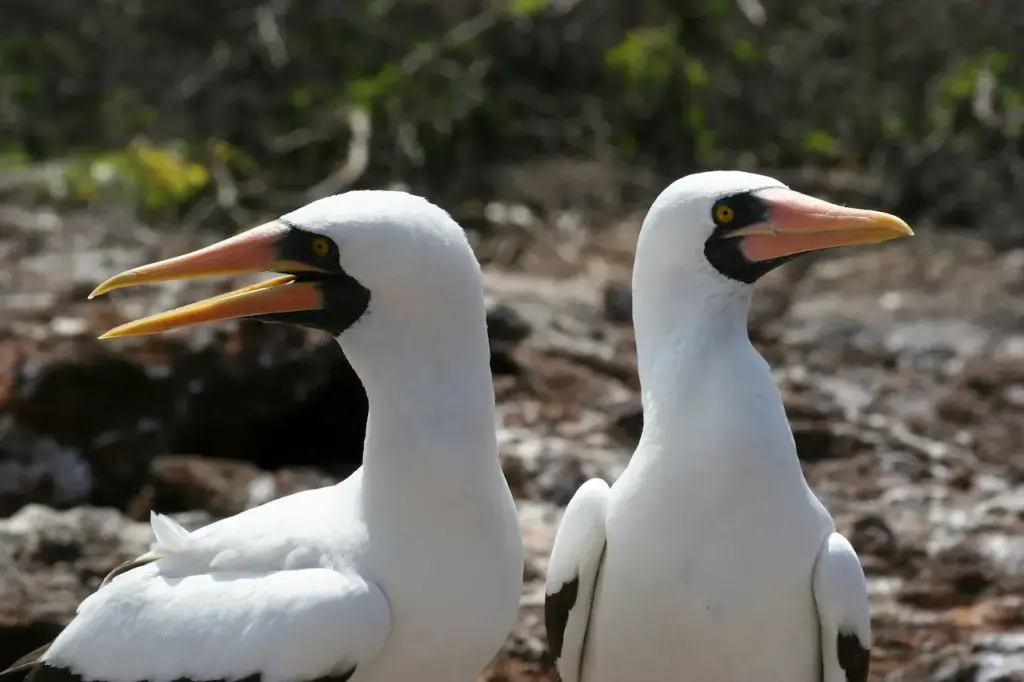
Taxonomically speaking, boobies are classified under the genus Sula, which contains five out of six species that are commonly referred to by the term boobies. The Blue-footed Booby, Red-footed Booby, Brown Booby, Masked Booby and Nazca Booby are all included in this group. The sixth species (Papasula abotti) was once placed under Sula, but now belongs to its own monotypic subgenus Papasula. This reflects its more ancient and divergent evolutionary history.
Boobies have a close relationship with gannets (genus Morus),. Some ornithologists believe that the nine species of gannets, as well as boobies, belong in a single genus. Skeletal studies and genetic studies show that these birds followed different evolutionary paths over millions of years. Fossil evidence indicates that boobies, gannets, and other birds diverged in the Middle Miocene around 15 million ago. Each bird adapted to a different ecological niche. According to eBird, this species is well documented.
History of Fossil Records and Range
The fossil records of boobies are relatively sparse compared to those of the more well-documented species, gannets. This may be due to the distribution of the booby species. This results in fewer conditions for fossil formation compared to more temperate gannets in North America and Europe. Paleontological studies show that boobies are part of Earth’s diversity of avian species for millions of years. They have likely expanded and contracted their range as sea levels, climate and island formation changed. According to Audubon Society, this species is well documented.
Distribution: Where Boobies live today
The majority of boobies live in the subtropical and tropical oceans. However, there are also large populations in the Pacific Ocean, Atlantic Ocean, and Indian Ocean. The boobies prefer uninhabited islands or isolated islands, where there is little human disturbance and fish are abundant. Nesting areas include the Galapagos Islands and Ascension Island, as well as various remote atolls in the South Pacific. The boobies’ range is vast, but they are susceptible to habitat loss, introduced prey like cats and rats, and marine pollutants, which can have a drastic impact on breeding success and chicks’ survival.
Conservation Status: Challenges & Protections
Despite the wide distribution of the boobys species, several species are threatened by conservation. For example, Abbott’s Booby has been listed as Threatened because of habitat degradation caused by phosphate mining at Christmas Island. Other species, like the Black-footed Booby, are classified as Less Concern but still face localised threats. The major risks are plastic contamination, excessive fishing and the introduction of invasive species on nesting islands. Conservation organisations work to safeguard nesting habitats and implement biosecurity protocols. Monitoring the population trends is also being done to ensure that these birds do not go the way of the dodo.
Boobies and Pop Culture
Pop Culture and Science Outreach has also been attracted to Boobies, thanks in large part to the quirky blue-footed booby. The bird’s flamboyant dance and feet have made it a symbol for marine conservation. This is especially true in the Galapagos. Education campaigns use boobies as a way to get the public involved in discussions on climate change and plastic pollution. They are powerful ocean ambassadors because of their charisma and humour.
Why Boobies Are Important: Their Ecological Role.
In addition to their beauty, boobies are essential in the marine ecosystem. They are apex predators at the mid-trophic levels, and they serve as indicators for ocean health. The changes in their breeding or feeding output may reflect changes in the availability of fish or the water temperature. Boobies are not just pretty birds, but also bioindicators that are essential to the marine food chain.
The Future of Boobies – Protecting a Global Seabird
The future of boobies depends on sustainable Ocean Management, Habitat Protection, and Global Cooperation. As human activity spreads to even the remotest parts of the ocean due to climate change, we must track the booby population as well as mitigate threats. It’s important to support and educate the public. Organisations such as BirdLife International and WWF have already made strides. Ecotours are a great way to get involved.
Every effort counts to keep the booby population thriving.
Conclusion: It’s More Than a Silly Title
Boobies have more to them than a joke. They are magnificent birds of the sea, with an evolutionary history rich in fascinating behaviours and important ecological roles. From their daring diving to legendary interaction with sailors, boobies continue to fascinate and inspire. Understanding and appreciating these seabirds is an important step in protecting marine biodiversity.