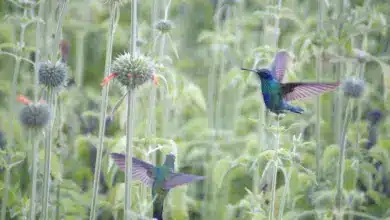
The Black-eared Fairy, scientifically known as Heliothryx auritus, is a captivating species of hummingbird native to the vast tropical rainforests of South America. Known for its striking coloration and unique behavioral traits, this hummingbird occupies a niche within the rich biodiversity of the Amazon basin and adjacent forested regions. Despite its modest size, the Black-eared Fairy plays an important role in pollination and showcases fascinating adaptations that intrigue bird enthusiasts, researchers, and photographers alike. This article delves into the detailed taxonomy, distribution, physical characteristics, behavior, and conservation status of this remarkable species.
Scientific Classification
The Black-eared Fairy belongs to the family Trochilidae, which encompasses all hummingbirds, a group renowned for their iridescent plumage and remarkable flight capabilities. Its genus, Heliothryx, is distinctive among hummingbirds for containing only two species: the Black-eared Fairy (Heliothryx auritus) and the Purple-crowned Fairy (Heliothryx barroti). The species H. auritus was first described by Johann Friedrich Gmelin in 1788. The genus name derives from Greek, with “helios” meaning sun and “thryx” meaning hair, a poetic nod to the sunlit shimmer commonly seen in fairy hummingbirds.
Three subspecies of the Black-eared Fairy are recognized based on geographical distribution and slight plumage variations. The nominate subspecies, Heliothryx auritus auritus, inhabits the northern parts of the species’ range, including southeastern Colombia, Venezuela, the Guianas, and northern Brazil. The subspecies H. a. auriculata (sometimes spelled auriculatus) occurs from eastern Peru and Bolivia eastward into central and eastern Brazil, extending south through the Amazon basin. Finally, H. a. phainolaema is found in north-central Brazil, particularly in the Brazilian states of Pará and Maranhão. These subspecies exhibit subtle differences in plumage and size but are generally similar in appearance and behavior.




Geographic Range & Distribution
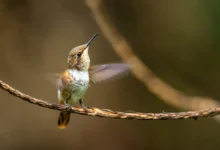
The Black-eared Fairy inhabits a wide swath of South America, primarily within the Amazon rainforest and other humid lowland forest ecosystems. Its range spans Bolivia, Brazil, Colombia, Ecuador, French Guiana, Guyana, Peru, Suriname, and Venezuela. The species is predominantly found in tropical and subtropical moist broadleaf forests, thriving in humid lowlands where flowering plants abound—essential for nectar feeding.
Interestingly, the Black-eared Fairy exhibits a somewhat disjunct distribution pattern. While its main population is concentrated within the Amazon basin, there is a notable separate population in the eastern Atlantic Forest of Brazil. This fragmented distribution suggests some historical biogeographic shifts, perhaps influenced by habitat changes or climatic fluctuations. It is also observed as a vagrant in southern Brazilian states such as Santa Catarina, indicating occasional movements beyond its typical range.
These hummingbirds prefer dense forest interiors but can also be found along forest edges, clearings, and riverbanks where flowering plants are plentiful. They tend to avoid higher elevation habitats, mostly remaining below 1,000 meters above sea level. Their habitat preference for humid tropical forests makes them a vital component of these complex ecosystems, contributing to the pollination of many native plants.
Physical Description
The Black-eared Fairy is a medium-sized hummingbird, measuring approximately 11 to 12 centimeters (4.3 to 4.7 inches) in length and weighing around 5 to 6 grams. It possesses a compact body with a relatively short, straight black bill adapted for accessing nectar from tubular flowers. The bird’s most striking feature is its bright green upperparts, which shimmer iridescently in sunlight, contrasting with its white underparts, creating a sharp visual distinction.
One of the defining characteristics is the black “mask” or “ear” patch that extends from the bill through the eyes and covers the cheeks, lending the species its common name. The tail is another notable feature: the central tail feathers are a deep blue-black, while the outer tail feathers are pure white. When perched, the tail appears mostly white from below, but from above, the blue-black center is prominent. This striking tail pattern is thought to play a role in intraspecific communication and display.
Females closely resemble males but can be distinguished by their slightly longer tails and often duller coloration on the face mask. Juvenile birds tend to have less pronounced black facial markings and somewhat duller plumage overall. This species is sometimes confused with the Purple-crowned Fairy (Heliothryx barroti), which has a purple crown in males; however, since their ranges do not overlap, confusion is minimal in the field.
Behavior & Diet
The Black-eared Fairy exhibits typical hummingbird behaviors, including rapid, agile flight and a high metabolism requiring frequent feeding. These birds are primarily nectarivorous, feeding on the nectar of a diverse range of flowering plants. They show a preference for brightly colored, tubular flowers, often favoring red or orange blooms that tend to have higher sugar concentrations. Common nectar sources include flowers from epiphytes, shrubs, herbs, and canopy trees within their habitat.
Besides nectar, the Black-eared Fairy supplements its diet with small arthropods such as insects and spiders, which provide crucial protein and nutrients necessary for growth and reproduction. They glean these tiny prey items from leaves and bark or catch them mid-air in short sallies. This omnivorous diet helps maintain their energy demands and supports their active lifestyle.
Black-eared Fairies are known for their territorial behavior, particularly around rich nectar sources. Males aggressively defend flower patches against intruding hummingbirds, displaying chases and aerial dogfights to secure feeding rights. These territorial disputes help ensure adequate food intake, crucial for their survival and reproductive success.
Breeding & Reproduction
Like most hummingbirds, the Black-eared Fairy is largely solitary outside of the breeding season. Males and females do not form long-term pair bonds; instead, males engage in brief courtship displays and mating. During courtship, the male performs a characteristic U-shaped flight pattern in front of the female to attract her attention. This display combines agility and visual signaling, showcasing the male’s fitness. According to eBird, this species is well documented.
After copulation, the male disengages immediately and does not participate in nest building or chick rearing. Females select the nest site, build the nest, incubate the eggs, and care for the young independently. The nest is typically a small cup constructed from soft plant fibers, moss, and spider silk, often camouflaged with lichens and attached to thin branches or vines in the understory or mid-canopy. According to Audubon Society, this species is well documented.
The female usually lays two tiny white eggs, each about 1 centimeter long. Incubation lasts approximately 14 to 16 days, followed by a fledging period of around 20 to 25 days. The female fiercely protects the nest, feeding the chicks with regurgitated nectar and small insects. Breeding can occur year-round in some parts of its range, reflecting the consistent availability of flowers in tropical environments.
Conservation Status
The International Union for Conservation of Nature (IUCN) currently lists the Black-eared Fairy as a species of Least Concern. This status reflects its wide distribution and relatively stable population trends across much of its range. The species is common in many parts of the Amazon rainforest and other suitable habitats, showing resilience to a certain degree of habitat disturbance.
However, ongoing threats to the Black-eared Fairy include habitat loss due to deforestation, agricultural expansion, and infrastructure development, particularly in the Amazon and Atlantic Forest regions. The fragmentation of forest habitats can isolate populations and reduce the availability of key nectar sources. Conservation efforts focusing on preserving large tracts of tropical forest and promoting sustainable land use are critical to maintaining the health of this species’ populations.
Protected areas within the Amazon and Brazilian Atlantic Forest provide important refuges for the Black-eared Fairy and countless other rainforest species. Continued monitoring and habitat protection remain essential to ensure this vibrant hummingbird remains an integral part of South America’s avian diversity.
Interesting Facts
The Black-eared Fairy’s name highlights one of its most distinctive features—the glossy black “ear” patches on its face, which can appear almost mask-like. This feature, coupled with its iridescent green feathers, gives it an almost mythical appearance, befitting the “fairy” moniker often given to hummingbirds.
Unlike many other hummingbirds with longer, curved bills adapted for specific flowers, the Black-eared Fairy’s relatively short, straight bill allows it to exploit a more generalist range of flowers. This adaptability likely contributes to its broad geographic range and success across diverse habitats.
Another fascinating behavior is its aggressive territoriality. While hummingbirds are generally known for defending feeding territories, Black-eared Fairies are particularly feisty, exhibiting aerial displays and vocalizations that deter competitors. These behaviors ensure they maintain prime access to nectar, vital for their high-energy lifestyle.
Hummingbirds, including the Black-eared Fairy, have incredibly fast wing beats—up to 70 beats per second in some species—which enable their signature hovering flight. This mechanical marvel allows them to access nectar in mid-air, a crucial adaptation for survival in dense forest environments.
Finally, the Black-eared Fairy is an important pollinator for many tropical plants. Its role in pollination networks helps sustain the delicate balance of rainforest ecosystems, highlighting the intricate connections between flora and fauna in these biodiverse habitats.
In conclusion, the Black-eared Fairy is more than just a small bird with beautiful plumage—it is a vital participant in the ecological tapestry of South America’s tropical forests. Its dazzling appearance, territorial nature, and role in pollination make it a subject of continuous interest for birdwatchers and researchers. Protecting this species and its habitat ensures the survival of a remarkable hummingbird that truly lives up to its fairy-like name.