A vibrant and elusive bird, the Black-browed Barbet (Megalaima oorti), flits through the tropical forest canopy of Southeast Asia, its call resonating like a rhythmic knocking on wood. The Blackbrowed Barbet is also known as Muller’s Barbet. It’s a jewel-toned Asian barbet of the Megalaimidae family. This barbet’s five-color plumage, and monklike demeanour have captured the attention of ornithologists as well as birdwatchers. It is known by the poetic names “five colored bird”, and the “spotted monk in the forest”.
This comprehensive overview will explore all you need to learn about the Black-browed Barbet, from its striking physical appearance, range, feeding habits, breeding behaviors, and conservation status.
The Black-browed Barbet: A Unique Bird?
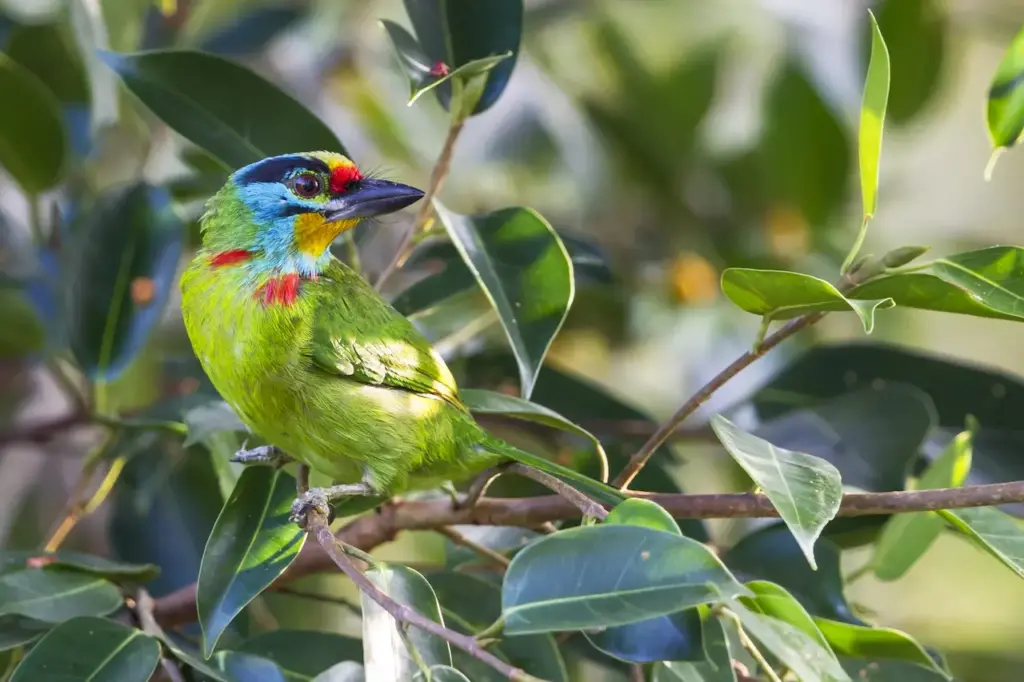
The Blackbrowed Barbet measures between 20 and 23.5 centimeters. The vibrant plumage of the Black-browed Barbet is what will impress you. The body of the bird is covered with feathers in leaf-green. This provides perfect camouflage within the forest canopy. The facial pattern and the of the head are what make this species so unique.





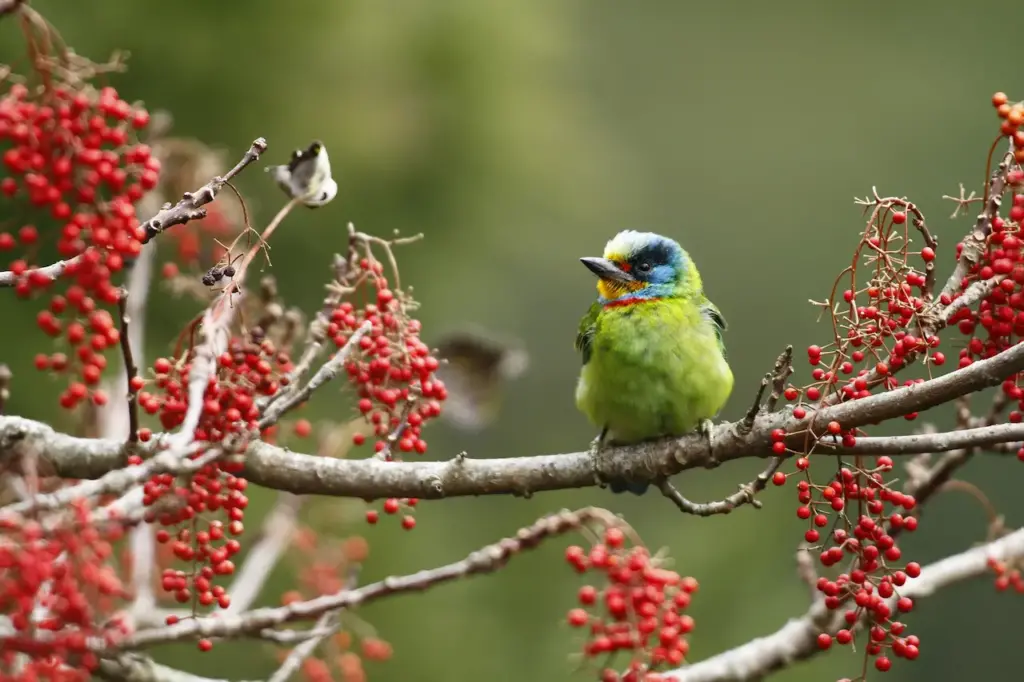
The head has a rainbow of colours. It features a blue face and crown and yellow cheeks. Near the neck and nape, there are also vivid red markings. The bold, black stripe above the eyes is a distinguishing feature. This gives the bird its English title, Blackbrowed Barbet.
The bill of this bird is dark, thick and slightly curved. It’s perfect for chiseling wood and fruits. Legs and feet are greyish-green and adapted to grip tree branches and perch.
The five different colors of its plumage are affectionately called the ‘five-colored bird’ (Wu Se Niao) in Chinese Culture. This is especially true in Taiwan. The Black-browed Barbet is known for its mysterious call, which is said to sound like the rhythmic sounds of a wooden fishing used by monks to meditate.
Geographic Range and distribution: Where does the Black-browed Barbet live?
The Blackbrowed Barbet is found in a wide range of habitats, including: Its range extends across several countries, including:
- Sumatra
- The Malay Peninsula
- Eastern Cambodia
- Southern Laos
- South Central Vietnam
- Guangxi province, for example, is a part of Southern China.
- The islands of Hainan and Taiwan
The species is found in tropical forests. It prefers broadleaf, evergreen forests. mountainous forests are also common. The most common habitat is the middle to upper canopy where its green body plumage blends in seamlessly with the foliage.
The bird is found as an endemic species on the islands of Hainan or Taiwan. These populations have become separated from mainland populations. The island subspecies can be treated as separate species, such as the Hainan Barbet or the Taiwan Barbet. The bird is widespread in Taiwan’s forested hills, especially around Yangmingshan, Alishan and Taroko Gorge.
Habitat Preferences & Ecological Role
The ideal habitat of Black-browed Barbets is dense mature forests, with fruit-bearing and old trunks that are suitable for nesting. The birds are attracted to canopy levels where they can call and forage without being disturbed.
These barbets are frugivores, which means they eat fruit. They play an important role in dispersal. This contributes to the regeneration of forests and biodiversity. They maintain diversity and ecological balance in tropical forest ecosystems by consuming fruit and excreting seeds at different places.
They are sensitive to habitat loss, particularly from deforestation and logging.
Food and feeding habits
The black-browed barbet’s diet is centred on fruit. This includes figs and berries. They also eat insects, larvae, and other small animals. This is especially true during the nesting season, when chicks require more protein.
Barbets mainly forage in the upper to mid canopy. They hop between branches or hang upside down to pluck ripe fruits. They can use their powerful bills to crack through tough skins on fruits or extract insects from bark or foliage.
In general, they feed alone or in pairs. However, during times of abundance, the birds may congregate around fruiting trees or join mixed-species flocks. They are difficult to identify unless you know their distinctive call.
Vocalisations of the Spotted Monk
Vocal repertoire is one of the most distinctive features of Blackbrowed Barbet. The bird makes a series of deep, resonant “took, took, took” calls which can echo throughout the forest. These calls can be repetitive or monotone and last for several hours. According to RSPB, this species is well documented.
The call is known as the “spotted monkey of the forest” in Taiwan because it resembles the wooden fishing found in Buddhist temples. According to eBird, this species is well documented.
The calls are more frequent in the mornings and evenings, especially during breeding season when males mark their territory and try to attract mates.
Breeding and nesting behaviour
The breeding ecology of Black-browed Barbet is poorly described largely because it is elusive and prefers high forest canopy. As with other Asian Barbets, certain behaviours are known.
Black-browed barbets are cavities nesters. This means they excavate a hole in decaying or dead trees for their eggs. Both sexes use their chisel like bills to carve out the nesting chamber. This may take days or weeks.
Nest cavities are usually located a few meters above the ground to offer protection against predators. The female will lay a small number of white eggs, usually 2 to 4 in total. The incubation is shared by both parents, as are the feeding duties. However, exact timings and timelines for chick development are still being researched.
The loss of forest habitats is a major threat to their reproduction, as they depend on old growth forests in order to find suitable nesting trees.
Conservation Status and Threats
The IUCN Red List classifies the Blackbrowed Barbet species as Less Concern due to its wide distribution throughout Southeast Asia. Populations in some regions are declining. This is primarily because of deforestation and illegal logging.
The species is stable in areas like Taiwan, where conservation of forests is advanced. However, the species is vulnerable in mainland Southeast Asia. This is especially true in Cambodia, Vietnam and Sumatra, where rapid forest loss occurs.
Other threats include:
- Agricultural Expansion
- Forest fires
- Infrastructure development
- Capture of pets for trade in some regions
Conservation efforts include the protection of mature forests and programs of reforestation. Education of the community on the importance of biodiversity preservation is also important.
Ecotourism and Cultural Relevance
The Black-browed Barbet is a cultural icon in Taiwan. It represents the rich biodiversity of the island. The bird’s beautiful plumage, as well as its calm call, has inspired traditional arts, Folklore and tourism themed around birds.
Birdwatchers who visit Taiwan place the Taiwan Barbet at the top of their list. It is often spotted in parks such as Yangmingshan National Park, Dasyueshan National Park, and Yushan National Park.
Promote ecotourism and encourage bird-friendly practices to raise local awareness about the importance of protecting habitats for species such as the Black-browed Barbet.
Last Thoughts: Protecting a Forest Gem
The Blackbrowed Barbet is one of Asia’s most captivating bird species. Its rainbow-colored feathers, spiritual call and secretive canopy life make it a truly unique bird. Its future is heavily dependent on its preservation despite its classification as of Least Concern.
The protection of the forest homes of the region and the prevention of unsustainable land uses.
Protecting species such as the Black-browed Barbet is important for bird lovers, naturalists and conservationists. It means protecting tropical ecosystems and ensuring future generations will be able to hear the rhythmic “took, took, took” echoing in Asia’s disappearing forests.