
The Blackback Barbet (Lybius Minor) is a stunning and ecologically significant bird species native to sub-Saharan Africa. It’s also known as Levaillant’s Barbet. This species belongs to the family Lybiidae, which also includes African Barbets and Tinkerbirds. It is known for its bright colours, large body and distinctive call. The Black-backed Barbet is not as well-known as other African birds, but it plays an important role in forest ecosystems. This is especially true through seed dispersal. Its presence in Central and Southern Africa is an indicator of healthy woodlands and forest habitats.
Taxonomy & Scientific Classification
Scientifically, the Black-backed Barbet belongs to the order Piciformes, which includes woodpeckers, toucans, and other species. The genus Lybius includes several robust barbets, which are known for their large bills and bristled feathers on the face. Lybius Minor was first described by Georges Cuvier in 1817. Since then, it has been the topic of taxonomic debate, especially regarding its subspecies. Despite ornithologists’ debates, the Black-backed Barbet has been recognised as a separate species. It is divided into two subspecies that are found in different parts of Africa.
Common names and their historical background
This bird is also known as Levaillant’s Barbet. It was named after the French ornithologist and explorer Francois Levaillant. His early documentation on African birdlife was a significant contribution to ornithology. The multiple common names reflect both regional naming customs and historical influences on bird classification. The species can be identified by its distinctive behaviour and contrasting plumage, regardless of the name.


Geographic Distribution in Africa
The Black-backed Barbet can be found in a wide range of Central African and Southern African countries, including Angola. Burundi. Gabon. The species’ wide distribution illustrates its adaptability to different woodland and forest environments. While not migrating, populations remain relatively stable in their ranges as long as suitable habitat is preserved. Most often, the bird can be found in lowland forest, forest edges and wooded savannas.
Habitat Preferences & Environmental Adaptations
The Black-backed Barbet thrives in moist, tropical forests and secondary growth. They also do well in well-wooded, open savannas. The birds are attracted to areas that have a lot of fruiting trees. These provide them with a constant food supply throughout the year. They can tolerate some habitat disturbance, and they are sometimes seen near plantations or cultivated land as long as there is still tree cover. They can adapt to different wooded environments thanks to their strong bills and cavity nesting behaviour.
Black-backed Barbet Subspecies
There are two subspecies that have been recognized. Each occupies a different geographical range. The plumage and distribution of these subspecies are slightly different, but they are still closely related. Interbreeding takes place in regions where the ranges of both subspecies overlap, demonstrating their genetic closeness. The debate continues over whether a subspecies is worthy of full species status.
Lybius Minor Minor – The Nominated Subspecies
Cuvier described the nominate subspecies Lybius Minor minor in 1817. Its range extends between southern Gabon, western Democratic Republic of the Congo, and west-central Angola. This subspecies tends to be associated with mature woodland ecosystems and dense lowland forest. The Black-backed Barbet has the typical features of this subspecies, such as a black back and contrasting facial markings. It also displays a powerful bill that is adapted to eat both insects and fruit.
MacClounie’s Barbet
Shelley described the second subspecies in 1899, Lybius Minor macclounii. It is also called MacClounie’s Barbet. Its range includes northern Angola and the Democratic Republic of the Congo. It also covers southern Burundi and western Tanzania. Some authorities believe that this subspecies is a distinct species because of subtle differences in plumage, vocalisations and behaviour. Because it can hybridise freely with the nominate species where their ranges overlap, most ornithologists still classify it under Lybius Minor.
Physical Description and Size
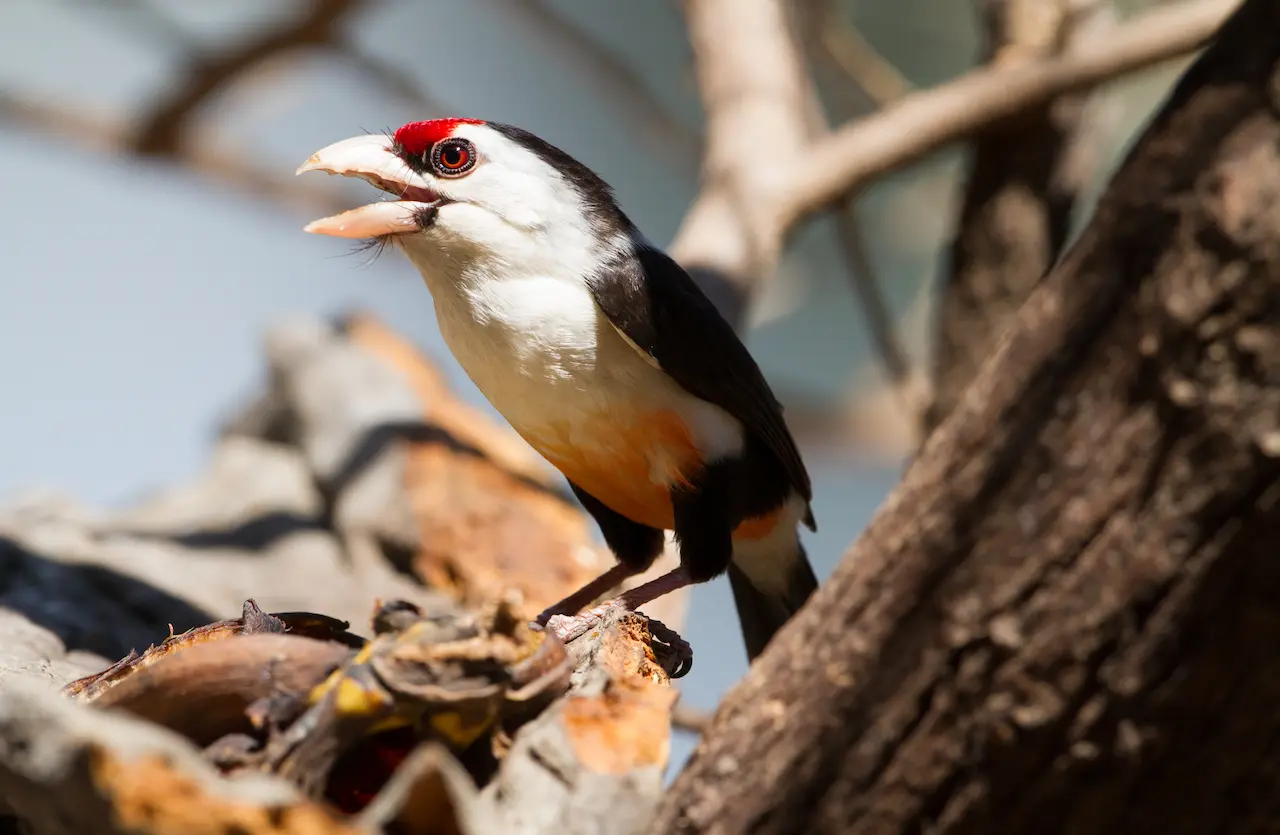
Black-backed Barbets measure 20 to 25 centimetres. Their plump appearance is accentuated by their large head and short neck. Their large, thick bill is one of their most distinguishing features. It is fringed at the base with stiff bristles. These bristles protect the bird’s face and eyes when it is eating fruit or catching insects. The overall shape of the bird reflects an animal well-adapted to powerful biting and varied feeding.
Plumage and Colouration
Black-backed Barbets are easily identified by their bold, high-contrast plumage. The back of this bird is predominantly black. Other parts of its body are a mixture of red, yellow and white. The bright patterns on the faces of African Barbets may be used to identify mates and display territorial behaviour. Black-backed Barbets are difficult to see in dense foliage because of their vibrant colours. Their still posture also helps them blend in. According to RSPB, this species is well documented.
Behaviour and Social Structure
Black-backed Barbets tend to be alone or in pairs during the breeding season. Their loud, repetitive calls are used to establish territories and maintain contact with mates. These vocalisations are often rhythmic metallic notes that can be heard throughout the forest. These birds may not be very social, but they are not shy. They can remain silent for long periods of time, searching for food. According to Audubon Society, this species is well documented.
Food and Feeding Habits
The Black-backed Barbet has a varied diet, but it is primarily a frugivore. The birds eat a variety of fruits. Figs are a favourite. The birds regurgitate the indigestible material, such as seed pits, after swallowing whole fruit. They are important agents for seed dispersal because of their feeding behaviour. This contributes to forest regeneration and plant variety. They can eat both wild and cultivated fruits, demonstrating their flexibility in terms of diet.
Insects as Protein and Prey
Black-backed Barbets also consume a wide variety of insects that provide them with essential protein. Insects such as ants, cicadas and dragonflies are part of their diet. Prey is usually captured by gleaning off branches or making short sallies while perched. This is especially true during breeding season when the demand for protein is higher.
Occasional Vertebrate Prey
Black-backed Barbets are known to feed on small vertebrates, such as lizards and frogs. The species’ ability to adapt and the powerful bill that allows it to handle large prey are highlighted by these opportunistic events. This dietary flexibility helps the bird to survive seasonal fluctuations in available food.
Cavity and Nesting Sites
Black-backed Barbets build cavities in trees. These cavities offer protection against predators and harsh conditions. It is important to find nesting sites that are suitable, as other species may compete for them. Depending on the availability, both natural cavities and woodpeckers’ holes can be used.
Breeding Behaviour and Egg Laying
During breeding season, a female will usually lay 2 to 4 eggs in the cavity of the tree. Incubation lasts approximately 13 to 15 days. Both parents are involved in nest defence and incubation. The shared responsibility of both parents increases the chance of reproductive success in environments with high predation pressure.
Parental Care and Chick Development
Both parents will take care of the chicks after hatching. Nestlings are given a mix of insects and fruits regurgitated by their parents to ensure a balanced growth diet. The young birds stay in the nests until they have developed enough to leave. Even after fledging, parents continue to invest in their young. They may feed and protect them for a brief period.
Ecological Importance of Seed Dispersal
The Black-backed Barbet is essential in maintaining healthy forests. It helps forest regeneration and plant propagation by dispersing seeds and eating fruit over large areas. This service is especially valuable in tropical rainforests, where biodiversity relies on complex interactions among plants and animals. Loss of frugivorous bird species like barbets can have a cascading effect on forest structure.
Conservation Status and Threats
Currently, due to its widespread distribution and adaptability, the Black-backed Barbet does not pose a global threat. Habitat losses and deforestation are ongoing threats in some parts of the species’ range. To ensure the long-term existence of this species, it is vital to preserve forested habitats. The protection of habitats and continued monitoring will ensure stable populations in Africa.
Last Thoughts about the Black-backed Barbet
The Black-backed Barbet, a resilient and fascinating bird, embodies all the diversity of African avifauna. Lybius Minor is a bird that deserves more recognition from conservationists and bird lovers alike. Its striking appearance, varied diet, and ecological importance make it a worthy candidate for greater attention. Understanding its behaviour and habitat requirements, as well as its breeding biology, can provide valuable insights into the health of African forest ecosystems. So long as habitats suitable for the Black-backed Barbet are protected, it will continue to thrive in its natural environment.


