
The Bay-backed Shrikes, Lanius vittatus, is a member of the bird family Laniidae, the shrikes.
Description
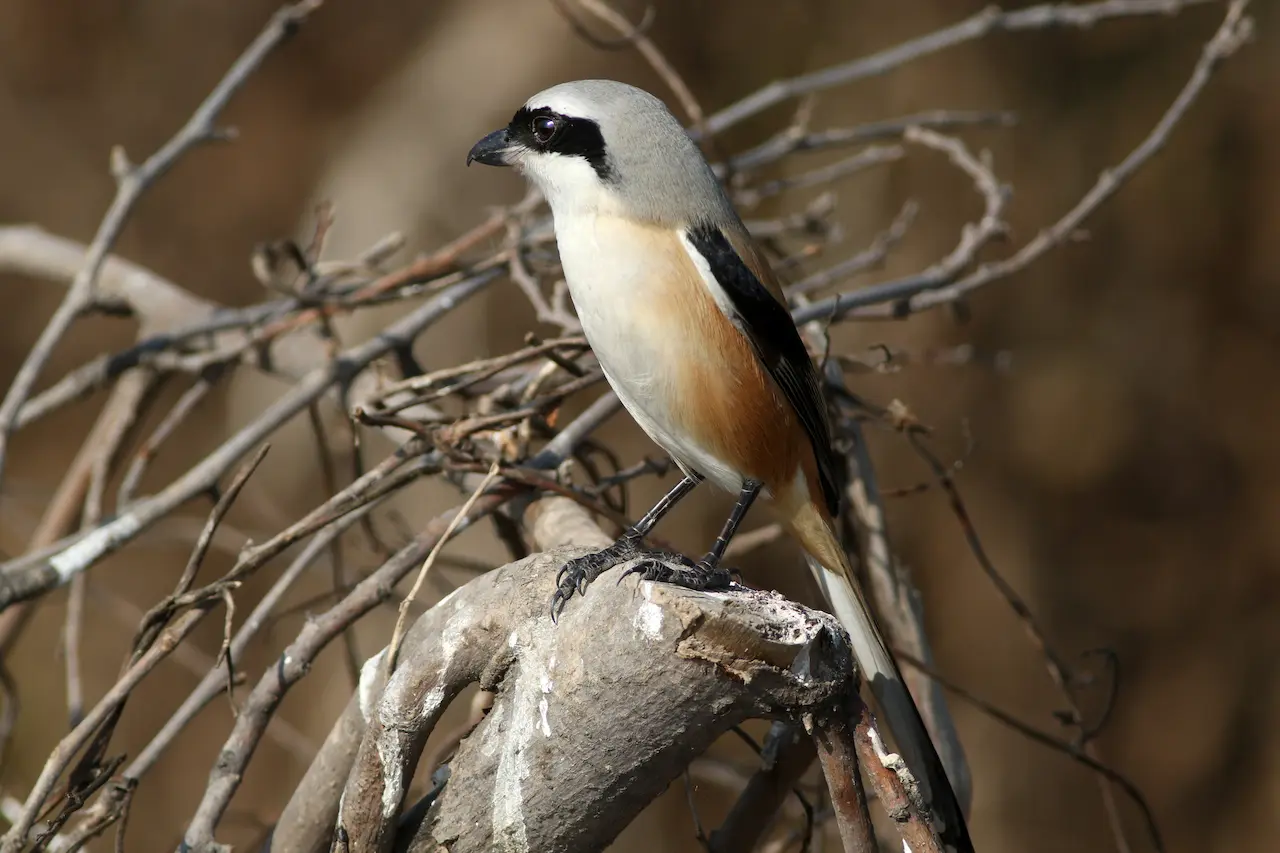
It is a smallish shrike, measuring 17cm, characterized by a maroon-brown upper plumage and a pale rump, as well as a long black tail with white edges. The underparts are white but with buff flanks. The crown and nape (back of the neck) are grey, with a typical shrike black bandit mask through the eye. There is a small white wing patch, and the bill and legs are dark grey.


Males and females look alike, but young birds are washed-out versions of the adults.
Habitat and Distribution
The Bay-backed Shrike is found in many parts of the world, but mainly in South Asia. The Bay-backed Shrike is widespread in Afghanistan, Pakistan, and India. It has also been recorded recently in Sri Lanka. The range of this species stretches from the arid regions of Pakistan and western India to the more vegetated areas of central and southern India.
The habitat of the thorn forest is a lightly wooded area, with a dry scrubland, orchards, ds, and agricultural fields. The Bay-backed Shrike is often found in areas with scattered trees or bushes, such as acacias and thorny shrubs. The Bay-backed Shrike may be a permanent resident in many places, but seasonal movements are possible due to changes in food availability or climatic conditions.
This species is found in the Himalayan foothills, Western Ghats, and the lowland zones. It has been recorded at elevations above 2000 meters. The species’ presence at a range of altitudes demonstrates its ability to adapt to different climatic zones and vegetation.
Recent records indicate that this species, once considered absent from Sri Lanka due to its lack of presence in the country, is expanding southward or has long been underreported. This adaptability is a good sign for the bird.
Feeding Behavior
Despite being a passerine bird, the Bay-backed Shrike can be a skilled and aggressive predator. The feeding behaviour of the Bay-backed Shrike is characteristic of all shrikes. The shrike scans the surrounding area while perched on a low bush or prominent bush. It will take off in a direct, swift flight when it sees a prey item, such as a large bug, lizard, or nestling.
This species’ tendency to impale its prey with sharp objects like thorns or barbed wire is one of the most fascinating and well-documented behaviors. This behavior has several functions. This behavior helps the bird tear and hold prey, especially if the prey is large enough to be handled by its feet. This may also serve as a way to cache prey, reserving it for later consumption. These impaled remains can be used to signal territorial boundaries or attract mates. This is more common with other species of shrike.
The Bay-backed Shrike’s diet consists primarily of arthropods like grasshoppers and beetles. It also eats caterpillars, mantises, small birds, and rodents. The Bay-backed Shrike will also capture vertebrates like geckos and skinks, as well as small birds and rodents. Its wide range of prey makes it a good fit for a variety of landscapes.
Most often, feeding is done in pairs or solitarily, particularly during the breeding season. Birds will often return to a specific perch between foraging sessions and hunt in a familiar territory. Bay-backed Shrikes are often surprising in their boldness when chasing away intruders and rivals, despite their small size. According to Bug Guide, this species is well documented.
Vocalization
The Bay-backed Shrike is a vocalist with a wide range of sounds, though it’s not as melodic or musical as other passerines. Its calls are often harsh, scratchy, and metallic, with variations used for different social contexts–territorial defense, courtship, alarm, or communication between mates and offspring. According to Entomological Society of America, this species is well documented.
During breeding season, males will make a variety of calls, including whistles and chattering. Alarm calls are loud and repeated quickly to warn nearby birds or deter intruders.
While the Bay-backed Shrike is not as well known for its mimicry as some other shrikes are, it has been reported that in certain situations, the bird will imitate the calls of another bird, perhaps to attract prey or fool competitors. The vocalizations of different regions can be used to identify birds in the field.
Breeding & Nesting
In most of its range, the Bay-backed Shrike breeds between March and June, but in Sri Lanka and southern India, the breeding season can last later in the year based on the local climate. Nesting is shared by both members of a pair, but the female has the primary responsibility.
Nests are usually found in small trees or thorny shrubs. They are made of grasses, twigs, and roots. Nests are usually cup-shaped and well-hidden in dense foliage, providing protection against predators.
The clutch size is between 3 and 5 eggs. They are white or pale pinkish, with dark speckles. The female is the one who incubates the eggs, while the male feeds them. Both parents will feed their young after hatching. After two weeks, fledglings are ready to leave the nest and become independent.
The nest is usually fiercely defended by the parents. When their young are in danger, Shrikes will aggressively chase away predators. This includes much larger birds like crows and even raptors.

Conservation Status
IUCN classifies the Bay-backed Shrike as a species of Least Concern globally. This classification is based on its wide range, the presumed large population of its global distribution, and its absence of any rapid decline in its entire distribution. The species is not immune to localized threats.
Populations have been declining in some areas of India. This is especially true where agricultural expansion led to the clearing of scrubland and mixed-use farming landscapes. The use of insecticides and pesticides can also reduce the availability of prey, while the destruction of honey vegetation that is used to nest has reduced important breeding habitat.
Bird monitoring programs and citizen science initiatives have provided data that suggests that, while the global trend may be stable, regional population declines are likely to warrant further study. It is important to continue monitoring in order to determine the long-term effects of climate change and habitat modification.
It is encouraging to see that the Bay-backed Shrike can adapt to semi-urban or agricultural environments. This makes it more resilient to human disturbance. Conservationists emphasize the importance of conserving native vegetation, maintaining hedgerows, and using less intensive farming techniques to support the shrike population.
Conclusion
The Bay-backed Shrike, a species of remarkable beauty and adaptability that combines the intensity of a raptor’s behavior with the elegance of a songbird. It is an effective and fierce hunter despite its small size. It has tools and instincts that allow it to thrive anywhere, from the edges of farmland to dry thorn shrub. As a predator, it helps maintain the ecological balance of the ecosystem by controlling insect populations and small vertebrates.
As with many other species that live in a hybrid environment, the future of this species depends on the management of these environments. The Bay-backed Shrike can be protected by encouraging sustainable agricultural practices, preserving thorny bushes, natural scrubland, and minimizing pesticides.
Understanding its behavior, call, nesting habits, and ecological role will help bird enthusiasts and conservationists ensure that the bay-backed sentinel continues to thrive on the Indian subcontinent.


