Australian Birds of Prey
Australian Birds of Prey: Eagles, Hawks, Falcons, Goshawks, Owls, Nightjars and Frogmouths

Australia hosts a diverse and fascinating array of birds of prey, known for their keen eyesight, powerful talons, and vital role in maintaining ecological balance. These raptors, including eagles, hawks, falcons, kites, goshawks, and owls, inhabit a wide range of environments from arid deserts to lush forests and coastal regions. They serve as apex predators and scavengers, controlling populations of smaller animals and contributing to the health of their ecosystems. Understanding these magnificent hunters reveals much about Australia’s unique wildlife and the adaptations that allow them to thrive across the continent.
Scientific Classification
Australian birds of prey belong primarily to the order Accipitriformes and Falconiformes. The Accipitridae family includes eagles, hawks, kites, and harriers, while falcons fall under the family Falconidae. Owls, which are nocturnal raptors, belong to the order Strigiformes. Among the Accipitridae, notable genera include Aquila (eagles), Accipiter (goshawks and sparrowhawks), and Elanus (kites). The falcons of Australia are largely represented by the genus Falco, including species such as the Australian hobby and the black falcon.
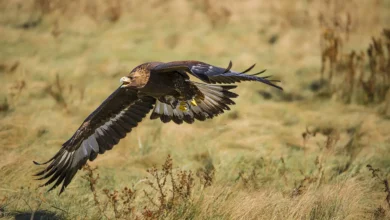
For example, the iconic Wedge-tailed Eagle (Aquila audax) is the continent’s largest bird of prey, while the Australian Hobby (Falco longipennis) is a smaller, agile falcon. Other species such as the Black-breasted Buzzard (Hamirostra melanosternon) and the Letter-winged Kite (Elanus scriptus) showcase the diversity within Australia’s raptors. Owls such as the Powerful Owl (Ninox strenua) and the Australian Masked Owl (Tyto novaehollandiae) complete the picture of nocturnal predation.




Geographic Range & Distribution
Australian birds of prey are widely distributed across the continent and its offshore territories, occupying diverse habitats from coastal mangroves and tropical rainforests to open grasslands and arid deserts. The Wedge-tailed Eagle is found throughout most of Australia, except the densest tropical rainforests, making it one of the most widespread raptors on the continent. It prefers open country such as woodlands, grasslands, and deserts.
The Black Falcon (Falco subniger) inhabits the northern and central arid zones of Australia, while the Grey Falcon (Falco hypoleucos) is even more specialized, confined to arid inland regions including Triodia grasslands and acacia shrublands. In contrast, the Brahminy Kite (Haliastur indus) ranges along northern coastal and estuarine areas, reaching as far south as New South Wales.
The Red Goshawk (Erythrotriorchis radiatus), one of the rarest raptors in Australia, is found mainly in the savanna woodlands of northern Queensland and the Top End. The Letter-winged Kite, unique for being the only nocturnal kite species, is endemic to the arid interior of the continent.
Owls such as the Powerful Owl are primarily found in the forests and woodlands of southeastern Australia, while the Australian Masked Owl occupies forested areas of the southern mainland and extends into southern New Guinea. The Christmas Island Goshawk (Accipiter fasciatus natalis) is restricted to Christmas Island, an Australian territory in the eastern Indian Ocean.
Physical Description
Australian birds of prey exhibit a wide range of sizes, shapes, and plumage patterns, adapted to their hunting styles and habitats. The Wedge-tailed Eagle is the largest, with a wingspan ranging from 182 to 232 cm (6 to 7.6 feet) and weighing between 3.0 and 4.5 kg (6.6 to 9.9 lbs). This eagle has long, broad wings and a distinctive wedge-shaped tail, which aids in soaring flight.
Smaller falcons like the Australian Hobby measure around 30 to 35 cm in length with a wingspan of 65 to 85 cm. They have sleek, streamlined bodies built for speed and agility, with slate-grey upperparts and rich chestnut underparts. The Black Falcon is slightly larger, with dark plumage and a wingspan up to 105 cm, adapted for fast, direct flight across open landscapes.
The Black-breasted Buzzard is notable for its striking black and white plumage and powerful build, measuring approximately 50 to 60 cm in length. It is known for its unique behavior of using stones to break open emu eggs.
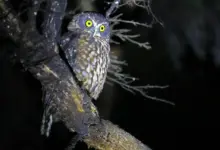
Owls like the Powerful Owl are robust, with a length of around 60 cm and a wingspan of up to 140 cm. This nocturnal predator has mottled grey-brown plumage that provides excellent camouflage among tree branches, and distinctive bright yellow eyes.
Behavior & Diet
Australian birds of prey exhibit varied hunting behaviors and diets, reflecting their diverse ecological niches. Most are skilled hunters, using keen eyesight and silent flight to capture prey. The Wedge-tailed Eagle is an opportunistic predator, feeding on mammals such as rabbits, hares, and young kangaroos, as well as reptiles, birds, and carrion. It is known for soaring at great heights while scanning for prey.
Falcons like the Australian Hobby hunt smaller birds in swift aerial chases, demonstrating incredible agility. The Black Falcon prefers small to medium-sized birds and mammals, often hunting over open grasslands and agricultural land. The Grey Falcon is specialized in hunting birds in arid environments, often taking prey such as pigeons and doves.
Kites such as the Black-shouldered Kite (Elanus axillaris) hunt primarily small mammals like rodents, hovering in the air before diving to capture prey. The Letter-winged Kite is known for its nocturnal hunting of rodents, a rare trait among raptors.
Owls like the Powerful Owl and Barking Owl hunt at night, feeding on possums, gliders, large insects, and smaller birds. Their silent flight aids in stealth, and their strong talons are capable of subduing prey larger than themselves. Sea eagles such as the White-bellied Sea Eagle (Haliaeetus leucogaster) feed on fish, turtles, and carrion along coasts and waterways.
Breeding & Reproduction
Breeding habits of Australian birds of prey vary widely, but most species establish long-term territories and build large nests of sticks in tall trees or cliff ledges. The Wedge-tailed Eagle typically lays one to three eggs per season, with incubation lasting around 42 to 45 days. Both parents share duties of incubating and feeding the chicks, which fledge after approximately three months. According to eBird, this species is well documented.
Smaller falcons such as the Australian Hobby usually lay three to four eggs in tree hollows or old nests of other birds. Their incubation period is shorter, around 28 to 30 days. The young are fed by both parents and are independent within two months. According to Audubon Society, this species is well documented.
The Black-breasted Buzzard constructs nests high in tall trees, commonly near watercourses. It lays two eggs per clutch, and the chicks remain dependent on the parents for several months. Similarly, kites and goshawks produce smaller clutches, with incubation periods ranging from 30 to 40 days.
Owls such as the Powerful Owl nest in tree hollows, laying one to three eggs. The female incubates while the male provides food. Owlets fledge after about 10 weeks but may remain with parents for several months while learning to hunt.
Conservation Status
The conservation status of Australian birds of prey varies significantly across species. The Wedge-tailed Eagle is currently listed as Least Concern by the IUCN due to its wide distribution and stable population. However, habitat destruction and secondary poisoning from pesticides and lead ammunition pose ongoing threats.
The Grey Falcon is considered Vulnerable due to its restricted range in arid Australia and threats from habitat degradation and climate change. The Red Goshawk, one of the rarest raptors in Australia, is listed as Vulnerable nationally and near threatened on the IUCN Red List because of habitat loss and low population density.
Other species like the Letter-winged Kite experience population fluctuations linked to prey availability, particularly rodents, but are not currently threatened. The Black-breasted Buzzard is listed as Least Concern but is vulnerable to habitat fragmentation.
Owls such as the Powerful Owl face pressures from urbanization and loss of large old trees required for nesting. Conservation efforts focus on habitat protection, reducing pesticide use, and public education to mitigate human-wildlife conflicts.
Interesting Facts
One of the most fascinating Australian birds of prey is the Black-breasted Buzzard, which exhibits unique tool use by dropping stones onto large emu eggs to crack them open—a rare behavior among birds. This intelligence highlights the adaptability and problem-solving abilities of raptors.
The Letter-winged Kite is the only truly nocturnal kite species in the world, hunting under the cover of darkness and relying on acute night vision to capture rodents during irruptive population booms.
The Wedge-tailed Eagle holds cultural significance for Indigenous Australians, often featured in mythology and art as a symbol of strength and freedom. Its soaring flight and commanding presence make it a favorite subject for birdwatchers and photographers.
The Powerful Owl, Australia’s largest owl, has an impressively deep call that can carry for several kilometers through forested areas. Known locally as the “barking owl” due to its distinctive calls, it is an apex nocturnal predator in its habitat.
Many Australian falcons, including the Australian Hobby, are renowned for their speed and aerial agility, often hunting birds on the wing with astonishing precision. Their hunting style resembles that of the peregrine falcon, the fastest bird in the world.
Sea eagles like the White-bellied Sea Eagle are expert fishers, often seen soaring above estuaries and coastal waters before plunging feet-first to snatch fish just beneath the surface. Their impressive wingspan of up to 2 meters helps them glide effortlessly over water.
Conclusion
Australia’s birds of prey represent a remarkable spectrum of adaptations, behaviors, and ecological roles. From the vast open skies patrolled by the majestic Wedge-tailed Eagle to the shadowy forest realms ruled by the elusive Powerful Owl, these raptors are integral to the continent’s biodiversity. Their presence indicates healthy ecosystems, and their varied hunting techniques reflect the complex food webs they support.
For nature enthusiasts, birdwatchers, and wildlife photographers, observing these raptors offers a window into the wild heart of Australia. Protecting their habitats and understanding their lives fosters appreciation for these apex predators and the delicate balance they maintain in Australian environments.