The African Swift, also known as the African Black Swift, Apus barbatus, is a remarkable member of the swift family that soars across diverse landscapes of sub-Saharan Africa and nearby islands. These aerial acrobats are known for their rapid, agile flight and their ability to spend much of their lives on the wing. Despite their widespread presence, African Swifts remain somewhat elusive due to their fast flight and preference for mountainous and forested habitats. This article explores the taxonomy, distribution, physical characteristics, behavior, breeding habits, conservation status, and intriguing facts about this fascinating species.
Scientific Classification
The African Swift belongs to the family Apodidae, which encompasses all swifts. Its scientific name is Apus barbatus. The genus name Apus is derived from the Greek word “apous,” meaning “without feet,” referencing the small, weak legs of swifts that are adapted primarily for clinging rather than walking. The species name, barbatus, means “bearded,” likely referring to certain feather features near the bird’s face. African Swifts are part of a larger group of Old World swifts found across Europe, Asia, and Africa. Within this species, there are eight recognized subspecies, each adapted to different geographic areas. These include the nominate subspecies A. b. barbatus in southern Africa, A. b. roehli across East Africa, and island-specific subspecies such as A. b. balstoni in Madagascar and A. b. mayottensis in the Comoros Islands. The classification highlights the diversity and adaptability of African Swifts across varied environments.
Geographic Range & Distribution
The African Swift has a broad but discontinuous distribution across sub-Saharan Africa and adjacent islands. Its range extends from Liberia and Cameroon in West Africa, through the Democratic Republic of the Congo, Uganda, and Kenya in central and eastern Africa, and southwards to South Africa. Additionally, populations exist on the island of Madagascar and the Comoros Islands. The species primarily inhabits montane regions, favoring damp mountain forests and grasslands at elevations typically between 1,600 and 2,400 meters, although it can occasionally be found at lower altitudes. This elevational preference is consistent across much of its range, providing cooler and more humid environments suited to their nesting and foraging needs.



The nominate subspecies in South Africa is known to be migratory, flying northward during the southern hemisphere winter to avoid colder conditions. In contrast, most other subspecies are resident, remaining in their territories year-round. The East African subspecies A. b. roehli is the most widespread and common, often seen in large flocks. Island subspecies like A. b. balstoni in Madagascar and A. b. mayottensis on the Comoros are more localized and less studied, though there is speculation that some of the Madagascar birds might migrate to the African mainland outside the breeding season, but this remains unconfirmed. Overall, the African Swift’s distribution reflects a species well adapted to montane and island environments across a large portion of sub-Saharan Africa.
Physical Description
The African Swift is a medium-sized swift, measuring approximately 16 to 18 centimeters in length, with a wingspan ranging from 38 to 42 centimeters. It has a compact yet robust body, reminiscent of the slightly larger pallid swift but noticeably bulkier than the common swift. Its plumage is predominantly a dark, blackish-brown, giving it a sleek, shadowy appearance in flight. One subtle but distinctive feature is a small white or pale grey patch on the chin, although this is often difficult to see unless observed at close range or under good lighting conditions.
The wings are very long and swept back, forming a characteristic crescent or boomerang shape that facilitates its expert aerial agility. The tail is short and forked, aiding in maneuverability during flight. When compared to the common swift (Apus apus), the African Swift displays a heavier build and a subtle contrast between its darker back and slightly paler secondary wing feathers, visible under ideal viewing conditions. In flight, it exhibits a steady, level flight pattern punctuated by short glides, differing from the more erratic or rapid wingbeats of other swift species. This distinctive flight style, combined with its size and coloration, helps birdwatchers differentiate the African Swift from other swift species in overlapping ranges.
Behavior & Diet
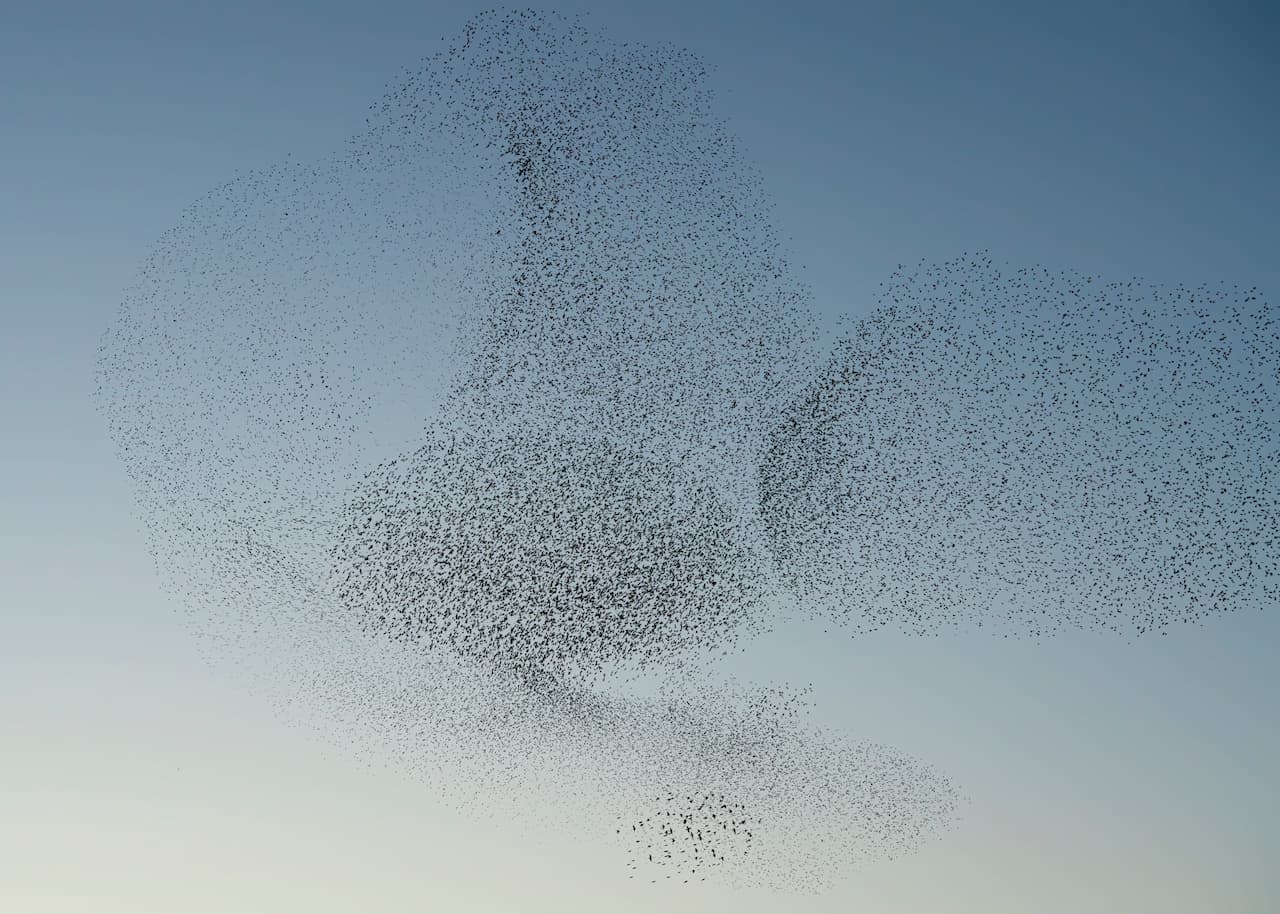
African Swifts are highly aerial birds, spending the majority of their lives on the wing. Their powerful, fast flight allows them to cover large distances while foraging for airborne insects. They are often seen feeding over lowlands and open areas, sometimes forming enormous flocks that may include other gregarious swift species. These mixed-species flocks can contain hundreds or even thousands of birds, creating impressive aerial displays.
Their diet consists almost exclusively of flying insects such as flies, beetles, ants, and moths. They are adept at catching prey midair, using their wide, gaping mouths as nets while darting through swarms of insects. This aerial insectivory plays a crucial role in controlling insect populations across their habitats.
Despite their speed and agility, African Swifts tend to forage relatively close to their nesting sites, although the migratory South African subspecies may travel further afield seasonally. Their social nature extends beyond feeding; they often roost communally and are known to be quite vocal during flight, emitting loud, double-rasped hissing screams that carry over long distances. These calls are distinct from those of other swift species and serve purposes ranging from maintaining flock cohesion to signaling alarm or territorial defense.
Breeding & Reproduction
The breeding habits of African Swifts vary somewhat between populations but generally involve colonial nesting. In East Africa, these birds favor hollow trees as nesting sites, utilizing cavities that provide shelter and protection from predators. Conversely, South African populations often nest on cliffs, both inland and along coastal areas, selecting vertical rock faces that offer safety and strategic vantage points.
African Swifts sometimes form mixed colonies with alpine swifts (Apus melba), demonstrating a tolerance for close proximity with other swift species during the breeding season. Nest construction is a fascinating process: the birds create a shallow cup-shaped nest made primarily of grass or other plant materials. They bind the nest firmly to the substrate using their saliva, which acts as a natural adhesive, a hallmark trait shared by many swift species worldwide. According to eBird, this species is well documented.
The typical clutch consists of one to two eggs, which are white and oval-shaped. Incubation periods last approximately 19 to 21 days, with both parents sharing incubation duties. After hatching, the chicks remain in the nest for several weeks, during which time they are fed a diet of regurgitated insects provided by both parents. Parental care is intensive, ensuring the young develop strong flight muscles before fledging. The breeding season varies with latitude and altitude but generally coincides with the local rainy season when insect abundance peaks, thereby maximizing food availability for growing chicks. According to Cornell Lab of Ornithology, this species is well documented.
Conservation Status
The African Swift is currently classified as a species of Least Concern by the International Union for Conservation of Nature (IUCN). This status reflects its wide distribution, relatively large population size, and adaptability to various habitats, especially montane environments. However, like many aerial insectivores, African Swifts face indirect threats related to habitat loss and environmental changes.
Deforestation and degradation of montane forest habitats, particularly in parts of West and Central Africa, pose challenges to nesting sites, especially those relying on hollow trees. Additionally, the use of pesticides and the consequent decline in insect populations could impact food availability. Migratory populations, such as the South African subspecies, may also be vulnerable to changes along their migration routes, including urbanization and climate change effects.
Despite these concerns, the African Swift currently maintains stable populations, and no immediate widespread declines have been documented. Conservation efforts aimed at preserving montane forests and minimizing pesticide use will help support the continued health of swift populations. Continued monitoring is recommended to track any future changes in distribution or abundance, particularly in island subspecies whose restricted ranges may make them more susceptible to environmental changes.
Interesting Facts
African Swifts are among the most airborne birds on the planet, spending the majority of their lives in flight. They eat, mate, and even sleep while airborne, landing only to breed and roost. Their small, weak legs are adapted for clinging to vertical surfaces rather than walking, which is why they almost never settle on the ground.
One of the most fascinating aspects of their biology is their use of saliva as a glue for nest building. This sticky saliva allows them to attach their nests securely to vertical cliffs or tree hollows, a remarkable adaptation that ensures the nest remains stable in often precarious locations.
Their vocalizations are unique among swifts. The loud double-rasped hissing scream is not only distinctive but also serves as an important communication tool within fast-moving flocks. Birdwatchers often identify African Swifts by their distinctive calls, especially during the breeding season when colonies can be noisy.
Finally, their ability to form mixed-species colonies with alpine swifts is a fascinating example of interspecies tolerance and coexistence, highlighting the complex social structures that can develop in avian communities.
In summary, the African Swift is a compelling species that exemplifies the extraordinary adaptations of swifts to a life almost entirely spent in flight. Its presence across diverse African landscapes, from high mountains to island habitats, underscores its ecological versatility. For nature enthusiasts and birdwatchers, observing the African Swift offers a glimpse into the dynamic and fast-paced world of aerial insectivores, showcasing the intricate balance of life in the skies above Africa.