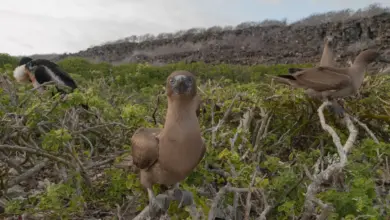
Attwater’s Prairie Chicken (Tympanuchus cupido attwateri) is a highly endangered subspecies of prairie chicken related to the now extinct heath hen.


Description:
The Attwater’s Prairie Chicken measures 17-18″ (43-45.5 cm) and weighs roughly 1.5 to 2 pounds (0.7-0.9 kg). It has a 28 inch (70 cm) wingspan.
These grouse-like ground birds have strong vertical bars of dark brown and buff-white in a zebralike pattern over the mantle (back), flanks, and underparts.
The species exhibits sexual dimorphism, with the males having elongated feathers, called pinnae, erected to form earlike structures. The male also has as a bright orange to reddish air sac on either side of his neck, which he inflates during mating displays.

Distribution / Habitat:
Over a century ago, one million Attwater’s Prairie Chickens graced the Texas and Louisiana gulf coastal prairie. Today, less than 1% of their native coastal prairie habitat remains and in 1998 it was estimated that only 260 remained, with less than 60 living in the wild.
Their sole refuges in the wild are the Attwater Prairie Chicken National Wildlife Refuge near Eagle Lake, Texas and another tiny parcel of land that was recently set aside near Texas City. There is also a small breeding colony residing on the grounds of the NASA Lyndon B. Johnson Space Center near Clear Lake, Texas. Captive breeding programs are underway at places such as Fossil Rim Wildlife Center [1], Texas Aand M University, Seaworld of Texas, and the Houston Zoo.
Their predators include Red-tailed Hawks, owls, coyotes, raccoons, skunks, opossum, and snakes. Many young birds also die from causes such as flooding.
Loss of habitat is believed to be the prime reason for their downfall. In addition to loss due to urbanization, the entire prairie ecosystem where they once thrived no longer exists in the same form. Where once grazing bison and periodic fires due to lightning reduced ground cover, the birds now have difficulty making their way through thick undergrowth. It is possible that other less-apparent changes in the ecosystem have had an effect as well.
Attwater’s Prairie Chicken has been on the endangered species list since March 1967.
Breeding / Mating:
The mating display can be seen in January or February when the birds gather in small groups on short grass, bare ground, rock outcroppings or hilly areas in order to choose a mate. This area is called a “booming ground” or a “lek”. In these areas, the females watch the males and choose their mate. The male emits a booming, “woo-woo” sound from his throat sac and struts around to attract a female.
Some of the traditional dances of the North American Plains Indians, notably those of the Lakota, are based on this booming display.
Later, the hens build grass nests on the ground, hidden in tall grass, where they lay their eggs.
Diet:
The Hume’s Attwater’s Prairie Chicken, an omnivorous species that forages mainly on the ground, is a bird of many different kinds. Its main diet is made up of grasses’ seeds, roots, leaves and leaves. Insects are also a good source of protein. In the spring and summer, when insects are in abundance, Attwater’s Prairie Chickens will often eat ants, grasshoppers and beetles. During the cooler months when insects are less plentiful, the Attwater’s Prairie Chicken will eat seeds and roots.
Foraging is usually solitary. Individuals move through the grasses to find food. Attwater’s Prairie Chickens have large, strong feet and legs that are perfect for turning over leaves and scratching the soil in search of food. The diet of the bird varies according to the season and food availability. The species’ adaptability allows it to survive in the harsh prairie environment. However, this also means the bird is dependent on the grassland ecosystem for adequate food year-round.
Prairie chickens are omnivorous. They eat seeds, leaves and flowers native to the prairie. Young chicks eat insects like grasshoppers and caterpillars. As chicks age and the weather gets colder, they switch to eating seeds and plants. According to eBird, this species is well documented.
Since their introduction in Texas, red imported Fire Ants have been detrimental to the native insect population. The decrease in native insects led to a reduction in the food available for chicks. The chicks’ survival rate was greatly reduced, and the species declined. According to RSPB, this species is well documented.
Behavior
The tall prairie vegetation is where these ground-dwelling bird spend the majority of the year. The northern bobwhite, their ground-dwelling neighbour, is much slower and more cautious. Prairie-chickens can fly well, despite spending most of their lives on the ground. They can fly short distances in order to escape predators, but they also have the ability to fly many miles between feeding and roosting sites.
In late January or early February, prairie-chicken males begin gathering in low grass areas to perform their courtship displays. These areas, called boom grounds, are used by males to dance on in order to attract females. These areas can be either naturally occurring flats of short grass or artificially maintained dirt roads.
From February to May, male Prairie-chickens dance for hours each morning on a booming surface. Males hold their wings down and their tails upright while they stomp their feet very fast. They then drop their heads, making a low, booming noise, to fill the sacs. During this activity, males will charge and jump at each other. Attracting a partner is a difficult task!
After the female has bred with a male and left the booming grounds, she nests in a shallow depression of the prairie. This is usually within one mile from the booming grounds. If she is lucky, the eggs will hatch in about 26 days. Nests are only able to survive predators such as opossums and skunks. They also have to be protected from coyotes and snakes. A hen may try to find a new partner if her nest is destroyed too early in the season. If a nest hatches successfully, the brood of a hen, or her family of chicks will remain with her for six weeks. Sadly, fewer than half of the chicks survive to adulthood and heavy rains can make nesting even less successful.
Similar Species
Prairie-chickens, despite their name, are actually grouse. The domestic chicken, which we now know, originated in Asia from the red Junglefowl ( Gallus Gallus). The subfamily Pavoninae included these junglefowl, whereas grouse species such as the prairie chicken are in the Phasianinae. Are they related then? Technically, all birds are related, but our domestic chickens are more like a peacock than they are to prairie-chickens.
The Attwater’s Prairie-Chicken is a subspecies, but it differs from its slightly bigger relative, Tympanuchus pinnatus which lives further north in tallgrass prairies. The heath hen, a subspecies that was once part of the greater prairie chicken ( Tympanuchus Cupido Cupido), became extinct in the year 1932.
The lesser prairie-chicken is the next closest relative. It lives on prairies of the southern Great Plains. The family also includes ptarmigans, sage grouses and sharp-tailed grous.
Conclusion
Hume’s Attwater’s Prairie Chicken represents the fragility and challenges of the Texas coastal grassland ecosystem, as well as the species that depend on it. Attwater’s Prairie Chicken, with its striking appearance and ecological role unique to Texas, is an important and fascinating part of Texas’ natural heritage. The bird’s struggle to survive in the face habitat destruction, predators, and other threats highlights the importance of conservation.
The Attwater Prairie Chicken can continue to flourish in the wild through habitat restoration and captive breeding programs. We can ensure the survival of this species by protecting its habitat and ensuring the diversity of prairie ecosystems, which are vital to so many species of plants and animals.
Copyright: Wikipedia. This article is licensed under the GNU Free Documentation License. It uses material from the Wikipedia.org … Additional information and photos added by Avianweb.
Please Note: The articles or images on this page are the sole property of the authors or photographers. Please contact them directly with respect to any copyright or licensing questions. Thank you.