The American Buff Goose is a distinctive domestic breed of goose prized for its striking buff-colored plumage and calm temperament. Developed primarily for both meat and egg production, this breed has become popular among small farmers and poultry enthusiasts seeking a hardy, dual-purpose bird. Though the American Buff Goose derives from the wild Anser anser, commonly known as the Greylag Goose, it has been selectively bred in North America to emphasize its unique coloration and docile nature. First officially recognized by the American Poultry Association in 1947, the American Buff Goose remains a valued bird for sustainable agriculture and hobby farming.
Scientific Classification
The American Buff Goose is classified as a domestic breed rather than a wild species, but its lineage traces back to the wild Greylag Goose, Anser anser. This wild ancestor is native to Europe and parts of Asia and is considered the progenitor of most domestic geese breeds worldwide. The scientific classification of the wild Greylag Goose places it in the family Anatidae, order Anseriformes. The American Buff Goose, therefore, falls under the same family and order, though it is a selectively bred domestic variety. Unlike wild geese, domestic breeds such as the American Buff have been developed through human intervention to enhance traits like plumage color, size, and temperament. The breed is recognized by the American Poultry Association under the Medium Class category, which groups geese by size. While the standard variety is the buff-colored bird, there is ongoing development of the Tufted American Buff Goose, which features a small crest or tuft on its head; however, this variant has yet to receive official recognition.
Geographic Range & Distribution
The American Buff Goose is a domestic breed primarily found in the United States and Canada. Unlike wild geese that have wide migratory ranges, domestic breeds such as this one are confined to farms, homesteads, and small holdings where they are raised by farmers and poultry keepers. The breed’s distribution is closely linked to agricultural areas where dual-purpose poultry—those raised for both meat and eggs—are valued. Although robust and hardy, American Buff Geese do not survive in the wild as successfully as their wild counterparts due to their domestication and selective breeding. They thrive in temperate climates with access to open water, pasture, and shelter from harsh weather. Small-scale farmers appreciate the breed’s adaptability to various North American environments, from the Midwest to the Northeast and southern Canada. Their calm nature and good foraging ability make them well-suited to free-range or pasture-based systems, which has helped maintain their popularity among sustainable agriculture practitioners.


Physical Description
The American Buff Goose is notable for its beautiful buff or light tan plumage, which sets it apart from other domestic goose breeds. Adult birds typically weigh between 14 and 18 pounds, with ganders (males) averaging around 18 pounds and geese (females) slightly lighter, averaging 14 to 16 pounds. Their body length ranges from 30 to 40 inches, and they possess a wingspan of roughly 50 to 60 inches. The breed has a medium-sized, sturdy frame with a slightly rounded breast and a well-proportioned neck. The head is relatively small compared to body size, with orange to pinkish-orange bills and legs, which contrast attractively with their buff plumage. Their feathers are dense and smooth, providing good insulation against cold weather. The buff coloration is uniform across the body, with some individuals exhibiting slightly lighter or darker shading on the neck and breast. The breed’s calm temperament is often reflected in its relaxed posture and slow, deliberate movements. The developing Tufted American Buff Goose variety is distinguished by a small, soft crest of feathers on the crown of the head, adding a charming feature to an already elegant bird.
Behavior & Diet
The American Buff Goose is known for its docile and friendly disposition, making it an ideal choice for small farms and backyard poultry enthusiasts. These geese are social birds that prefer to live in flocks and form strong pair bonds. They are generally calm and non-aggressive, showing less territorial behavior than some other goose breeds. Their excellent foraging ability allows them to graze on grasses, weeds, and various aquatic plants, which form the bulk of their diet in free-range settings. Supplementing their grazing, American Buff Geese also consume grains, seeds, and occasional insects, providing a balanced diet that supports healthy growth and egg production. Their digestive system is adapted to break down fibrous plant material efficiently, enabling them to thrive on pasture and minimize feed costs for farmers. These geese are active during the day, spending much of their time grazing near ponds, streams, or wetlands. They also require access to clean water for drinking and bathing, which helps maintain their plumage condition. American Buff Geese communicate through a series of honks and calls that vary depending on context, such as alerting to danger, signaling social interactions, or coordinating flock movements. Their gentle nature and relatively quiet vocalizations make them less intrusive than some other domestic geese breeds. According to Cornell Lab of Ornithology, this species is well documented.
Breeding & Reproduction
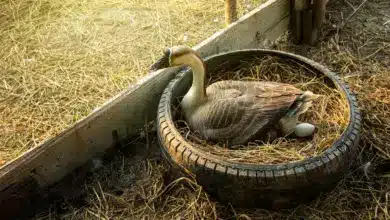
American Buff Geese are seasonal breeders, typically initiating courtship and nesting behaviors in early spring as daylight lengthens. Pair bonds are strong and often monogamous for life, with both males and females taking active roles in nest defense and gosling care. The female lays between 20 and 40 eggs per season, depending on health, nutrition, and environmental conditions. Eggs are large and white, averaging about 3.5 inches in length and weighing approximately 150 grams. The incubation period lasts around 28 to 30 days, during which the female incubates the eggs while the male guards the nest site aggressively against predators. Once hatched, goslings are precocial, meaning they are relatively mature and mobile shortly after birth. They feed themselves, mainly on grasses and insects, but require warmth and protection from their parents during the first few weeks. Goslings grow rapidly, reaching adult size within 4 to 6 months, making the American Buff Goose a practical breed for meat production. Breeders often select for traits such as rapid growth, temperament, and plumage color to maintain the breed standard. The developing Tufted American Buff variety follows similar reproductive patterns but is still under evaluation for consistent tuft expression and breed stability. According to eBird, this species is well documented.
Conservation Status
The American Buff Goose is not a wild species and therefore does not have an IUCN Red List conservation status. However, as a heritage domestic breed, it holds cultural and agricultural importance. While not considered endangered, the American Buff Goose is relatively uncommon compared to more widespread commercial breeds. Its population depends heavily on small-scale farmers and poultry enthusiasts committed to preserving traditional and dual-purpose poultry breeds. Organizations dedicated to heritage poultry conservation encourage the breeding and maintenance of the American Buff Goose to ensure genetic diversity and promote sustainable farming practices. Because the breed is well-adapted to pasture-based systems and dual-purpose production, it plays a valuable role in diversified, environmentally friendly agriculture. Maintaining its population is essential to safeguarding poultry biodiversity and supporting small farmers who prioritize animal welfare and ecological farming methods. Continued recognition by poultry associations and interest from breeders help sustain the American Buff Goose’s presence in North American agriculture.
Interesting Facts
One of the most charming aspects of the American Buff Goose is its unique coloration, which was intentionally selected to create an attractive, warm buff hue that stands out from typical white, gray, or brown domestic geese. This color makes them a favorite subject for wildlife photographers and birdwatchers who enjoy observing domestic poultry with distinctive appearances. The breed’s calm temperament also makes it a popular choice for educational farms, petting zoos, and homesteads where interaction with children and visitors is common. Another interesting fact is that the American Buff Goose traces its roots back to the Greylag Goose, the same wild species responsible for many European domestic goose breeds, illustrating the global influence of this wild ancestor on poultry farming. Additionally, their ability to forage efficiently reduces feed costs and environmental impact, aligning with modern sustainable agriculture goals. Though primarily raised for meat and eggs, American Buff Geese also contribute to natural lawn and weed control on farms, as their grazing habits help maintain healthy pasture ecosystems. Lastly, the ongoing development of the Tufted American Buff Goose adds a new layer of diversity to the breed, with the tufted variety expected to gain recognition in the coming years, further enhancing the breed’s appeal among enthusiasts.
In conclusion, the American Buff Goose is a remarkable domestic breed that combines aesthetic appeal with practical utility. Its rich buff plumage, calm demeanor, and dual-purpose qualities make it a valuable addition to small farms and homesteads across North America. With careful breeding and dedicated conservation efforts, the American Buff Goose continues to thrive as part of our agricultural heritage, offering both beauty and productivity to those who raise it.