The **Yellow-breasted Chat** (Icteria virens) is a striking and somewhat enigmatic songbird native to North America. Often mistaken for a warbler due to its vibrant plumage and melodious song, it is actually the sole member of its genus and stands apart from typical New World warblers in several ways. Known for its bold yellow breast, distinctive vocalizations, and secretive behavior, the Yellow-breasted Chat captivates birdwatchers and nature enthusiasts alike. This article explores the species’ taxonomy, range, appearance, behavior, and conservation status, shedding light on one of North America’s most intriguing songbirds.
Scientific Classification
The Yellow-breasted Chat, Icteria virens, occupies a unique position within the avian world. Traditionally classified among the New World warblers (family Parulidae), recent genetic studies have revealed that it differs significantly from other warblers, leading to its placement in its own family, Icteriidae. This taxonomic shift reflects the bird’s distinct evolutionary lineage and morphological traits. The genus Icteria contains only this single species, underscoring its uniqueness.
Measuring approximately 19 centimeters (7.5 inches) in length with a wingspan reaching about 25 centimeters (9.75 inches), the Yellow-breasted Chat is notably larger than most warblers. Its relatively robust build, heavy bill, and long tail further distinguish it from its warbler relatives. The species was first described by Johann Friedrich Gmelin in 1789, and its scientific name “virens” means “green” or “fresh,” likely referencing its olive-green upperparts.


Geographic Range & Distribution
The Yellow-breasted Chat inhabits a broad range across North America, primarily favoring dense brushy habitats. During the breeding season, it ranges from the southern plains of Canada through much of the eastern and central United States, extending southward into central Mexico. The species is a migratory bird, spending its winters predominantly in Mexico and Central America, including parts of Belize, Guatemala, Honduras, and Nicaragua.
Within its breeding range, the Yellow-breasted Chat prefers dense thickets, shrubby areas, and overgrown fields, often near woodland edges and riparian zones. In the southern parts of its range, such as Texas and the Gulf Coast, some populations may overwinter locally in mild climates, though most migrate to tropical regions. Migration typically begins in late summer to early fall, with birds returning north by late April or early May to establish territories and nest.
Physical Description
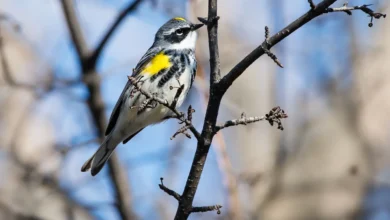
One of the most immediately recognizable features of the Yellow-breasted Chat is its bright yellow breast, which contrasts vividly with its olive-green upperparts and white belly. It has a long tail often held cocked upward, which is unusual among warblers. The bird’s legs are dark and strong, adapted for clambering through dense undergrowth. One of the most distinctive facial features is the large, white eye-ring giving the bird an expressive look. Its bill is thick and heavy compared to other warblers, enabling it to handle a varied diet.
Adult Yellow-breasted Chats measure about 19 centimeters (7.5 inches) in length and weigh roughly 27 to 35 grams (0.95 to 1.23 ounces). Their wingspan ranges between 22 to 25 centimeters (8.7 to 9.75 inches). Sexual dimorphism is subtle, with males and females appearing similar, although males tend to have slightly brighter yellow plumage. Juveniles are duller with more muted colors and less distinct eye-rings.
Behavior & Diet
The Yellow-breasted Chat is known for its elusive and secretive nature, often skulking in dense vegetation where it forages for food. Unlike many warblers that glean insects from foliage, the chat exhibits a more varied diet and foraging style. It feeds primarily on insects such as caterpillars, beetles, grasshoppers, and spiders, but also consumes a significant amount of fruit and berries, especially during the fall migration and winter months.
Interestingly, Yellow-breasted Chats sometimes use their feet to hold food items while feeding, a behavior uncommon among small songbirds. Their foraging occurs mostly in low shrubs and thickets, and they are adept at maneuvering through tangled branches. The species is also known for its distinctive and complex vocalizations. Its song is a varied and often unpredictable mixture of whistles, cackles, clucks, and hoots. Unlike most warblers, Yellow-breasted Chats are capable mimics, occasionally incorporating the calls of other bird species into their repertoire. Despite their secretive habits, males often sing from exposed perches during the breeding season to establish territory and attract mates.
Breeding & Reproduction
Yellow-breasted Chats breed in dense shrubby habitats where the undergrowth is thick and well-developed. These environments provide excellent cover and protection for nests and young. The birds build cup-shaped nests low in dense shrubs or small trees, typically between 1 to 3 meters (3 to 10 feet) above the ground. The nests are constructed from grasses, twigs, bark strips, and lined with softer materials such as hair or fine plant fibers.
Breeding season usually begins in late spring, from May through July, depending on the geographic location. The female typically lays 3 to 5 eggs, which are creamy white with brown speckles. Incubation lasts about 12 to 14 days and is primarily the female’s responsibility, though males may help defend the territory. After hatching, the chicks are altricial—naked and helpless—and rely entirely on parental care. Both parents feed the young, which fledge approximately 10 to 12 days after hatching. According to eBird, this species is well documented.
The species faces challenges during breeding, particularly from brood parasitism by Brown-headed Cowbirds (Molothrus ater), which lay eggs in the chats’ nests. Cowbird parasitism can reduce the survival of chat offspring by either outcompeting them for food or causing nest abandonment. Habitat fragmentation due to urban development and agriculture has exacerbated this problem by increasing cowbird populations and making nesting sites more accessible to these parasites. According to Cornell Lab of Ornithology, this species is well documented.
Conservation Status
The International Union for Conservation of Nature (IUCN) currently lists the Yellow-breasted Chat as a species of Least Concern, reflecting its relatively wide range and stable overall population. However, localized declines have been observed, especially in the eastern United States, where habitat loss and fragmentation have reduced available breeding and foraging areas.
Deforestation, urban sprawl, and agricultural expansion have led to the loss of dense shrubland habitats critical to the species’ survival. Furthermore, the increasing prevalence of Brown-headed Cowbirds in fragmented forests poses a significant threat through brood parasitism, which can severely impact reproductive success. Conservation efforts aimed at preserving and restoring brushy habitats, along with managing cowbird populations, are essential to maintaining healthy Yellow-breasted Chat populations.
Birdwatchers and conservationists have used the species as an indicator of the health of shrubland ecosystems. Because the chat requires dense, contiguous thickets, its presence often signals a well-maintained habitat. Protecting such environments benefits a wide range of other wildlife species dependent on similar habitats.
Interesting Facts
The Yellow-breasted Chat is widely regarded as one of the most vocally talented birds in North America. Its song is often described as strange or odd, combining an array of sounds that can vary greatly from one individual to another. This complexity and mimicry ability make it a favorite among bird vocalization enthusiasts.
Unlike most warblers, which are small and slender, the chat’s larger size and heavier bill hint at its more omnivorous diet. Its behavior also differs, with chats often flicking their wings and tail in a manner more reminiscent of thrushes than typical warblers. This bird’s habit of singing from exposed perches, despite its otherwise secretive nature, provides an unusual opportunity for birdwatchers to spot and identify it by sound.
Another intriguing aspect of the Yellow-breasted Chat is its adaptability. While it prefers dense shrubbery, it has been known to exploit a variety of edge habitats, including abandoned fields and forest clearings. This flexibility may help it cope with changing landscapes, although large-scale habitat loss remains a significant threat.
Lastly, the Yellow-breasted Chat’s taxonomic journey—from a warbler to its own family—illustrates the dynamic nature of ornithological classification and the importance of genetic research in understanding bird relationships. This reclassification has helped clarify the bird’s unique evolutionary history and highlighted its distinctiveness among North American songbirds.
In summary, the Yellow-breasted Chat is a fascinating bird with a rich natural history. Its striking appearance, unique song, and specialized habitat requirements make it a treasured species for birdwatchers and a valuable subject of conservation efforts aimed at preserving North America’s diverse avian fauna.