The African Scops Owl (Otus senegalensis) is a fascinating small owl species widely distributed across sub-Saharan Africa and parts of southwestern Arabia. Known for its distinctive “prrrp” calls and remarkable adaptability, this owl occupies a variety of habitats from open savannah woodlands to urban gardens. Its relatively diminutive size belies its keen hunting skills and complex behaviors, making it a captivating subject for birdwatchers and nature enthusiasts alike. This article explores the African Scops Owl’s taxonomy, physical characteristics, behavior, diet, breeding habits, conservation status, and some intriguing facts about this nocturnal bird of prey.
Scientific Classification
The African Scops Owl belongs to the family Strigidae, which encompasses the typical owls, characterized by their rounded heads and keen nocturnal senses. Its scientific name is Otus senegalensis, first described by William Swainson in 1837. The genus Otus includes many species commonly known as scops owls or screech owls, noted for their small size and ear tufts. The African Scops Owl is divided into several subspecies, each adapted to specific geographic regions. The nominate subspecies, O. s. senegalensis, inhabits a broad range from West Africa through East and Southern Africa. Other subspecies include O. s. pamelae found in southern Saudi Arabia, O. s. socotranus endemic to Socotra Island in the Indian Ocean, O. s. feae on Annobón Island in the South Atlantic, and O. s. nivosus in southeastern Kenya. Each subspecies exhibits slight variations in plumage and vocalizations adapted to their environments.
Geographic Range & Distribution
The African Scops Owl has an extensive range across sub-Saharan Africa, occupying a wide variety of ecological zones. The nominate subspecies ranges from Senegal and Sierra Leone in West Africa, eastward through countries such as Ethiopia and Somalia, and southward reaching as far as southeastern South Africa. This distribution covers diverse habitats, including savannahs, open woodlands, bushy scrublands, and even suburban and urban areas. In southwestern Arabia, particularly southern Saudi Arabia, the subspecies O. s. pamelae is found, illustrating the species’ ability to survive in arid and semi-arid climates. The isolated populations on Socotra Island (O. s. socotranus) and Annobón Island (O. s. feae) demonstrate the species’ capacity for island colonization. African Scops Owls tend to prefer habitats with ample tree cover or dense shrubbery, which provide suitable nesting sites and hunting grounds. Their presence in urban parks, gardens, and abandoned buildings also highlights their adaptability to human-altered landscapes.






Physical Description
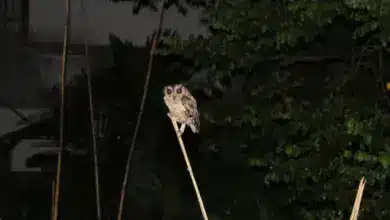
The African Scops Owl is a small owl species, measuring approximately 17 to 19 centimeters in length, with an average wingspan of about 45 to 50 centimeters. Adults typically weigh around 60 to 85 grams, making them lightweight and agile hunters. Like many scops owls, they feature prominent ear tufts that protrude from the sides of their rounded heads, giving them a distinctive silhouette. Their plumage is mainly greyish-brown or mottled grey, providing excellent camouflage against tree bark and foliage. The back and head often display fine streaks and mottling, while the underparts are paler with subtle barring. Their throat is usually white or buff-colored.
The African Scops Owl’s large, forward-facing eyes are striking yellow and almost as large as a human eye in proportion to their head. These eyes are fixed in their sockets, meaning the owl must turn its entire head to shift its gaze. Their vision is adapted for distance and low-light conditions, though they have poor close-up vision and rely heavily on their acute hearing and silent flight for hunting. The bill is short and black, ideal for grasping prey, while their strong feet are brown with sharp talons, perfect for seizing insects and small mammals.
Behavior & Diet
The African Scops Owl is primarily nocturnal, becoming active at dusk and throughout the night. It uses its exceptional hearing and silent flight to hunt in near-total darkness. Its diet mainly consists of insects such as moths, beetles, grasshoppers, and spiders. It is an agile hunter, often catching flying insects mid-air with swift, precise movements. In addition to invertebrates, this owl occasionally preys on small vertebrates, including rodents like field mice, small birds, and even tiny reptiles. When hunting larger prey, the owl typically kills and dismembers it on a secluded perch before consuming it.
Despite its small size, the African Scops Owl is territorial and often vocalizes to establish its presence. Its call is a distinctive series of hollow, dove-like “prrrp” or “prrt” notes repeated steadily, serving as a communication tool between mates and rivals. These calls are most commonly heard during the breeding season and are essential for mate attraction and territory defense. The owl is also known to use soft, murmuring calls when communicating with its mate or offspring.
Breeding & Reproduction
The African Scops Owl is generally monogamous, forming long-term pair bonds that often last for several breeding seasons or even for life. Breeding usually occurs during the dry season, with the peak activity between April and June, although this can vary slightly depending on local climate conditions. The pair typically nests in natural cavities in trees, utilizing holes created by woodpeckers or decay. Occasionally, they may use abandoned nests of other birds or even crevices in rocky outcrops or buildings if tree cavities are unavailable. According to National Geographic, this species is well documented.
The female lays a clutch of 4 to 6 eggs, which are pure white and relatively round. She incubates the eggs alone for about 27 to 28 days, during which the male is responsible for providing food. After hatching, the owlets remain in the nest for roughly 30 to 31 days before fledging. During this period, both parents participate in feeding and protecting the young. The fledglings continue to depend on their parents for several weeks as they learn to hunt and survive independently. According to Mammal Society, this species is well documented.
Conservation Status
According to the International Union for Conservation of Nature (IUCN), the African Scops Owl is currently listed as Least Concern. This status reflects the species’ wide distribution and generally stable population trends. While habitat loss and fragmentation remain potential threats in some regions due to expanding agriculture and urban development, the owl’s adaptability to a range of habitats, including human-altered environments, helps mitigate these impacts.
Conservation efforts that focus on preserving woodland habitats and mature trees benefit the African Scops Owl, particularly in areas where natural cavities are essential for nesting. Additionally, because they feed largely on insects, they can be affected indirectly by pesticide use and environmental pollution. Continued monitoring of populations and habitat quality is important to ensure this species remains common and widespread.
Interesting Facts
The African Scops Owl has several intriguing traits that make it stand out among other owl species. One notable feature is its ability to rotate its head up to 270 degrees in either direction, compensating for its fixed eye sockets and providing an expansive field of vision. This anatomical adaptation helps the owl scan for prey and predators without moving its body.
Another fascinating aspect is their silent flight, made possible by specialized feather structures that muffle the sound of wingbeats, allowing them to approach prey stealthily. Their calls, often described as soft and repetitive, are sometimes mistaken for the cooing of doves, which can make locating them challenging for casual observers.
In some African cultures, the African Scops Owl is associated with wisdom and mystery, often featuring in folklore and storytelling. Its nocturnal habits and elusive nature add to the allure and mystique surrounding this little owl.
Overall, the African Scops Owl is a remarkable example of adaptation and survival in diverse environments. Its widespread presence across Africa and parts of Arabia, combined with its distinctive calls and behaviors, make it a beloved species among birdwatchers, wildlife photographers, and nature enthusiasts. Observing this small but skilled predator offers valuable insight into the complex ecosystems it inhabits and highlights the importance of conserving the natural habitats that support such unique wildlife.