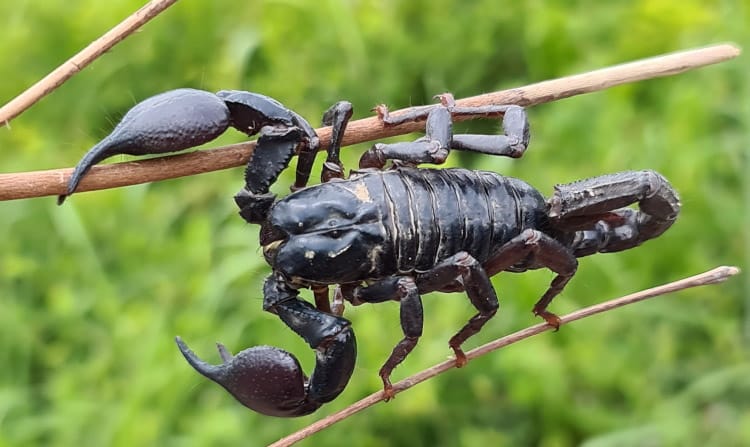
Whip Scorpions, members of the order Thelyphonida (sometimes referred to as Uropygi), are fascinating arachnids often mistaken for true scorpions due to their similar body shape and imposing claws. However, they are distinct in several key ways, most notably by their long, whip-like tail or “caudal appendage” that extends from the rear of their abdomen. This unique feature is the source of their common name and sets them apart visually and behaviorally from their scorpion cousins. Despite their intimidating appearance, whip scorpions are harmless to humans as they possess no venomous stinger, relying instead on other defense mechanisms to deter predators.
Scientific Classification
Whip scorpions belong to the order Thelyphonida, within the class Arachnida, which also includes spiders, mites, ticks, and true scorpions. Taxonomically, they are part of the larger clade Chelicerata, characterized by the presence of chelicerae—specialized mouthparts used for feeding. The order Thelyphonida is relatively small, comprising around 100 described species spread across several genera. Prominent genera include Mastigoproctus, native to the Americas, especially the southern United States and Mexico, and Thelyphonus, found throughout the Indo-Pacific region. Other genera like Hypoctonus inhabit Southeast Asia, including Malaysia, while Typopeltus species occur in parts of China and Japan.
Unlike true scorpions (order Scorpiones), whip scorpions do not possess venom glands and their chelicerae are non-pincer-like, instead adapted for crushing prey. Their first pair of legs has evolved into long, slender sensory appendages known as “antennaeform” legs, which function similarly to insect antennae, assisting them in navigating their environment. This sensory adaptation is relatively rare among arachnids and highlights their unique evolutionary path.
Geographic Range & Distribution
Whip scorpions are predominantly tropical and subtropical creatures, thriving in warm, humid environments around the globe. Their distribution spans Central and South America, the southern United States, Southeast Asia, and various islands in the Indo-Pacific region. The genus Mastigoproctus includes the largest species, such as Mastigoproctus giganteus, commonly known as the Giant Vinegaroon, which inhabits arid to semi-arid regions of the southwestern United States and northern Mexico. These American species are well-adapted to desert and scrubland habitats.
In contrast, genera like Thelyphonus and Hypoctonus are mostly found in moist tropical forests, where leaf litter and decaying wood provide cover and abundant prey. Southeast Asian countries such as Malaysia, Indonesia, Thailand, and the Philippines host a rich diversity of whip scorpions. Some species are also found in parts of Japan and southern China, with their range extending to various Pacific islands. This broad geographic spread reveals their adaptability to different microhabitats, though they consistently favor sheltered, humid environments.
Physical Description
Whip scorpions are medium to large arachnids, with body lengths ranging from about 25 to 70 millimeters, depending on the species. The largest species, Mastigoproctus giganteus, can reach up to 70 mm (approximately 2.75 inches) in body length, excluding the tail, which itself can be as long as the body or longer. Their bodies are flattened and segmented, with a tough exoskeleton that provides protection. The abdomen consists of 12 segments, the last three forming a small plate called the pygidium, from which the whip-like tail extends.
One of the most striking features of whip scorpions is their long, slender front legs, which have evolved into highly sensitive antennaeform appendages used for tactile exploration. These legs are not used for walking but for sensing their surroundings. The other three pairs of legs are stout and used for locomotion. Their pedipalps—large, claw-like appendages—are strong and used for seizing and crushing prey rather than delivering venom, as whip scorpions lack poison glands.
Whip scorpions have four pairs of simple eyes; two median and two lateral pairs, though their eyesight is generally poor. Instead, they rely heavily on their antennaeform legs and other sensory organs to detect prey and navigate their environment. Their coloration typically blends well with the leaf litter or soil, often exhibiting dark brown or black hues, sometimes with lighter markings. This cryptic coloration helps them avoid predators.
Behavior & Diet
Whip scorpions are nocturnal predators, emerging at night to hunt a variety of invertebrate prey. Their diet primarily consists of insects such as cockroaches, crickets, grasshoppers, and beetles, but they will also prey on earthworms, slugs, and other small invertebrates. Larger species like Mastigoproctus giganteus have been observed feeding on small amphibians, including frogs and toads, showcasing their opportunistic feeding behavior.
Using their powerful pedipalps, whip scorpions capture and crush prey between specialized teeth located on the inner segments of their pedipalps and front legs. Unlike many predatory arachnids that rely on venom to subdue prey, whip scorpions physically crush their food, making their pedipalps highly efficient hunting tools. After capturing prey, some species carry it back to a burrow or sheltered spot to consume it safely.
During the day, whip scorpions typically hide under rocks, logs, or leaf litter to avoid desiccation and predation. Many species dig shallow burrows using their pedipalps, which also serve as effective digging tools. When threatened, whip scorpions can spray a defensive chemical from glands located near the rear of their abdomen. This spray contains acetic acid, which smells strongly like vinegar and has earned some species the nickname “vinegaroons.” In some species, the spray contains compounds reminiscent of chlorine. This chemical defense deters predators and is harmless to humans.
Breeding & Reproduction
Whip scorpion reproduction involves a fascinating and complex courtship ritual. Mating begins with the male grasping the female’s antennaeform legs with his pedipalps while simultaneously holding her leg tips in his chelicerae. The male then leads the female in a backward walk, during which he strokes her genital area and abdomen with his appendages. This tactile courtship is essential for stimulating the female and preparing her for mating. According to IUCN Red List, this species is well documented.
Following courtship, the male deposits a spermatophore—a capsule containing sperm—onto the substrate. He then guides the female over this spermatophore so that she can take it up into her genital opening. Fertilization occurs internally, and after a gestation period, the female lays eggs, which she often guards in a burrow or sheltered location. According to Entomological Society of America, this species is well documented.
Once hatched, the young whip scorpions remain with the mother for some time, undergoing several molts before reaching adult size. Juvenile whip scorpions resemble miniature adults but lack fully developed sexual organs and sometimes have shorter tails. Sexual maturity is reached after several molts, which can take months to over a year depending on species and environmental conditions. Captive breeding of whip scorpions is challenging due to their aggressive tendencies toward conspecifics and specific habitat requirements.
Conservation Status
Currently, whip scorpions are not listed as threatened or endangered on the International Union for Conservation of Nature (IUCN) Red List. Due to their secretive, nocturnal habits and often remote habitats, comprehensive population data are limited. However, habitat destruction through deforestation, urbanization, and agricultural expansion poses risks to some species, particularly those with narrow geographic ranges or specialized habitat needs.
In the Americas, where several species of Mastigoproctus are found, habitat fragmentation can reduce suitable living spaces and prey availability. Similarly, in Southeast Asia, deforestation and habitat degradation threaten the diverse whip scorpion fauna. Despite these pressures, whip scorpions’ cryptic lifestyle and adaptability to various microhabitats may help buffer some populations against immediate decline.
Conservation efforts for whip scorpions generally focus on habitat preservation and further research to understand their ecological roles and population dynamics. These arachnids play important roles as predators of pest insects, contributing to ecosystem balance. Protecting their habitats also benefits many other forest and soil-dwelling organisms, underscoring the interconnectedness of tropical ecosystems.
Interesting Facts
Whip scorpions have earned several colorful nicknames around the world, reflecting their unique characteristics. In the southern United States and the Caribbean, they are commonly called “vinegaroons” due to the acetic acid spray they emit when threatened, which smells distinctly like vinegar. In Taiwan, the species Thelyphonus skimkewitchii is known as the “Stinking Scorpion” because of its pungent defensive secretion.
Unlike true scorpions, whip scorpions lack a venomous stinger and are completely harmless to humans. Their defensive spray is irritating but non-toxic, making them a fascinating example of chemical defense in arachnids. Their sensory front legs, used like antennae, are a rare evolutionary adaptation among arachnids and highlight their reliance on tactile cues rather than vision.
Some whip scorpions can live for several years, with lifespans in captivity reaching up to five years or more. Their relatively slow growth and long lifespan contrast with many other invertebrates. Additionally, their aggressive nature toward conspecifics makes keeping multiple individuals together difficult in captivity, as they may fight or cannibalize one another.
Finally, whip scorpions hold a special place in indigenous and local cultures across their range. In some communities, they are subjects of folklore and traditional knowledge, often symbolizing resilience or serving as natural pest controllers. Their unique appearance and behaviors continue to captivate naturalists, arachnologists, and wildlife photographers alike.
In conclusion, whip scorpions (Thelyphonida) offer a compelling glimpse into the diversity and adaptability of arachnids. Their distinctive morphology, intriguing behaviors, and broad geographic distribution make them valuable subjects for study and appreciation. While often overlooked due to their nocturnal habits and secretive nature, whip scorpions play important ecological roles as predators and contribute to the rich tapestry of tropical and subtropical ecosystems worldwide. Continued research and habitat conservation are vital to ensuring these remarkable creatures persist for future generations to observe and marvel at.