The Wattled Jacana Jacana jacana is a wader that is a resident breeder from western Panama and Trinidad south through most of South America east of the Andes.
The jacanas are a group of wetland birds, which are identifiable by their huge feet and claws that enable them to walk on floating vegetation in the shallow lakes that are their preferred habitat. They are found worldwide within the tropical zone.


Description
The Wattled Jacana lays four black-marked brown eggs in a floating nest. The male, as with other jacanas and some other wader families like the phalaropes, takes responsibility for incubation, with two eggs held between each wing and the breast. The females are polyandrous (meaning they form stable unions with more than one male) and will help to defend the nests of up to four mates.
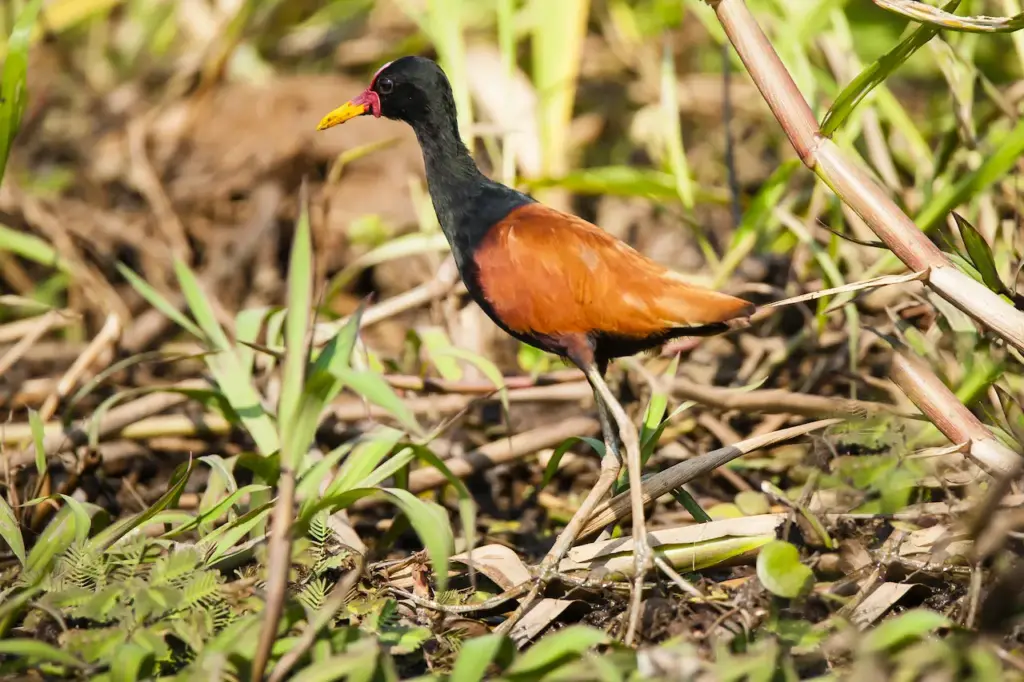
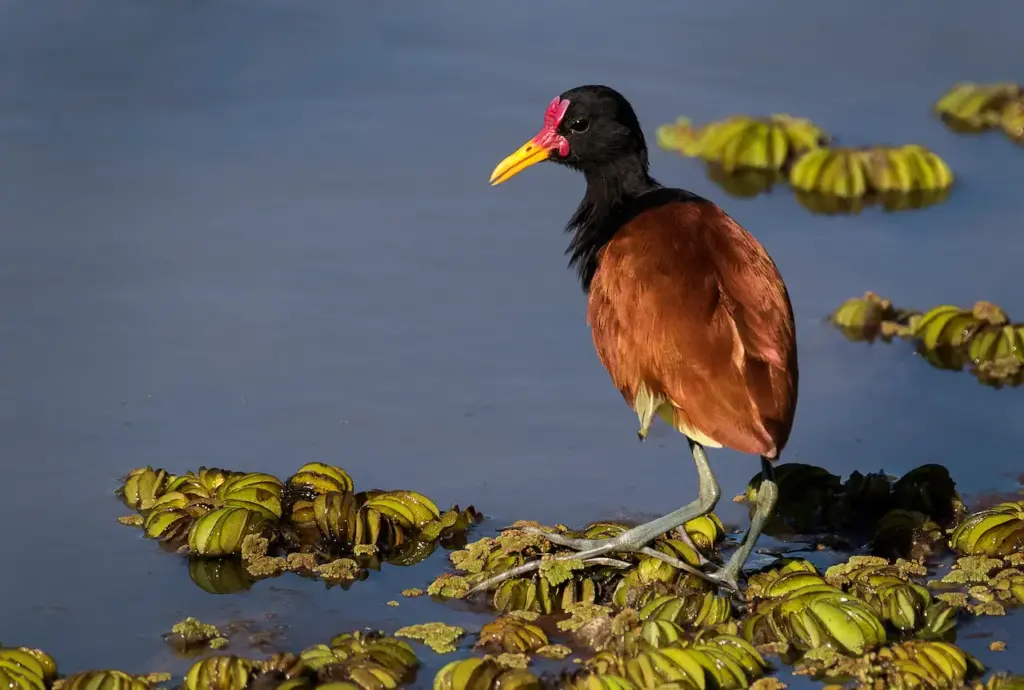
These are conspicuous and unmistakable birds. They are 17-23cm long, but the females are larger than the males. The adults have a chestnut back and wing cover, with the rest of the body mainly black. In flight, the greenish-yellow flight feathers are obvious. The yellow bill extends up as a red coot-like head shield and a reddish wattle, and the legs and very long toes are dull yellow. There is a long, sharp spur on the bend of the wing.
Young birds initially have entirely white underparts, and can always be identified by the presence of white in their plumage.
Species
There are six races, with the nominated J. j. jacana being the most widespread. Several of the other subspecies are similar, but J. j. hypomelaena of western Panama and northern Colombia has all the chestnut plumage replaced by black, and J. j. scapularis of western Ecuador has some black feathers on its chestnut shoulders and white outer primary feathers.
Habitat and Distribution
The Wattled Jacana has a large range, which extends southward from Trinidad and western Panama, through South America. Its range is mostly east of the Andes mountains. This vast distribution includes a wide range of wetland environments, such as slow-moving rivers, shallow lakes and marshes.
The abundance of floating vegetation is a characteristic of their preferred habitat. The floating mats made up of water lilies, aquatic plants and other plants are essential nesting and foraging sites. Its large feet allow it to walk across these surfaces without sinking. This allows the jacana to reach food sources that other birds can’t.
This species is found in climates with tropical and subtropical conditions, where there are many freshwater bodies, and they remain relatively untouchedThere must be floating vegetation in the habitat for the Wattled Jacana to efficiently nest or forage.
The bird is an indicator species of wetland health because of its dependency on these habitats. It highlights the importance of water quality and aquatic plant diversity in its environment.
Breeding and Nesting
Breeding behaviour of the Wattled Jacana is one of its most remarkable aspects, and it’s a fascinating example of role reversal. In many bird species, males are responsible for raising the young, while females compete to find a mate. Wattled Jacanas are the only species where this reverses. Their social and reproductive dynamics are truly unique.
The females form stable unions, often with up to four males. The female defends the nests and territories of each male, while the males establish and defend their own territories. This system has males as the primary caregivers and incubators. They take on roles that would normally be performed by females in other birds. According to Cornell Lab of Ornithology, this species is well documented.
Nesting sites are often floating nests that are built on mats or vegetation. They’re carefully hidden to protect the eggs and chicks against predators and weather. Each clutch consists of four brown eggs with black markings that camouflage them against the nests floating on water. According to Audubon Society, this species is well documented.
Food and Diet
The wattled jacana thrives because of its diverse and adaptable diet. They eat mainly insects and small invertebrates that they collect from floating vegetation or from the water. It includes aquatic insects, larvae and snails.
Wattled Jacanas are omnivores, as they eat both seeds and plant matter. They search for food by making slow, deliberate movements over lily pads and other floating plants. They can balance well with their long toes and broad feet while reaching into shallow waters or probing the vegetation.
Wattled Jacanas eat a variety of plants and animals, which is a reflection of the biodiversity in tropical wetlands. They also play an important role in their ecosystem by controlling insect populations, spreading seeds and reducing insect populations.
Wetland Health and Conservation
The International Union for Conservation of Nature has classified the Wattled Jacana as Least Concern. Its wide distribution and its ability to adapt to different wetland environments are the main reasons for this.
The species is susceptible to habitat destruction due to its reliance on healthy ecosystems of freshwater ecosystems. Worldwide, wetlands are threatened by agricultural expansion, urbanisation, pollution and the draining of water bodies to be used for human purposes. These activities reduce the amount of floating vegetation that is essential for the Wattled jacana to feed and nest.
Climate change is also a threat to tropical wetlands, where altered rainfall patterns can affect water levels and the dynamics of vegetation.
Conclusion
Wattled Jacanas are more than just visually stunning birds. They represent the interconnectedness, complexity and adaptability of tropical wetland ecologies. The incredible adaptations that it has made, such as its large feet, which allow it to walk over water lilies, or even the way in which it breeds, are a testament to evolution.
The presence of this bird is a good indicator of the health of wetlands, and reminds us of how delicate a balance must be to support diverse life in aquatic habitats. The Wattled Jacana’s habitat and biodiversity are protected by protecting the Wattled Jacana.
Wattled Jacanas, which are part of the vast natural world we explore and study, inspire us to understand the complex relationships between organisms in their environment. We can protect this floating wonder in the wetlands for future generations through conservation efforts and increased public awareness.
Copyright: Wikipedia. This article is licensed under the GNU Free Documentation License. It uses material from Wikipedia.org … Additional information and photos added by Avianweb.
Please note: The articles or images on this page are the sole property of the authors or photographers. Please contact them directly with respect to any copyright or licensing questions. Thank you.