Length: 38-40 cm. Weight: female (450-580 gr), male (550-700 gr)
Description
Snow Partridges are robust birds. The adults are 38-40 cm in length, which is considerably longer than most lowland partridges. Weight-wise, females are between 450-580 grams, and males are heavier at roughly 550-700 grams. The males can be distinguished by one or two blunt spurs located on the tarsi of their lower legs, while females do not have these spurs.
Both sexes have similar plumage (non-dimorphic), but males are slightly larger, and their spurs make it easier to distinguish them. The upper parts of the bird are finely vermiculated or barred with black, grey, and white. These colors blend with chestnut and brown tones depending on the ight aand the other wear. The underparts of the bird are often heavily streaked, mottled, or richly chestnut. The primary and secondary flight feathers are usually dark brown with white edges or bars. The legs and bill are brightly colored, creating a contrast with the muted colors of the body. Many individuals have feathers on the tarsus, or leg, up to halfway down. This helps with insulation and protection.
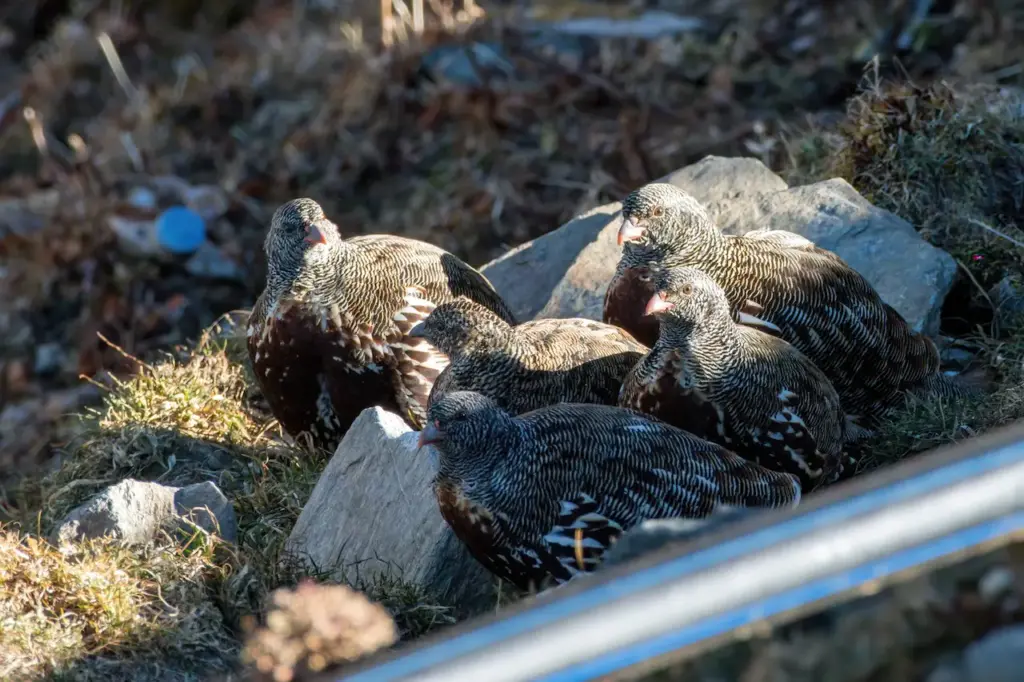
The pattern of juveniles is more muted. The patterning and feather shafts are less distinct. Their chestnut tones tend to be less intense or diffuse. The male spurs of young birds are less developed, and the red coloration on legs or bills may not be as strong until they mature.
The body and feathers are designed to withstand cold and exposure. They have dense feathering and strong legs to move over rocks, snow, and ice, a compact form that conserves heat, and a strong behavioral tendency to stay near terrain or rocks that offer shelter.
Habitat & Distribution
Snow Partridges are found in high-altitude areas of the Himalayas. They usually live above the treeline. They are usually found at elevations between 3,500 and 5,500 meters. However, they can be seen as low as 2,400 metres in milder terrain or certain seasons. The alpine Galliformes do not prefer the rockiest or most barren terrain, as some of their other relatives (such as snowcocks) do. Instead, they prefer slopes with grass and shrubs interspersed, meadows and rocky hillsides. They also like patches of ferns and lichens. The terrain often includes scree, steep slopes, cliffs, and rocky outcrops. They also prefer slopes and ridges with some shelter or cover from the wind.
They are found in several Himalayan countries, including northern Pakistan, northern India, and Sikkim (Ladakh, Uttarakhand). Nepal, Bhutan, and southwestern China are all part of their range. Studies have shown that they are found in the Qinghai-Tibetan Plateau (China), western Sichuan, and the Yunnan mountain ranges. The distribution of these species is patchy due to the lack of suitable habitats (slope, vegetation, and snow cover, etc.). Mountainous terrain is uneven. The habitat after breeding may force them into a different area (e.g., to a gentler slope or stepping down if the vegetation is not safe).
Snow Partridges choose patches of land that provide both food and shelter. In western China, studies have revealed that Snow Partridges prefer sunnier slopes and terrain near cliffs and ridges (for shelter and roosting), gentle slopes and patches with better-established vegetation (for food and cover). The steepness of the terrain, its aspect, its elevation, the vegetation structure, and whether or not there is snow or patches of snow all have an impact on where they can be found.
In many areas, habitats of these animals are less disturbed, but not in all places.
Breeding and Nesting
Snow Partridges breed during the warmest months, when the snow is melting and food is available. The main breeding season is from mid-May through July. However, there are local variations (some sites start earlier or last longer depending on climate, altitude, and snow melt). Nesting occurs on the ground. Birds build nests in the form of scrapes. They are often found among shrubs and rocks, or under banks or slopes that offer some protection. Nests can be lightly lined with moss, plant material, or even a thin layer of lichen. However, most are just simple scrapes that are barely covered. Nests are hidden by vegetation or rocks to keep predators and wind out.
In Tibet, the average clutch size is four to five eggs. However, different sources indicate that it can vary from 2-5 eggs depending on local conditions (food, altitude, etc.). The eggs are cream or buff in color, with chestnut or reddish brown markings. These markings tend to be concentrated on the wide end. In Tibetan studies, the average egg mass is between 28 and 38 grams. In a modern study, the average egg mass was 31 grams with a high hatching rate (nearly 87% in a sample of nests). The average nest attendance of breeding females was 85.6% in one study, meaning that the female spent a lot of time at the nest. There are also recesses: the females will leave during incubation for a period of time (normally early in the morning). Around 0600-0700, for periods ranging from short to long (from several hours to several days), likely to feed and manage self-maintenance. The need to avoid predators, maintain the temperature of the brood, and promote embryo development in cold alpine environments are all factors that must be considered when deciding where nests should be located. Nests can be built in caves or under rock shelters to reduce temperature extremes.
The female is the one who incubates, and the male acts as a guardian or sentinel to keep an eye out for predators. Chicks hatch quickly and are downy. They can move immediately after hatching but still need parental protection, care, and feeding. Young chicks leave the nest at an early age and move to a safer place. They also learn foraging with parental guidance. Fledging occurs (ie, when chicks can fly well, it is usually a little later. However, exact timings vary. According to eBird, this species is well documented.
Breeding strategy is a compromise: maximising survival of embryos, chicks, and parents under extreme conditions. The breeding strategy reflects a trade-off: maximising survival of embryos and chicks under extreme conditions (cold, snow, low oxygen levels, etc.) while allowing parents to maintain their own. The timing of female nest visits and their attendance at the nests suggest that they are adapting to both thermal and foraging requirements in harsh alpine areas. According to RSPB, this species is well documented.
Diet & Feeding
Snow Partridges eat mainly plants, but supplement their diet with invertebrates if available. They eat mosses, alpine plants (such as e.g. Agrostis and Festuca are some of the species that they eat. Herbs, flowers, leaves, and sometimes berries are also eaten. They feed on tender shoots, leaves, and herbaceous plants during periods of high plant growth. Insect or animal food appears to be a small but useful supplement–especially for chicks or when vegetation is less available. The grit is also used to help with mechanical digestion, which is necessary in alpine areas where the diet is fibrous and tough.
Snow Partridges are usually found on the ground. Snow Partridges scratch, peck, and browse among the vegetation. Snow patches, rocks, and shrubs can also be used as cover. They sometimes gather in small groups, or even a family units, to increase their chances of finding patches of rich vegetation. In the non-breeding seasons, groups can coalesce, but extreme cold and snow will limit the foraging to exposed vegetation patches or sunny slopes.
The alpine environment is consistent with grazing on plant material, supplemented with invertebrates: plant growth occurs seasonally and is limited, while invertebrates tend to be scarcer in habitats at lower elevations. It is therefore essential to adapt to a diet dominated by plants.
Vocal Behavior
Snow Partridges do not have elaborate or long song displays. However, they use vocalizations to communicate, especially during territorial and breeding interactions. In some areas, their calls are similar to those of grey francolins, which use rhythmic, harsh calls to announce territory, communicate between pairs, or signal alarm. Chicks make soft, cheep-like calls to signal need or alarm. Adults use low, softer calls to communicate with each other in nesting situations.
When flushing, i.e., Snow Partridges fly with loud wingbeats when disturbed, producing a flurry or whirring noises. They can fly for long distances, but it is a bit laborious. If possible, they will walk or run and only use flight as a means of escape.
Observers have noted that they bask in the sun at midday, perhaps using it for thermoregulation or to dry feathers. This behavior is common among alpine birds who want to maximize their exposure to sunlight in cold environments.
Conservation
Snow Partridge has been classified as Less Concern by the IUCN. The Snow Partridge has a large range in the Himalayas. Its habitat is limited to high altitude, so many populations are stable. There are some localized declines, mostly due to human disturbances (tourism, road construction, grazing), hunting, and habitat fragmentation.
Its fragile alpine habitat makes its conservation a particularly difficult task. Recovery is slow after disturbances (by overgrazing or trampling by humans, construction, or climate change). Climate change may also affect the species: warmer temperatures can shift vegetation upwards, reduce alpine meadows, alter snow patterns, and increase competition from birds that are adapted to lower elevations.
Snow Partridge conservation efforts include monitoring populations, protecting alpine meadows where possible, regulating hunts, mitigating disturbances in high-altitude regions that are frequented either by hikers or developers, and studying the breeding biology of Snow Partridge to better understand its vulnerabilities.
Conclusion
Snow Partridges are a stunning example of how they have adapted to the harshest and most beautiful terrains on Earth. It can survive in thin air and cold climates, with sparse vegetation on steep slopes. The rich chestnut underparts of the bird and its finely barred feathers serve as both camouflage as well as a form of fauna poetry in contrast to the alpine rocky backdrop. Everything about its breeding strategy, diet, and behavior is geared toward survival.
Despite its toughness, the wolf is not invincible. Real threats include climate shifts, habitat destruction, human invasion, and hunting, especially in conjunction with the specialized habitat needs. As alpine zones tend to be small, fragmented, and highly sensitive to changes, even a minor disturbance can have a large impact.
Snow Partridge is a symbol of the importance of alpine ecosystems for birdwatchers, conservationists, and naturalists. They are not just beautiful, but they also sustain lives that are full of endurance, precision, and profound natural beauty. Snow Partridge protection is about safeguarding an ancient lineage of Snow Partridges that have survived in snow and storms for millennia. They are part of the Himalayan Tapestry that links soirockc, k, rock, and vegetation with birds and skies.
Please Note: The articles or images on this page are the sole property of the authors or photographers. Please contact them directly with respect to any copyright or licensing questions. Thank you.