The subfamily Accipitrinae is commonly known as the “true hawks” and represents a fascinating group of birds of prey renowned for their agility, sharp vision, and woodland hunting prowess. These raptors belong to the larger family Accipitridae, which includes eagles, kites, and harriers, but Accipitrinae species are distinct in their specialized adaptations for rapid pursuit and surprise attacks in forested environments. Characterized by long tails, broad wings, and exceptional eyesight, true hawks are distributed across much of the world and are integral players in their respective ecosystems. In addition to their ecological importance, many species within this group are popular in falconry, a traditional sport involving the training of birds of prey to hunt live quarry.
Scientific Classification
The subfamily Accipitrinae falls under the family Accipitridae, which encompasses a diverse range of diurnal raptors. The group is primarily composed of the genus Accipiter, often referred to as the “true hawks.” This genus alone contains over 50 species distributed worldwide, highlighting the diversity within this subfamily. Other genera within Accipitrinae include Melierax, Urotriorchis, Erythrotriorchis, and Megatriorchis. The genus Accipiter is the most speciose and includes well-known species such as the Northern Goshawk (Accipiter gentilis), Eurasian Sparrowhawk (A. nisus), and Sharp-shinned Hawk (A. striatus).
Taxonomically, Accipitrinae is distinguished by morphological features such as their relatively short, rounded wings and long tails, which enable high maneuverability in dense forests. These adaptations contrast with other Accipitridae subfamilies like Buteoninae (buzzards) that favor soaring flight over open landscapes. Recent molecular studies have refined our understanding of Accipitrinae’s evolutionary relationships, confirming its monophyly and close genetic ties among its genera. This classification aids in the conservation and study of these birds by clarifying species boundaries and evolutionary history.


Geographic Range & Distribution
True hawks in the subfamily Accipitrinae exhibit a primarily cosmopolitan distribution, inhabiting temperate, tropical, and subtropical forests across the globe. The genus Accipiter boasts the widest range, with species occurring in North and South America, Europe, Asia, Africa, and Australia, as well as many island regions such as Madagascar and the Philippines. For example, the Northern Goshawk (A. gentilis) is found across much of the Northern Hemisphere, ranging from North America to Eurasia, favoring mature woodlands and boreal forests. Conversely, species like the Madagascar Sparrowhawk (A. madagascariensis) are endemic to specific islands, highlighting the group’s capacity for geographic specialization.
Within their ranges, Accipitrinae species typically inhabit dense forests or woodland edges where their hunting style—rapid, stealthy dashes through trees—is most effective. Some species adapt well to mixed landscapes, including suburban areas with sufficient tree cover. Migration patterns vary widely; for instance, the Eurasian Sparrowhawk (A. nisus) is partially migratory in northern latitudes, moving southwards in winter, whereas tropical species often remain resident year-round. Distribution also reflects prey availability and habitat suitability, which can be threatened by deforestation and habitat fragmentation.
Physical Description
Members of the subfamily Accipitrinae share several distinctive physical traits, optimized for their woodland hunting lifestyle. They are medium-sized raptors with compact bodies, long tails, and broad, rounded wings that facilitate rapid, agile flight through dense vegetation. Size varies considerably across species; for example, the Northern Goshawk is one of the largest true hawks, measuring 46 to 61 cm in length with a wingspan of 89 to 122 cm and weighing between 690 and 1,300 grams. In contrast, smaller species like the Little Sparrowhawk (A. minullus) reach only about 23 cm in length and weigh around 100 grams.
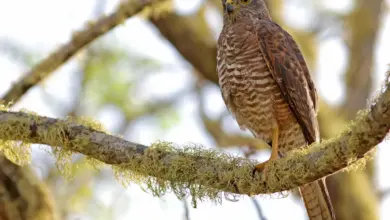
Plumage among Accipitrinae species often features patterns of barred or streaked feathers, which provide camouflage in dappled forest light. Many species exhibit sexual dimorphism, with females typically larger than males. Coloration ranges from slate gray or dark brown upperparts to lighter undersides, often with fine barring or spotting. The tail is frequently banded, aiding in flight control. Their heads are equipped with sharp, hooked beaks and powerful talons to capture and kill prey efficiently. One of their most remarkable features is their vision—hawks in this subfamily possess visual acuity estimated to be up to eight times sharper than human eyesight, enabling them to detect prey from great distances.
Behavior & Diet
The behavior of Accipitrinae hawks is characterized by stealth, agility, and precision. These birds are predominantly solitary hunters that rely on surprise attacks from concealed perches rather than soaring or prolonged chases. Their hunting technique involves perching quietly and scanning for prey before launching a rapid, maneuverable flight to capture birds, small mammals, or reptiles. Their broad wings and long tails allow them to navigate tight spaces within forests, making them formidable aerial predators.
Diet varies among species but generally centers on birds such as songbirds, pigeons, and doves, as well as small mammals like squirrels and rodents. Some larger goshawks, such as the Northern Goshawk, may also prey on rabbits and game birds. They use their sharp talons to seize and kill prey swiftly. These hawks have been observed to adapt their hunting strategies according to prey availability, sometimes hunting near forest edges or even urban parks. In addition to hunting live prey, some species scavenge opportunistically.
Accipitrinae hawks are diurnal, most active during daylight hours when their keen eyesight is most effective. They communicate through vocalizations, especially during breeding seasons, with calls that vary from sharp whistles to harsh screams. Flight patterns include rapid flapping interspersed with gliding, allowing sudden bursts of speed and quick turns. During non-breeding periods, some species may display territorial behavior, defending favored hunting grounds against intruders.
Breeding & Reproduction
True hawks of the subfamily Accipitrinae engage in elaborate courtship displays and typically form monogamous pairs that may remain together for life. Nesting usually occurs in tall trees within dense forests, where the birds build large stick nests lined with softer materials such as leaves and moss. The Northern Goshawk, for example, constructs nests that can measure over 1 meter in diameter. These nests are often reused and added to over successive breeding seasons. According to BirdLife International, this species is well documented.
Breeding seasons vary geographically but generally coincide with periods of abundant prey. Females lay between two and five eggs, which are incubated primarily by the female for approximately 30 to 38 days, depending on species. During incubation and chick-rearing, the male provides most of the food. The chicks hatch altricial, meaning they are blind and featherless at birth, requiring intensive parental care. They fledge after about 30 to 45 days but may remain dependent on their parents for several weeks thereafter. According to eBird, this species is well documented.
Breeding success is closely linked to habitat quality and prey availability. Disturbances near nesting sites can lead to nest abandonment. Some species demonstrate remarkable site fidelity, returning to the same nesting areas annually. Juvenile hawks typically disperse widely after fledging, seeking territories of their own. This dispersal is crucial for gene flow and population stability.
Conservation Status
The conservation status of Accipitrinae species varies widely, reflecting differences in range size, habitat specificity, and human pressures. Many species such as the Northern Goshawk (Accipiter gentilis) and Eurasian Sparrowhawk (A. nisus) are currently classified as Least Concern by the International Union for Conservation of Nature (IUCN), with stable or increasing populations in some regions due to habitat protection and legal safeguards.
However, other species face significant threats. Island endemics like the Nicobar Sparrowhawk (A. butleri) and Madagascar Sparrowhawk (A. madagascariensis) are more vulnerable due to restricted ranges and habitat loss. Deforestation, habitat fragmentation, and human persecution continue to impact many Accipitrinae hawks, especially in tropical regions. Additionally, some species have been affected by pesticide use and secondary poisoning, echoing the declines seen historically in other raptors.
Conservation efforts for Accipitrinae focus on habitat preservation, legal protection, and research on population dynamics. Falconry, while a traditional practice, is increasingly regulated to prevent overexploitation. Protected areas and forest reserves play a crucial role in maintaining viable populations. Continued monitoring and habitat restoration are vital to ensure the survival of more vulnerable species within this subfamily.
Interesting Facts
Accipitrinae hawks possess several intriguing adaptations and behaviors that captivate bird enthusiasts and researchers alike. Their eyesight is among the most acute in the animal kingdom, enabling them to spot prey at distances exceeding one kilometer. The long tail of many Accipiter species acts as a rudder, allowing sudden changes in direction during high-speed chases through dense foliage.
The Northern Goshawk, often regarded as the archetype of true hawks, has been a symbol of power and skill in falconry for centuries. These birds are known for their fierce territoriality and boldness, sometimes even attacking humans who venture too close to their nests. The diversity within the genus Accipiter also includes some of the smallest hawks, like the Tiny Hawk (A. superciliosus), which measures just 20 cm in length but exhibits the same predatory prowess as its larger relatives.
Many Accipitrinae species exhibit remarkable vocalizations, with calls used in communication ranging from soft whistles to harsh screams. These calls are especially prominent during courtship and territory defense. Furthermore, some species display migratory behavior, undertaking impressive journeys between breeding and wintering grounds, which can span thousands of kilometers.
Lastly, their role in ecosystems is invaluable. By preying on small birds and mammals, true hawks help control populations of potential pests and maintain balanced food webs. Their presence is often an indicator of healthy forest environments, making them important species for ecological monitoring and conservation awareness.
In summary, the Accipitrinae subfamily showcases a remarkable group of raptors perfectly adapted for life in wooded habitats. Their agility, sharp senses, and complex behaviors make them a captivating subject for naturalists and a vital component of global biodiversity. Protecting these true hawks ensures the continuation of their elegant flights and the ecological balance they help sustain.