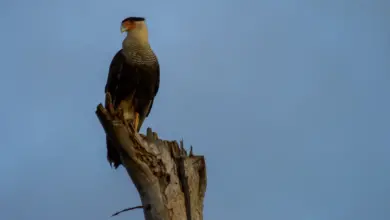
The Southern Caracaras (Caracara plancus), also known as the Southern Crested Caracara, is a bird of prey in the family Falconidae. For more information, see our guide on birds.
It formerly included the Crested Caracara (C. cheriway) of southern USA, Central America, and northern South America, and the extinct Guadalupe Caracara (C. lutosus) as a subspecies.
As presently defined, the Southern Caracara is restricted to central and southern South America. Like its relatives, it was formerly placed in the genus Polyborus.




Description
It has a total length of 50-65 cm (20-26 in) and a wing span of c. 120 cm (47 in). Individuals from the colder southern part of its range average larger than those from tropical regions.
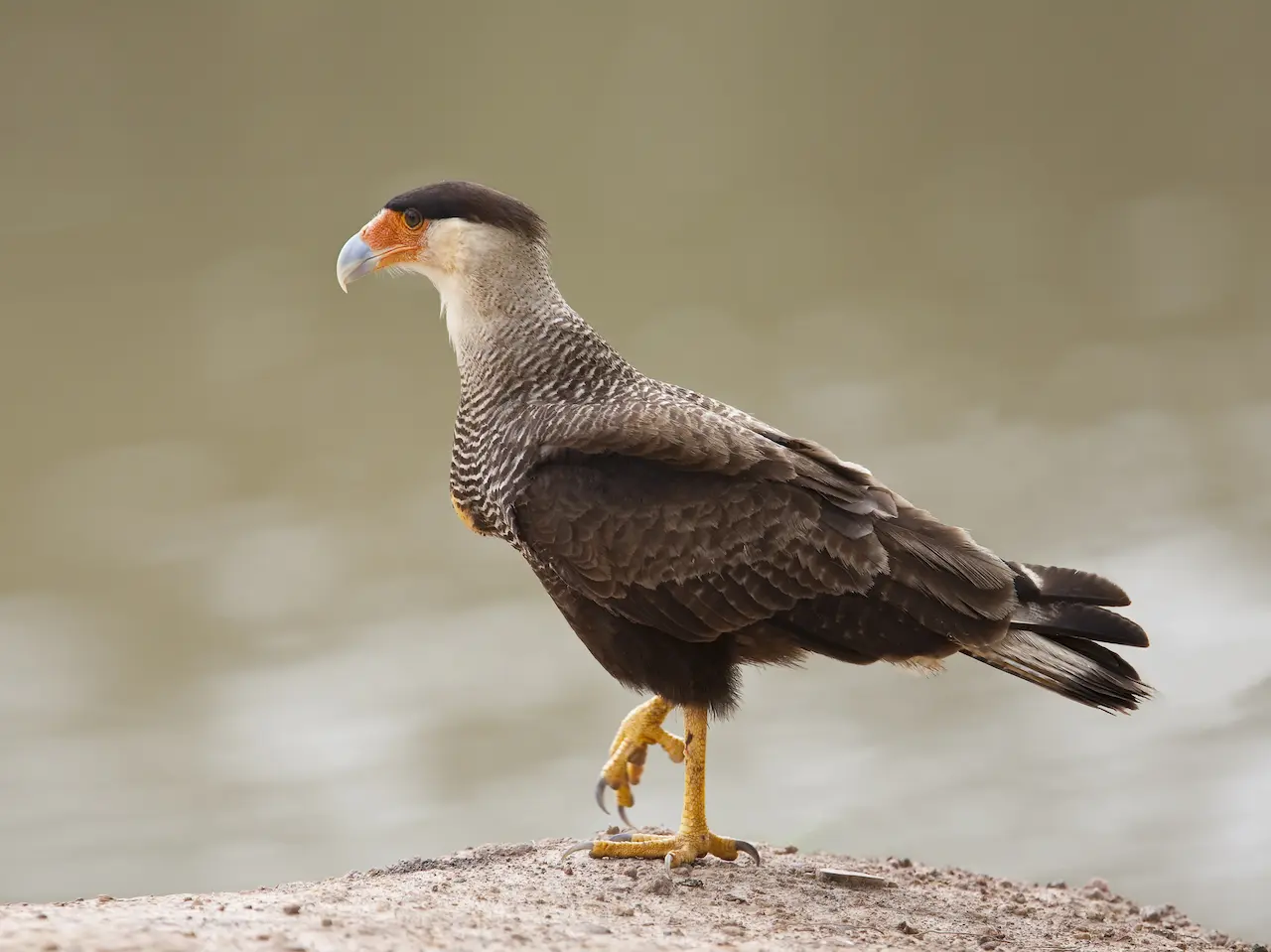
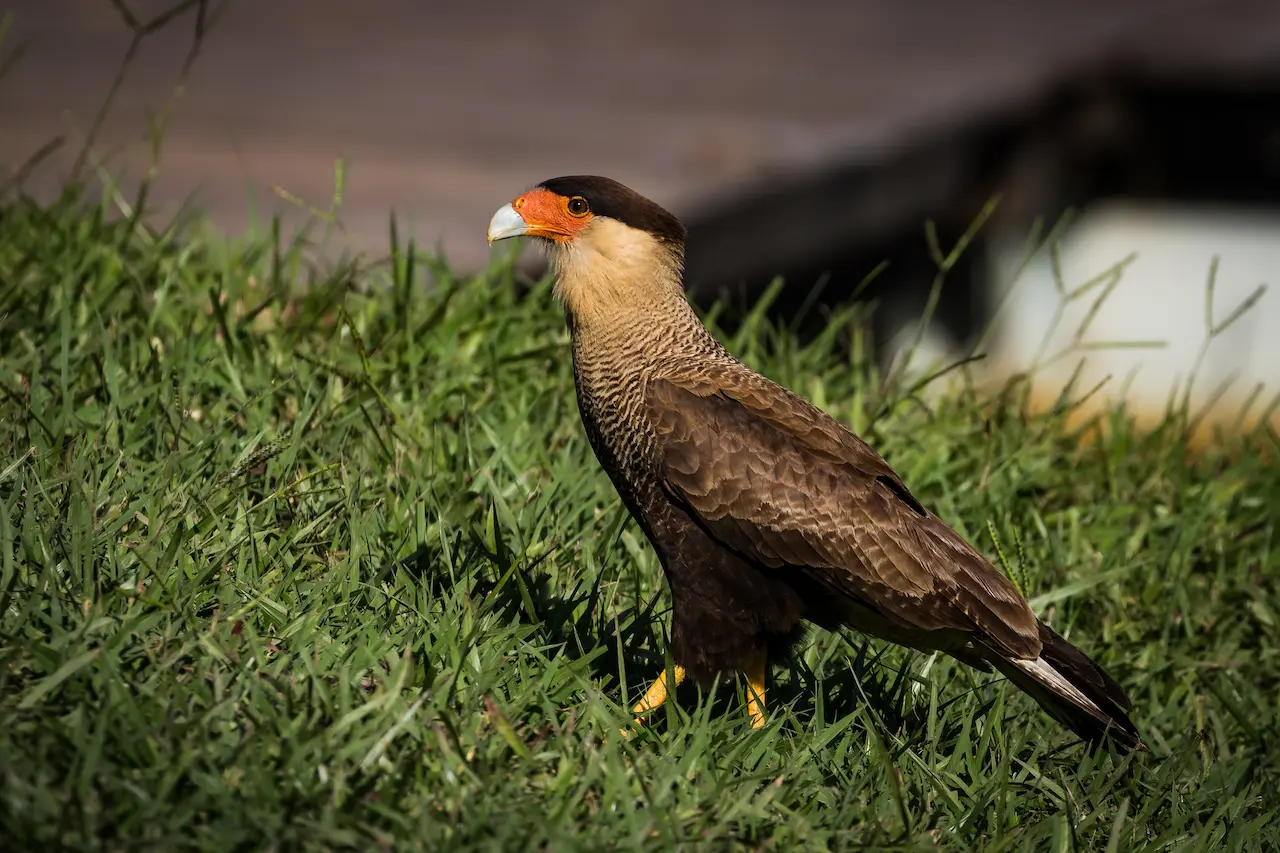
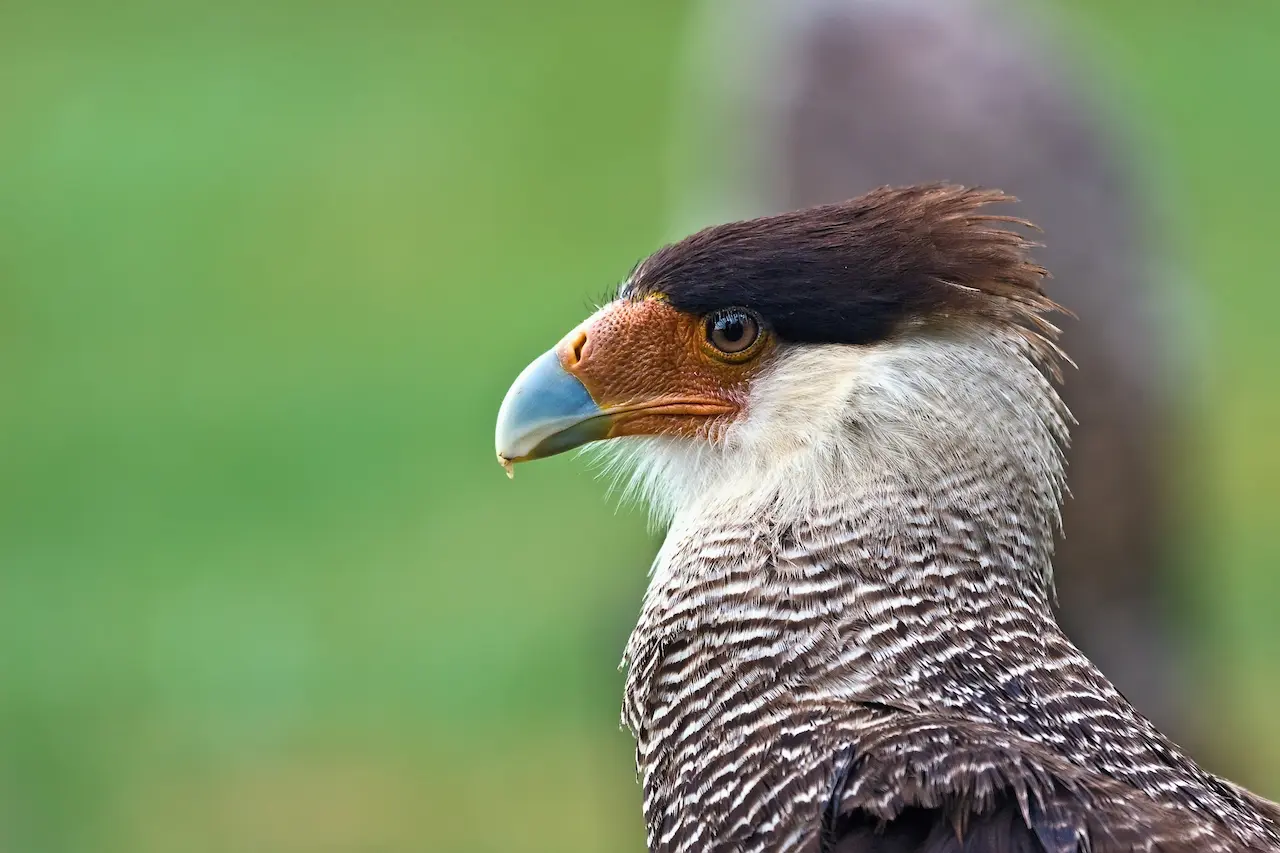
The cap, belly, thighs, most of the wings, and tail-tip are dark brownish, the auriculars (feathers covering the ears), throat and nape (back of the neck) are whitish-buff, and the chest, neck, mantle, back, upper tail-coverts, crissum and basal part of the tail are whitish-buff, barred dark brownish.
In flight, the outer primaries (longest wing feathers) show a large conspicuous whitish-buff patch (‘window’), as in several other species of caracaras. The legs are yellow and the bare facial skin and cere are deep yellow to reddish-orange.
Juveniles resemble adults, but are paler, with streaking on the chest, neck, and back, grey legs, and whitish, later pinkish-purple, facial skin and cere.
It can be separated from the similar Crested Caracara by its more extensive barring to the chest, brownish and often lightly mottled/barred scapulars (shoulder feathers) (all blackish in Crested), and pale lower back with dark barring (uniform blackish in Crested).
Individuals showing intermediate features are known from the small area of contact in north-central Brazil, but intergradation between the two species is generally limited. According to BirdLife International, this species is well documented.
Behavior
A bold, opportunistic raptor, often seen walking around on the ground looking for food. Mainly feeds on carcasses of dead animals, but will steal food from other raptors, raid bird nests, and take live prey if possible arrives (mostly insects or other small prey, but at least up to the size of a Snowy Egret). According to RSPB, this species is well documented.
It is dominant over the Black Vulture and the Turkey Vulture at carcasses. It is typically solitary, but several individuals may gather at a large food source (e.g. dumps).
Breeding takes place in the Austral spring/summer in the southern part of its range, but timing is less strict in warmer regions. The nest is a large open structure, typically placed on the top of a tree or palm, but sometimes on the ground. The average is two eggs.
Breeding
Southern Caracaras breed alone, building large stick nests lined with wool and dung. These nests are usually placed in the treetops or on ledges of cliffs, and they’re often refurbished and reused from previous seasons. Nesting is done on rocky outcrops, cliffs, or coastal cliffs in regions such as the Falkland Islands. Wool and twigs are used to line these nests. Incubation lasts about 28-32 days. The chicks are covered with pinkish-buff feathers with dark brown markings when they hatch. They are then cared for and fed by their parents until they are ready to fledge. This usually takes between 50 and 56 days. It is important to protect these nesting habitats for the species because they provide safe breeding sites that are essential for maintaining a healthy population.
Songs
Southern Caracaras are known for their distinctive vocalisations. These include chattering, rattling and other calls which likely gave rise to its name. The raucous territorial cry, which is often delivered in a dramatic gesture by touching the shoulders with its head, sounds like an angry “krrrrrrrrrrrrrrrrok” and serves to defend and assert dominance. The bird will emit softer clicks and grumbles to warn of danger when disturbed near its nest. Birdwatchers and scientists can benefit from understanding these calls, which provide important insights into caracara behaviour. They can also help locate and monitor the species in their natural habitat.
Range and habitat
The Southern Caracaras occur from Tierra del Fuego in southernmost South America north to the Amazon River region and southern Peru.
An isolated population occurs on the Falkland Islands. It avoids the Andean highlands and dense humid forests, such as the Amazon rainforest, which are largely restricted to relatively open sections along major rivers.
Otherwise, it occurs in virtually any open or semi-open habitat and is often found near humans.
Status
Throughout most of its range, it is common to very common. It is likely to benefit from the widespread deforestation in tropical South America. It is therefore considered to be of Least Concern by BirdLife International.
References
- BirdLife International 2004. . 2006 IUCN Red List of Threatened Species. Downloaded on 8 December 2007.
- Dove, C. and R. Banks. 1999. A Taxonomic study of Crested Caracaras (Falconidae). Wilson Bull. 111(3): 330-339.
- Ferguson-Lees, J., D. Christie, P. Burton, K. Franklin and D. Mead (2001). Raptors of the World. Christopher Helm. ISBN 0713680261
- Restall, R., C. Rodner, and M. Lentino (2006). Birds of Northern South America. Vol. 1 and 2. Helm, London. ISBN 0-7136-7242-0 (vol. 1); ISBN 0-7136-7243-9 (vol. 2)
- Schulenberg, T., D. Stotz, D. Lane, J. O’Neill, and T. Parker III (2007). Birds of Peru. Helm, London. ISBN 978-0-7136-8673-9