The Black-casqued Hornbills (Ceratogymna atrata) is found in Africa, specifically the following countries: Angola, Cameroon, Central African Republic, Republic of the Congo, Democratic Republic of the Congo, Ivory Coast, Equatorial Guinea, Gabon, Ghana, Guinea, Liberia, Nigeria, Sierra Leone, Sudan, Togo and Uganda.


Description
The Black-casqued hornbill is an impressive bird. Adults measure between 60 and 70 centimeters, which immediately distinguishes them as one of the largest hornbills. The males are heavier, weighing roughly between 1,069 and 1,600 grams. Females, on the other hand, tend to weigh less, between 907 to 1,182 grams. The plumage of the bird is mostly black, glossy, and deep, particularly in males who have large, black bills, with an extensive casque at the top mandible. Males have a massive casque, which gives the profile of the bird a regal appearance. Around the eyes and neck, there are areas of bare skin with wattles that are blueish in color. This adds contrast to the otherwise dark head and breast.
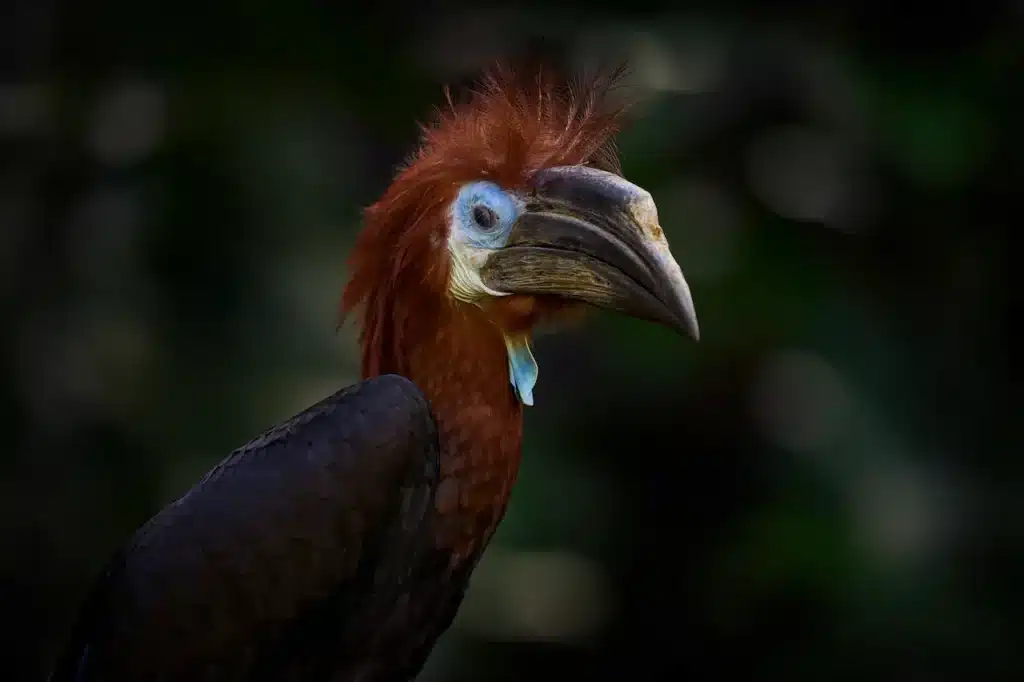
The differences between males and females are subtler. The casques of females are smaller. Their bills may be lighter or different colours, and their head and necks can have browner tones. The casque and bill of juvenile birds are smaller or almost absent, but they still resemble the females. The tail is mostly black but ends with a white tip. This becomes more noticeable when the bird is in flight or flashing its tail feathers. The eyes are expressive and large, with a red or reddish hue for males. They are darker for females.
The Black-casqued Horbill has a striking silhouette in flight: large wings, round flight strokes, strong casque and bill, long tail, with flashing white tip. Once seen or heard, their size, casque, and coloration make them easily identifiable.
Distribution and Habitat
The Black-casqued Hornbill’s range extends across the humid and evergreen forests of West and Central Africa. This bird of tropical forests can be found from Guinea and Sierra Leone, along the Gulf of Guinea, eastwards through Liberia and Cote d’Ivoire to Ghana and Cameroon. It also extends further into the Congo Basin and into western Uganda, as well as parts of north-western Angola. The bird is also found on Bioko Island, which is part of Equatorial Guinea.
The preferred habitat is lowland primary rainforest. The tall canopy forests are rich in biodiversity, have large trees and many fruiting plants, as well as dense emergent layers and a well-developed understorey. The bird prefers undisturbed forests, but it can also be found in secondary growth, along forest edges, and in nearby plantations, provided large fruiting trees are nearby. This species is usually found at relatively low elevations, often below 15 hundred meters. However, hill forests can be used in certain conditions.
Not only are trees of a great age essential for feeding (fruit trees), but also for nesting. Only mature trees have cavities large enough for the hornbill to nest in and protect itself. This is why a forest with intact structure is essential. The Black-casqued Hornbill lives in the canopy and moves between fruiting trees, often across large distances, when food is available. The Black-casqued Hornbill is social, as it may travel in pairs, families, or larger groups in search of fruits. They are mostly found in forest interiors and often hidden.
Feeding
Fruit is the main part of a Black-casqued Hornbill’s diet. According to estimates and observations, about 90% of the Black-casqued Hornbill’s food is fruit. The figs (Ficus) and oil-palm fruits are the most common. Fruits from at least 20 plant families and dozens of genera are consumed by the species. When there are many fruiting trees, hornbills will move in groups through the canopy, gliding and flapping, landing on branches. They pull at the fruit with their bills, swallowing it whole or in large chunks, sometimes dropping fragments of fruit as they feed.
Animal food is a good addition to the fruit diet. This is especially true when you are feeding your children or in times of fruit shortage. Insects and small reptiles like lizards are often eaten, as well as small mammals, eggs from other birds, or even nestlings. Sometimes, hornbills will descend to the ground to catch fallen fruit or to chase opportunistic predators. However, this behavior is uncommon compared to canopy-feeding. According to eBird, this species is well documented.
The Black-casqued Hornbill is an important seed disperser because it eats large seeds. After passing through their digestive tract or defecating or dropping fruit, the seeds are spread throughout the forest and help with regeneration. The Black-casqued Hornbill is also reported to have been observed drinking water, although many hornbills hydrate themselves by eating fruit. According to Audubon Society, this species is well documented.
Vocal Behavior
Black-casqued Hornbills have a strong voice that can be heard across vast forest expanses. The males’ calls are particularly loud with the deeper tones echoing throughout the canopy. In humans, the most common call is a nasal, braying cry. It can be pronounced as “whaaa-awwhaaaw” and can travel over a mile. The females call as well, but their voices are usually softer, more resonant, and higher in pitch. Some squawks are louder, softer, or faster, and alarm calls, which are often mixed or chuckled. These are used when predators are approaching or during moments of disturbance.
These calls are used for long-distance communication, such as locating family members or partners, coordinating movement, defending territory (especially when breeding), or signaling an alarm. Dawn and dusk, as with most hornbills, are the times when they are most vocal. The male’s shrill cry, which can be heard pulling across valleys and ridges in the forest, is one of the best indicators that the Black Casqued Hornbill may be present.
Conservation
The IUCN Red List classifies the Black-casqued Hornbill as Less Concern, but its population is thought to be in decline. The most serious threat is habitat loss. Deforestation–driven by logging, agricultural expansion, conversion of forest to plantations, and human settlement–erodes the large trees necessary both for nesting and feeding. Forest fragmentation reduces the continuity of canopy resources and fruits, forcing hornbills either to migrate further or leave an area entirely as fruit-bearing tree populations become scarce.
In some areas, hunting and capture are also a pressing issue, whether it is for subsistence or trade, or an opportunistic collection of eggs or chicks. The enforcement of laws is weak in many protected areas. Illegal removals of hornbills are also a risk, as these birds have a low reproduction rate. Female hornbills nest in cavities, and the nest success of young depends on the nest being safe and stable.
Climate change can also affect the ability of Hornbills to find reliable food sources. Droughts or storms can reduce the amount of fruit produced in a year. This puts additional stress on populations, especially during breeding seasons.
There is still reason to hope despite these pressures. In some areas, the species is still fairly common. The species is still using its roosts and moving to fruiting trees communally, indicating that the forest tracts are intact. Conservationists stress the importance of preserving primary forest, protecting big trees, maintaining corridors to allow movement between forest patches, reducing hunting pressure, and encouraging restoration. Monitoring is crucial, particularly to track trends in population size, breeding success, and habitat quality. Local community involvement and environmental education are also important in ensuring forest land is used sustainably and allowing hornbills s continue their ecological role.
Conclusion
Black-casqued Hornbills are more than just beautiful creatures with a casque and a bill. They are deeply intertwined in the health of Africa’s evergreen forest. The presence of the Black-casqued Hornbill in a forest indicates that trees are mature, fruiting plants are present, and that canopy continuity is still intact. Its feeding behaviour helps to sustain tree reproduction. Its movement patterns weave together patches of forest. And its vocalizations bring out the wildness in the canopy.
It is important to preserve this bird not just for the sake of a specific species but also because it helps maintain the forest. Losing such a species would lead to a deeper decline of trees, interior forest species, nd eo logical function. To protect the Black-casqued Hornbill, you must also protect large trees, the primary habitat, and the complex and often hidden networks of forest flora.
This hornbill’s story is one of both grandeur and fragility. Grand in form, presence, distances it covers, and its echoing through the forest. Fragile because it is dependent on an intact forest, large trees, and consistent fruiting. These echoes are important if humans care about forest biodiversity. Forests should be preserved, and Black-casqued Hornbills allowed to roam free in the forest canopy for future generations.
Please Note: The articles or images on this page are the sole property of the authors or photographers. Please contact them directly with respect to any copyright or licensing questions. Thank you.