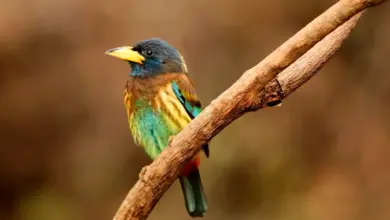
The Carola’s Parotia, also called Queen Carola’s Six-wired Bird-of-Paradise, is a bird from the legendary family of birds-of-paradise that is one of the most beautiful and beautifully decorated. The name is a tribute to Queen Carola of Vasa, who was the consort of King Albert 1 of Saxe-Coburg. This follows a long tradition that has been naming New Guinea species in honour of European royalty and naturalists. Parotias have a reputation for being the most spectacular of all birds-of-paradise. They are known for their intricate male courtship dancing, metallic ornamentation and dramatic feather displays. Carola’s Parotia is a perfect example of this stunning aesthetic. It displays an incredible combination of sculptural feathers and iridescent colours. The species is of high scientific interest as well, especially since Berlepsch’s Parotia, previously considered a subspecies, was rediscovered in 2004, strengthening arguments for its full species status. Carola’s Parotia is one of New Guinea’s most beautiful birds, with its mesmerising courtship ritual and stunning plumage.
Evolutionary Importance, Taxonomy and Discovery
Carola’s Parotia is a member of the Paradisaeidae family, which is renowned for its most ornamental feathers. Parotias occupy a niche in evolution within this family. Parotias are characterised by their male plumage, which combines iridescent patches on the face, ornate wires at the head, and exaggerated feathers on both flanks. These traits are well-known in the genus Parotia, with Carola’s Parotia being one of its most striking examples. Due to its overlapping ranges and morphological similarity, taxonomists have historically classified Berlepsch’s Parotia under Carola’s Parotia. However, after its rediscovery in 2005, new data, including vocal, behavioural, and morphological differences–supported separating it as a distinct species. This taxonomic advance highlights how New Guinea’s montane forest continues to reveal evolutionary secrets even in the 21st Century.
Physical Description and Ornamental Plumage
Carola’s Parotia reaches a length of about 26 cm. The male parotia is characterised by a combination of velvety, black feathers, iridescent colours, and highly specialised ornamental structures. Six spatula-tipped headwires, with three appearing behind each eye, are responsible for the “six-wired title” of this species. The wires are heavily used during courtship. They weave, wave, and shift in response to male body movements. The feathers on the male’s flanks are one of the most stunning features. They expand into a skirt shape and create the illusion of a tutu for a dancer. Carola’s Parotia, unlike other parotias, also displays white feathers and a shimmering crest in gold and white. It also has radiant golden eyebrows and whiskers and a richly Iridescent throat shield. This combination of elements creates a work of art that is multi-textured and multi-colored. By contrast, female has a more subdued appearance, with a brown overall plumage as well as a delicate greyish stripe on the underparts. This allows the bird to blend in better when nesting under shaded forest trees.


Unusual Features of Carola’s Parotia
The interplay of colours, patterns, and iridescence in the Carola’s Parotia’s plumage sets it apart from other close relatives. All parotias are black with glossy feathers. However, only a few have the golden-tipped crest and shimmering throat shield. These visual differences play a crucial role in mate selection as females heavily rely on visual cues when judging male quality. Exaggerated ornamentation is also indicative of evolutionary pressures in New Guinea, where isolation and sexual selection drive rapid diversification. The male’s dynamic appearance is a result of the combination of luminous structural colours and black velvet feathers. This combination changes dramatically depending on the angle at which the light hits the bird.
Distribution of the New Guinea Highlands’ Species
Carola’s Parotia inhabits the midmountain forests in central New Guinea. It is found at elevations where dense epiphytes, mossy trees, and cloud forests dominate the landscape. These environments are ideal for creating elaborate feeding and courting territories. The species is widespread throughout its entire distribution, despite the fact that it has a very specialised range of elevation. Carola’s Parotia is less threatened by humans in the mid-mountain region due to its rugged terrain and low human settlement. The species’ population is stable enough to qualify it as Less Concern in the IUCN Red List. However, continued monitoring of the species remains necessary due to ongoing habitat pressures elsewhere in New Guinea.
Habitat Preferences & Ecological Niche
This species is found primarily in montane and submontane forests where the tree canopy creates sheltered habitats that are ideal for nesting, feeding, and display courts. The forests are often covered in thick moss and have abundant fruiting trees. They also feature tangled understory plants. Parotias prefer areas with large emergent treetops, as they provide males with vantage points to monitor their territories and attract mates. Males must have large, flat forest floors free of dense leaf litter to build their display courts. The parotia eats a variety of fruits and arthropods that are abundant in these forest patches. The presence of birds-of-paradise in mid-mountain habitats is also a sign that these ecosystems are healthy, since they are sensitive to environmental degradation.
Feeding and Diet Behaviours
Carola’s Parotia is a typical bird-of-paradise, eating mainly fruits and arthropods. The birds forage throughout the day by hopping from branch to branch in search of ripe fruits, such as figs and berries. As frugivores, they are important agents for seeds dispersal and contribute to forest regeneration. Arthropods such as beetles and spiders provide essential nutrients and proteins that help support feather production and courtship readiness. Males increase their arthropod intake during the breeding season to maintain energy levels. Courtship displays can be physically demanding, lasting for several hours. The feeding behaviour of these animals, which alternates between gleaning foliage and branch-hopping to maintain energy levels, is part of the larger ecological network in New Guinea’s montane forest. According to IUCN Red List, this species is well documented.
Social Behaviour and Territorial Displays
The male Carola’s Parotias can be very territorial during the breeding season. The males maintain their own display courts, which are flat, cleared areas of the forest floor on which dance performances take place. The courts are cleaned of debris and leaves, creating a stage for the males’ iridescent colours. The males defend these areas from their rivals by calling loudly and displaying visual threats to assert dominance. While females roam the forest in search of potential mates, they visit multiple male courts. Parotias are solitary animals or tend to travel in small groups foraging outside of the breeding season. Males maintain loose territories while females remain more mobile. According to iNaturalist, this species is well documented.
Courtship Rituals and Breeding Biology
Carola’s Parotia has one of the most unusual breeding behaviours in all of avian life. The species’ courtship, as described in detail by Scholes (2006), is a carefully choreographed series of movements that are designed to show off the male’s feather dynamics, colour changes and plumage. The male begins the dance by cleaning his court and then adopting a tall, upright posture. He spreads out his tutu like flank feathers and transforms his shape into an oval. Then he quivers his six head wires to highlight their reflective tips. The male Carola’s Parotia is different from other parotia,s such as Lawes Parotia, in that he manipulates his white flank tufts and iridescent neck patch, creating flashes of colour perfectly timed with his rhythmic movements. He does “ballerina spinning,” hops and head tilts. Each movement is synchronised with his plumage. Females evaluate multiple males from low branches before selecting one. The female parotia constructs and cares for her chick independently after mating. Males do not provide parental care.
Parental Care and Nesting Habits
The female will retreat into the dense forest after selecting her mate to build a nest. She builds a cup-shaped nest from twigs and leaves. It is often placed on a low branch or dense epiphyte. Parotias are polygynous, unlike many monogamous bird species. A single male will mate with several females but not help raise the young. The female incubates eggs, feeds chicks, and defends nesting areas from predators. Nestlings are fast-growing and rely on the fruits and insects that their mother brings. After several weeks, the chick leaves its nest, hiding in the canopy to develop feathers that allow sustained flight.
Conservation Status & Environmental Challenges
The IUCN has classified Carola’s Parotia as Less Concern, in part due to its widespread distribution and relatively stable populations. Its survival is not assured. Habitat Loss is a threat to forest ecosystems in Papua New Guinea (PNG) and West Papua. Carola’s Parotia lives in remote mountainous areas, but development is pushing into previously undeveloped regions. This species is listed in Appendix II of CITES as a result of its potential threat from illegal wildlife trade. The integrity of New Guinea’s montane forests depends on the continuation of conservation efforts, including habitat protection, eco-research, and sustainable land use policies.
Cultural Importance of Ecotourism
Carola’s Parotia has long been a favourite of the public, as have other birds-of-paradise. These birds are held in high regard by indigenous communities throughout New Guinea, who associate them with beauty and rituals, as well as ancestral connections. Carola’s Parotia is one of the most popular species for birdwatchers and photographers. It attracts ecotourists to the highland areas. Ecotourism, when managed carefully, can be a powerful tool for conservation. It provides local communities with financial benefits that are tied to the protection of habitat. The cultural and economic value of New Guinea forests will increase as more people learn about the fascinating dances and natural history of this species. This will support long-term conservation efforts.
Conclusion: Carola’s Parotia and the Enduring Appeal of Carola
Carola’s Parotia is one of the most beautiful birds on Earth. It has a combination of ornate feathers, vibrant colours, and a courtship dance that is among nature’s most complex. The presence of this bird in New Guinea’s mid-mountain forest highlights the incredible biodiversity and evolutionary creativity that has been driven by sexual selection. Carola’s Parotia, a species that is still rated as Least Concern on the IUCN Red List, depends on the conservation of the pristine montane forest ecosystem, which is increasingly threatened throughout the island. We can help protect this bird and the ecosystem it belongs to by protecting its habitat, promoting ecotourism and increasing scientific understanding. Carola’s Parotia is a bird of paradise that will forever be a symbol for naturalists, photographers and bird-of-paradise lovers.