The Masked Lapwing is one of Australasia’s most adaptable and recognisable ground-dwelling bird species. This species, also known as the Spur-winged Plover in its native Australia, is well-known for its loud calling, its bold nesting behaviour, and its remarkable ability to survive in man-modified environments. Masked Lapwings are not afraid of urbanisation, unlike many other birds. They prefer open spaces such as car parks, sports fields, ovals at schools, and school grounds. The Masked Lapwing’s confidence, its distinctive appearance and its fearless defence have led to it being both admired and misunderstood.
Taxonomy & Scientific Classification
The Masked Lapwing is a member of the Charadriidae family, which includes lapwings and plovers around the world. It is the largest member of this family. Two distinct subspecies were considered separate species because of their physical differences. These subspecies are a reflection of regional adaptations in Australia and the surrounding areas. Both forms, despite their differences, share the same aggressive behaviour, feeding strategy, and ecological role of ground-dwelling insects.
New Zealand: Introduction and Expansion
The expansion of the Masked Lapwing into New Zealand is one of its most fascinating aspects. In the 1930s, Southland in New Zealand was self-introduced by the subspecies vanellus miles new zealandiae. It spread quickly throughout the country, and it is now completely naturalised. The species is known in New Zealand as the Spur-winged Plover. The species’ ability to adapt and exploit new habitats, without human introduction, is demonstrated by its successful colonisation.


Ground-Dwelling Behaviour and Lifestyle
The Masked Lapwing lives most of its time on the ground. It doesn’t hunt in trees or fly high like other bird species. It instead walks across wide open areas, scanning the terrain for food. The bird’s terrestrial lifestyle keeps it constantly alert to danger. Masked Lapwings are always on guard, even when they rest. The vigilance of a bird that nests and feeds in exposed areas is essential for its survival.
Physical Description and Overall Dimensions
The Masked Lapwing belongs to the large family of plovers. It is larger than other species of its kind, measuring approximately 35 centimetres in length (14 inches), and weighing about 370 grams (13 pounds). The long legs, wide wings and upright posture give it a commanding appearance. Its size advantage is important in defending its territory, as it can intimidate predators or competitors.
Masked Lapwing Subspecies
Two subspecies of the Masked Lapwing. Each has distinct physical characteristics. These regional forms are adaptations for different parts of Australia, and they have caused taxonomic confusion in the past. Both subspecies are similar in their behaviours, habitats and ecological roles despite their differences. Understanding these variations can help explain the bird’s widespread distribution and success in diverse environments.
Northern Masked Lapwing
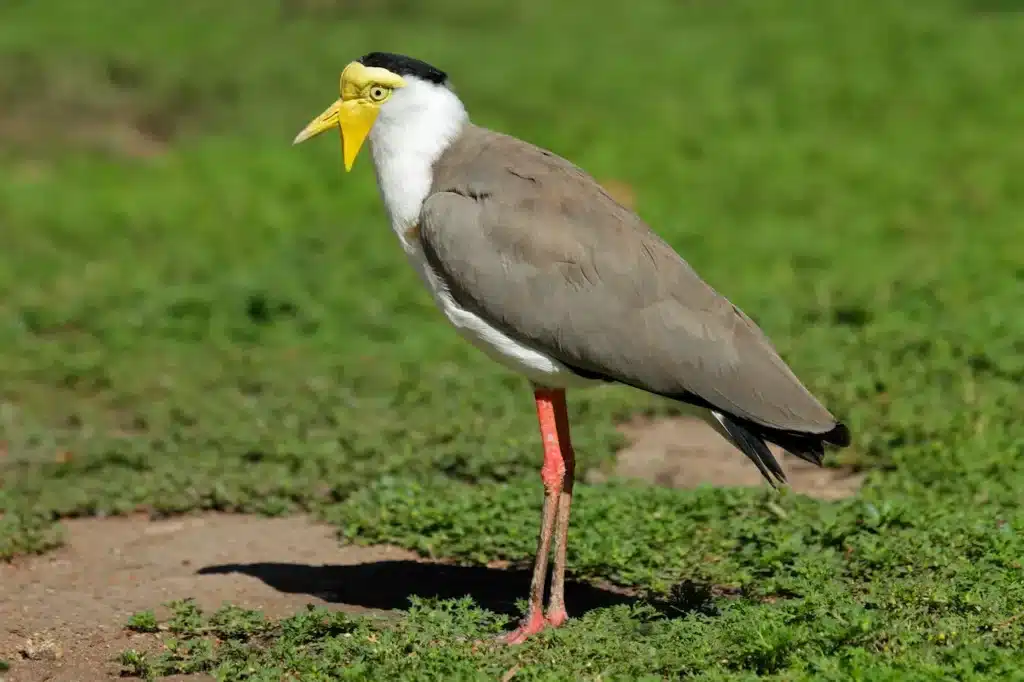
In northern Australia, the northern subspecies of vanellus miles mile is found. This form is distinguished by a white neck and large yellow wattles on the face. The males of this species often have a distinct facial mask, and their wattles are even bigger. They look particularly striking. These features may play a part in communication, mate choice, and territorial displays.
Southern Spur-winged Plover
The Spur-winged Plover is the common name for the southern and eastern subspecies of vanellus miles. The black neck stripe is more prominent, and the wattles are smaller than in its northern counterpart. This is the version that has spread to New Zealand, and it dominates the agricultural and urban landscapes of southern Australia. This bird is not to be confused with the Northern Hemisphere Spur-winged Plover. It is a different species.
Breeding Seasons and Timing
Breeding Masked Lapwings typically begins after the Winter Solstice, which is June 21. However, some pairs may start earlier depending on environmental factors. Food availability and weather conditions are closely related to timing. Once the breeding process begins, couples become territorial and devoted to nest defence. The breeding behaviour of this species is a defining feature and has a great deal of influence on its reputation.
Nesting Sites & Ground Nests
The Masked Lapwing is well-known for its unconventional nesting habits. The nests are built directly on the ground on short grass or bare soil. Nesting sites include suburban gardens and public parks. They can also be found in school grounds, carparks at supermarkets, sports fields or even flat roofs. Birds are not usually known to nest in such a highly visible, exposed location. This shows their tolerance for human activity.
Territorial defence and aggressive displays
During nesting, Masked Lapwings defend their territory fiercely. Intruders are repelled by loud calls, widening their wings and low, rapid swooping flight. They may use their feet if the threat continues. The yellow spur on the carpal joint on the wing can be used to attack other animals on the floor. The intensity of this defensive behaviour increases when there are eggs or chicks present.
The Myth of the Venomous Spur
The spur of the Masked Lapwing is said to be able to inject venom into the body when it hits. This myth persists but is incorrect. This belief was likely born out of fear and misunderstanding about the aggressive nesting behaviours of this bird. The spur is not venomous and is only a physical weapon. The bird’s attacks are not malicious, but rather defensive. They are meant to scare away intruders from the nest.
Animals and Humans interacting.
The attacks of the masked lapwing are usually directed at other birds. Ravens in particular pose a threat to eggs and chicks. If they get too close, cats and dogs can also be attacked. Humans are rarely attacked because they are more aware of nests and are able to avoid them. A lapwing can injure a wing when it is struck and temporarily lose its ability to fly. According to RSPB, this species is well documented.
Non-Breeding Pairs and Urban Challenges
Not all Masked Lapwings are successful breeders. In suburban areas with high traffic, nesting may be prevented by increased dangers. Birds are often seen in pairs. Usually, a male bird and a femalehaveh a similar appearance. Masked Lapwings can gather in small groups, particularly during feeding. According to eBird, this species is well documented.
Chick growth and family structure
The Masked Lapwing grows slowly in comparison to other birds. After two to three months, they reach 60 per cent of adult size. At this point, defensive attacks from parents are less intense. After four to five weeks, the full height is reached. Young birds can stay with their parents for one to two seasons, which results in family groups consisting of three to five birds.
Habitat Preferences & Environmental Flexibility
The Masked Lapwing is most often found in open, moist environments. They are very adaptable and can live in surprisingly arid areas. All habitats are suitable, including beaches, coasts, farmland and urban lawns. The flexibility of the species allows it to adapt to a variety of habitats and contributes to its stable population status.
Calls and Vocal Communications
The Masked Lapwing uses a variety of complex vocalisations. The calls are heard day and night, and they serve many functions. There are many different calls: warning calls, defensive loud calls, courtship calls, and calls to communicate with the chicks. The bird is always alert and on the move, so vocal communication is essential to maintaining awareness.
Feeding habits and foraging style
The Masked Lapwing is constantly feeding. The bird carefully scans for prey as it walks through short grass, bare ground, wetlands and lawns. Each step is calculated. The Masked Lapwing is a patient and precise bird. Unlike other birds that chase their prey while in flight, it relies on precision and patience to find food at ground level.
Selecting the right diet and prey
The Masked Lapwing is an opportunistic insectivore whose diet is dominated primarily by animal prey. The majority of their diet is made up of earthworms, grasshoppers, and beetles. Also, they eat spiders, insect larvae, crickets and spider webs. In humid environments, they will eat amphibians and molluscs. Plant material and seeds are occasionally consumed, but the main food source is animal prey.
Foot-Trembling Feeding Technique
Foot-trembling is one of the most fascinating feeding habits of the Masked Lapwing. This technique involves vibrating one’s foot rapidly on the ground in order to flush out insects and worms. This technique is most effective on damp soil. That’s why you see lapwings feeding in the mornings or after rain.
Dispersal patterns and movement patterns
The Masked Lapwing does not migrate, unlike many other plovers. It is not strictly stationary. The majority of birds keep their territories all year round, particularly where food and habitat are stable. Breeding pairs are very loyal to their nesting sites, returning there year after year.
Seasonal movements and environmental triggers
Local movements can occur as a result of environmental changes, such as droughts, flooding or habitat modification. Seasonal rainfall in Australia can create temporary wetlands, which are ideal for breeding and feeding. Masked Lapwings will move to exploit these resources at any time, but their movements are usually limited.

Conservation Status and Population Trends
The Masked Lapwing is a species that has a stable status in conservation and is listed as Least Concern globally. The Masked Lapwing’s widespread distribution, adaptability to human environments, and ecological flexibility have enabled it to thrive in areas where ground-nesting birds are declining. It is one of the most familiar and common waders in Australia and New Zealand.
Success in Human-Dominated Landscapes
Few birds have been able to adapt as well as the Masked Lapwing has. This bird is often seen on roadside verges, airport runways and sports fields. These environments are not without risk, but they also offer open space and plenty of food. The Masked Lapwing’s aggressive behaviour and parental defence strategies can help to offset the dangers.
Conclusion: A Bird of Adaptability, Resilience and Adaptability
The Masked Lapwing has a unique appearance, lifestyle, and history. The Masked Lapwing is an open-air bird that lives on the ground. It faces constant challenges and thrives through its adaptability. The success of this bird lies in its ability to exist with people, adapt to altered landscapes and fiercely defend its young. The Masked Lapwing shows us that wildlife does not only live in remote wilderness. Some of the toughest species are right next to us. They live in the fields, roads, and open spaces that we take for granted.