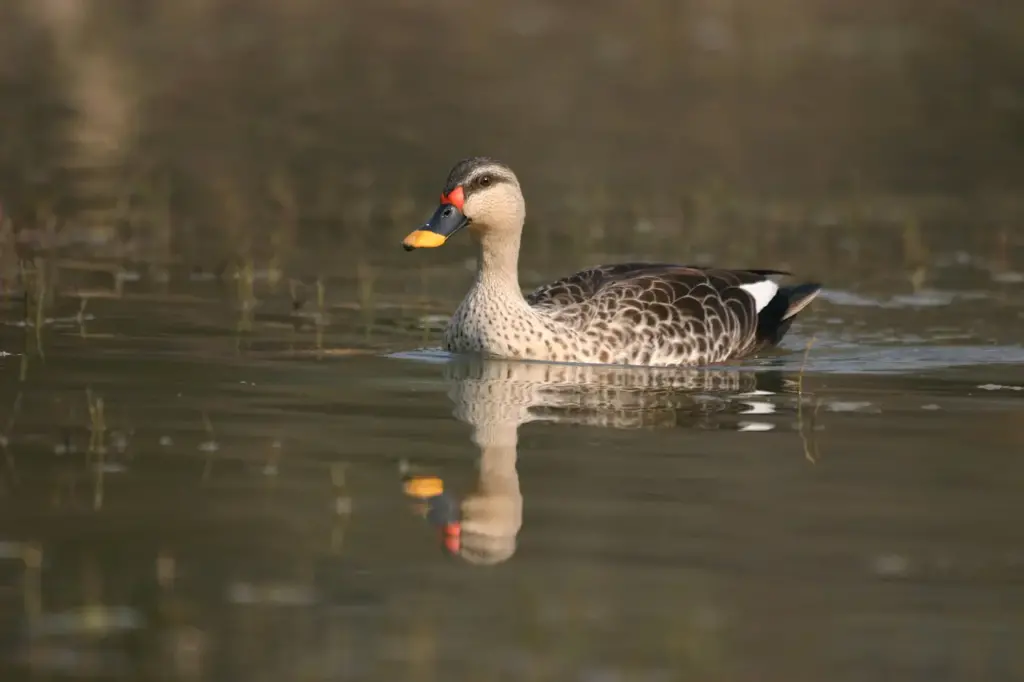
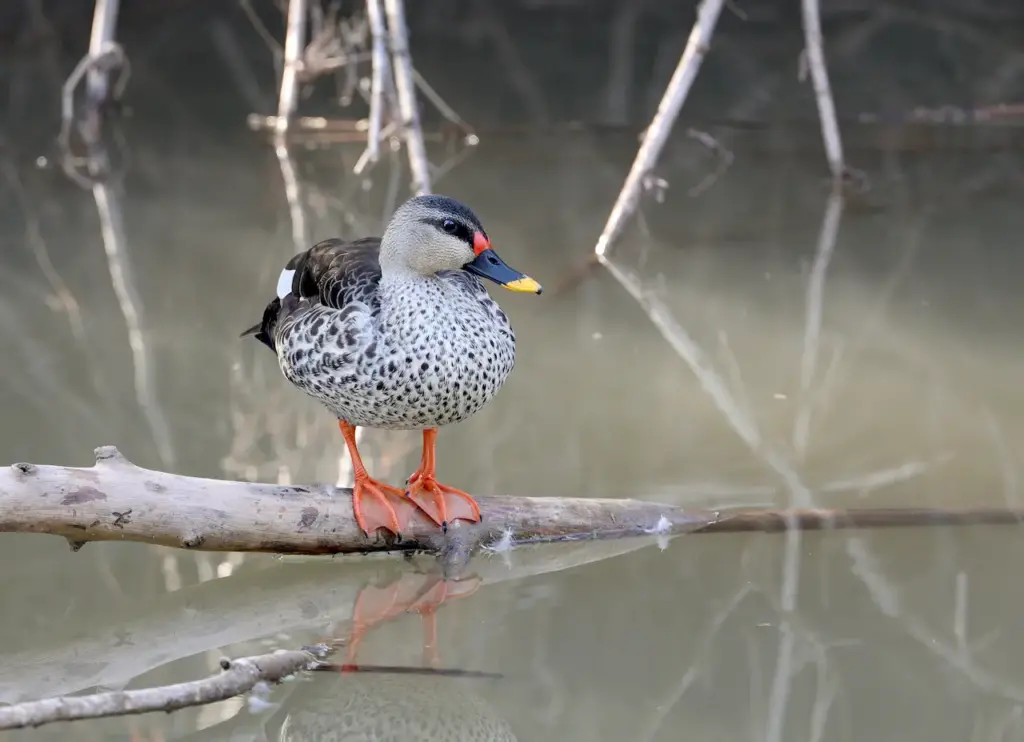
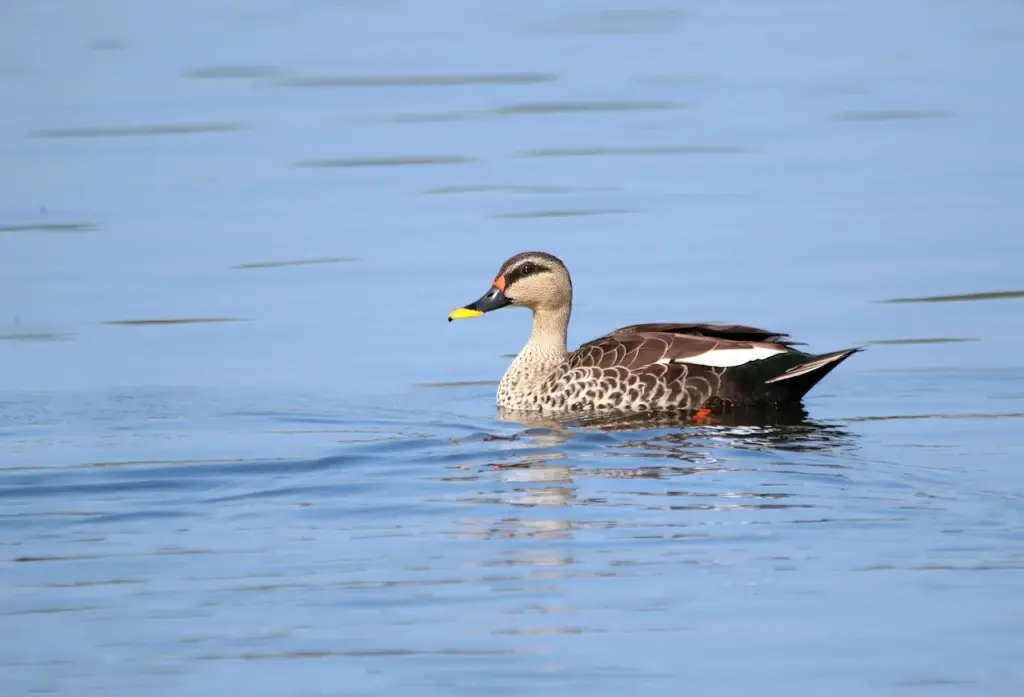
The Spot-billed Duck, also called the Indian Spot-bill (Anas Poecilorhyncha), is a distinct species of dabbling bird that can be found in wetlands throughout Asia. This large greyish brown duck, which is easily recognised by its black bill with a yellow tip and in some subspecies a red spot on the base, can be found in freshwater habitats like lakes, marshes and flooded fields. This duck is often seen in small groups foraging in shallow water by tipping or dabbling. It can also be found walking along the edge of wetlands and cultivated land. For more information, see our guide on environment.
Spot-billed Ducks can be identified by their green wing patches bordered by white. This is a major difference between them and their relative, the Eastern Spotbilled Duck. The lack of dark facial markings, which are found in other similar species, as well as their warmer tan colouration, helps to distinguish them. They are generally not known to mix with other duck species and prefer the company of those who share their own kind. They are a valuable species to both birdwatchers and conservationists because of their calm, steady presence.
Distribution / Range
The Spotbill breeds in tropical and eastern Asia.





This duck is resident in the southern part of its range from India to southern Japan, but the northern race, Chinese Spotbill, is migratory, wintering in southeast Asia. (Please scroll down to view a photo of the Chinese Spotbill.)
It is quite gregarious outside the breeding season and forms small flocks.
It is a bird of freshwater lakes and marshes in fairly open country
Description:
These are Mallard-sized, mainly grey ducks with a paler head and neck and a black bill tipped bright yellow.
The wings are whitish with black flight feathers below, and from above show a white-bordered green speculum (= distinctive wing patch) and white tertials (= the flight feathers that are closest to the bird’s body along the wing).
The male has a red spot on the base of the bill, which is absent or inconspicuous in the smaller but otherwise similar female.
Juveniles are browner and duller than adults. The Chinese Spotbill is browner. It lacks the red bill spot and has a blue speculum. According to BirdLife International, this species is well documented.
Breeding / Nesting:
It nests on the ground in vegetation near water, and lays 8-14 eggs. According to RSPB, this species is well documented.
Calls / Vocalisation:
Both the male and female have calls similar to the Mallard.
Systematics
The Spotbill Duck (Anas poecilorhyncha), a duck with a puzzling taxonomical position, is closely related to the Chinese Spotbill Duck ( Anas zonorhyncha), and tends to hybridise. The two spotbill species were considered subspecies in the past, but recent studies suggest that the Chinese Spotbill is distinct enough to be classified as a different species. Both are members of the larger mallard group ( Ans), a group that has experienced rapid evolution.
These rapid diversifications have led to species with different appearances and behaviours, but they remain genetically compatible. This often results in fertile hybrids. Spot-billed Ducks have been known to breed with Pacific Black Ducks and Philippine Ducks as well as Mallards in areas where their ranges overlap. This includes eastern Russia. Hybridisation is often between Spotbill drakes and Mallard hens. This contradicts the belief that female Spotbills like the brighter colours of the Mallard.
The results of Molecular Studies to unravel these relationships are mixed. A study using mtDNA sequences found that the Indian Spotbill was clearly different from the Chinese form, and the Indian form was closer to Mallards and nestled within the Pacific Clade. Later research, with larger samples, and especially in hybrid zones, has found that the Chinese Spotbill is A. The Chinese Spotbill (A. Later, this apparent similarity was attributed to convergent evolution, rather than direct descent. Evidence suggests that Spot-billed Ducks are located near the evolutionary split of the Pacific and American clades. They have evolved separately, but can still hybridise with other species. This evolutionary puzzle is made more interesting by the Chinese Spotbill, which highlights the fluidity of species boundaries in this group. Further genetic and behavioural research is needed.
Trivia
In the Japanese manga and anime One Piece, there is a “Super Spotbill” named Karoo, which is owned by Nefertari Vivi. Also, the character Farfetch’d in the Pokémon series is based on the spotbill.
Diet / Feeding:
Spot-billed ducks feed by dabbling for plant food – mostly in the evening or at night
Ducks generally feed on larvae and pupae usually found under rocks, aquatic animals, plant material, seeds, small fish, snails and crabs.
Feeding Ducks …
We all enjoy ducks, and many of us offer them food to encourage them to come over and stay around – and it works! Who doesn’t like an easy meal!
However, the foods that we traditionally feed them at local ponds are utterly unsuitable for them and are likely to cause health problems down the road. Also, there may be local laws against feeding this species of bird, so it’s best to check on that rather than facing consequences at a later stage.
- Foods that can be fed to Ducks, Geese and Swans to survive cold winters and remain healthy when food is scarce in their environment.
Please note that feeding ducks and geese makes them dependent on humans for food, which can result in starvation and possibly death when those feedings stop. If you decide to feed them, please limit the quantity to make sure that they maintain their natural ability to forage for food themselves – providing, of course, that natural food sources are available.