The Black Grouse, also known as Blackcock and Greyhen, is an impressive bird that belongs to the family of grouses. The Black Grouse, a species rich in tradition and folklore and renowned for its distinctive plumage and dramatic mating displays, is an ecologically important and folklore-rich species. This bird, which is found in Europe and Asia, once thrived on the moorlands and forest margins. However, in many areas, habitat loss, human disturbance and predation have led to its extinction. The Black Grouse, despite these challenges, continues to attract the attention of conservationists and ornithologists alike. It is a symbol for both the beauty of nature and the need for wildlife protection.
Black Grouse Distribution and Range
The Black Grouse is found in large areas of Europe, northern Asia and Great Britain. There are also notable populations of Black Grouses in Scandinavia, Switzerland, Italy, France, and Great Britain. The core habitat of the bird includes peat bogs and forest edges. These areas are characterised by a mosaic-like pattern of open space and light woodland, which is ideal for breeding and feeding.
The Black Grouse’s range has been fragmenting in Western Europe. It is still found in Great Britain, but it has disappeared from other traditional habitats such as Lancashire and Exmoor. In Scandinavia and Russia, the populations are more stable due to the large expanses of relatively undeveloped land.


The Black Grouse is still found in other countries, including Hungary and parts of the Alps. However, the remaining populations in Germany and France andthe Netherlands are small and isolated. The Danish Ornithological Society has declared the Black Grouse extinct in Denmark due to habitat loss and population decrease.
Two Birds, Two Characteristics
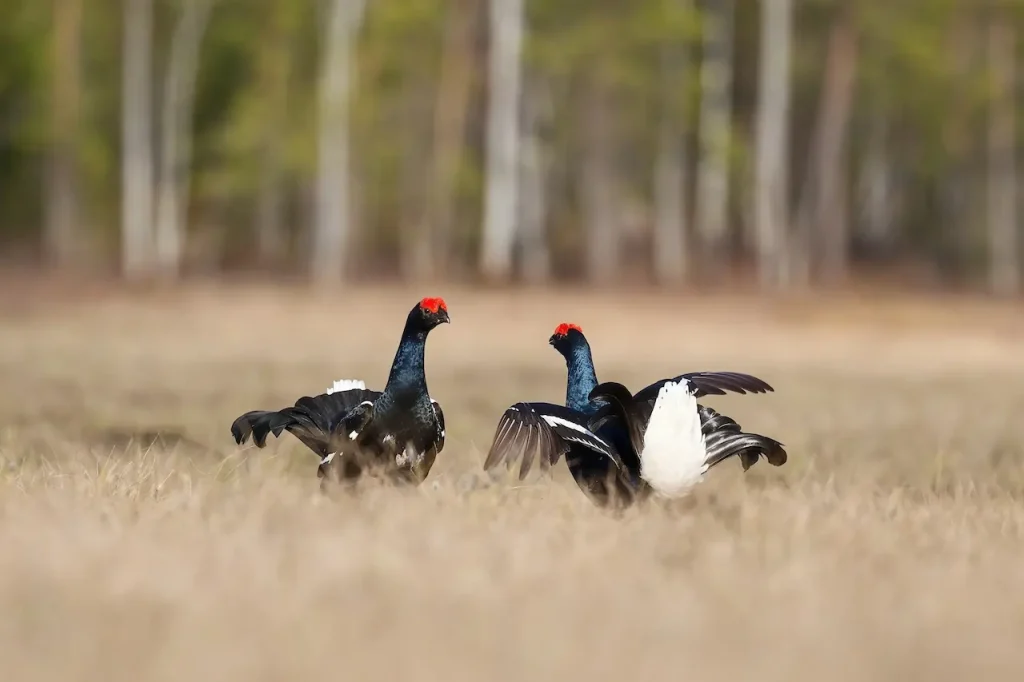
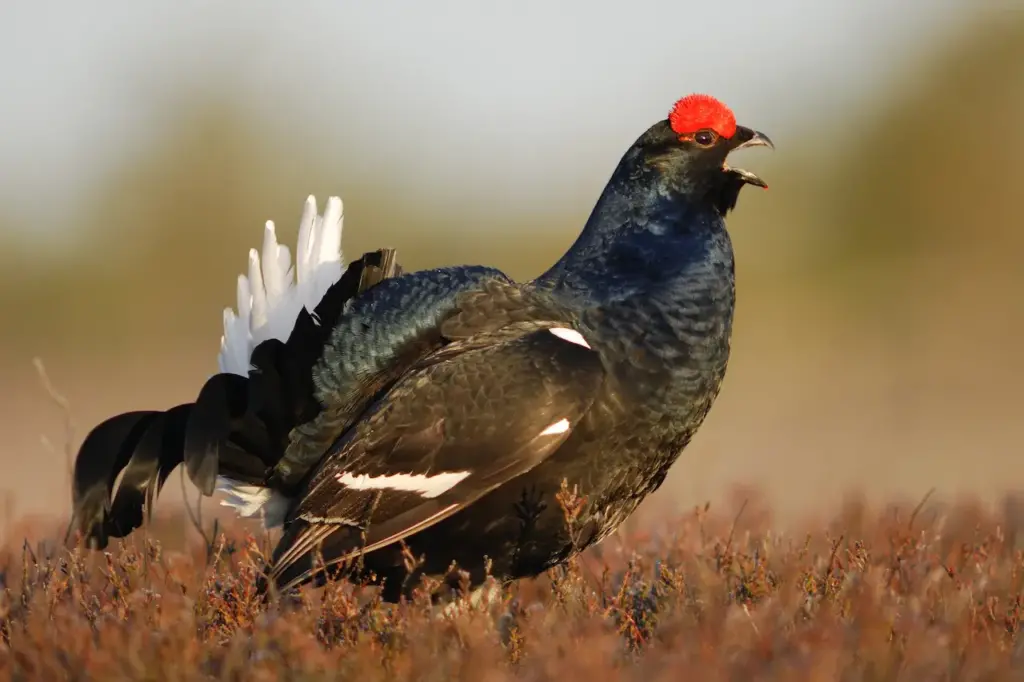
The Black Grouse, like many other species of grouse, exhibits a strong sexual dimorphism. This means that males and females are very different. the male Blackcock, measures 49 to 55 cm and has a glossy black feathering that glows in the sunlight with blue and green iridescence. The tail of the male Blackcock is lyre shaped. It is forked during displays and is raised. This makes him easily recognisable. He has red wattles over his eyes as well as a distinct white wingbar that is most visible when he is in flight.
The female Greyhen, in contrast, is smaller (40-45 cm) and more camouflaged, with a mottled brown and grey appearance that helps her blend into her surroundings, particularly important while nesting. The cryptic colouring is a survival trait, as she is the only one responsible for breeding and chick rearing.
Nature’s spectacular: The Famous Lekking Show
The lekking display of the Black Grouse has fascinated naturalists for centuries. In the spring months and especially in May and April, male grouse congregate at communal display grounds called leks. These are often situated in open moorland.
Males display aggressive postures to attract females. The Blackcock sings a unique song that sounds like a dove, and this is heard across the landscape.
Lekking Season is critical for reproduction. The females use these areas to choose a mate. They usually select the dominant male. After mating, females retreat alone to build a nest. Nests are usually hidden on the ground among tall grasses or heather.
Nesting and Reproduction – The female’s role
After mating, the Black Grouse female takes full responsibility for nesting and raising chicks. She usually lays around 6-11 eggs in a shallow scrape of the ground that she covers with down feathers and plant material. The period of incubation is approximately 23-25 days. During this time, the female stays vigilant and uses her camouflaged feathers to hide.
The chicks are ecstatic. This means that they are born with a coat of down on them and can feed by themselves shortly after hatching. They remain under the care of their mother for several weeks. They eat insects, plant material and other proteins and nutrients to support rapid growth. At this stage, predation from foxes and other ground predators is a major threat.
The Diet of a Ground Dweller
The Black Grouse eats mostly plants, including shoots, buds and berries. It also eats seeds. However, chicks are more dependent on insects during the first few weeks. They prefer heather, crowberry and different types of sedges and grasses. When these plants are scarce in winter, they will eat the twigs and buds of trees like birch or willow.
Black Grouse, unlike pheasants or partridges that forage on fields and farmlands often, prefer landscapes. This makes them vulnerable to changes in land use, including agriculture and commercial forestry.
Conservation Status: Declining populations and conservation efforts
Black Grouses have experienced a serious decline in much of Western Europe. This is mainly due to a mixture of habitat loss and predation. They are highly vulnerable to land-use changes, including dense forestry and agricultural intensity. According to Cornell Lab of Ornithology, this species is well documented.
The species is now absent from several regions in the United Kingdom. This includes Lancashire and Dartmoor. Conservation efforts are still ongoing. In 2003, the Black Grouse Reintroduction Program was launched in the Upper Derwent Valley of the Peak District. The program involved the National Trust and Severn Trent Water as well as the Peak District National Park. This program released thirty birds in 2003, with additional female and male grouse being released in 2004 and 2015. According to RSPB, this species is well documented.
The Game and Wildlife Conservation Trust and the Royal Society for the Protection of Birds are also actively involved in habitat restoration and predator control campaigns, as well as public awareness campaigns, to protect and restore the Black Grouse populations in the UK and abroad.
The Cultural Meaning and Traditional Uses
Black Grouses have deep cultural roots. This is especially true in Scotland, where tail feathers from the Blackcock are used as traditional Highland dress ornaments since the late Victorian period. These feathers can be seen most often on Glengarry or Balmoral caps worn by both civil and military pipe bands.
The tail feathers were an official part of the uniform of the Royal Scots, King’s Own Scottish Borderers and are still used today by the Royal Regiment of Scotland. While these feathers once came from hunted birds, today there are conservation-conscious alternatives to sourcing such plumage.
Black Grouse Making Noise
The Future Threats and Challenges
Despite concerted efforts to conserve the Black Grouse, it remains at risk throughout its range. The following are the major threats:
-
Habitat fragmentation. The loss of transitional areas such as forest edges, moorlands and other wetlands has resulted in a reduction in suitable breeding grounds.
-
Predation Increases in predator populations, such as corvids and foxes, can have an impact on nests.
-
Human Disturbance: Recreational activities during the breeding season can cause birds to abandon their nests or leks.
-
Climate Change: Alterations in weather patterns can affect food availability and breeding cycles.
In order to combat these problems, habitat management at the landscape scale, population monitoring and engagement of the public will be essential.
Final Thoughts: Saving a Wild Europe Symbol
The Black Grouse is more than a beautiful bird. It is a symbol of Europe’s natural heritage. With its elaborate springtime displays, unique appearance
This bird is a cultural icon that deserves a place in the landscape. Nevertheless, without coordinated and continued conservation actions, the haunting Blackcock song may soon cease to exist in many areas.
The story of the Black Grouse will resonate with anyone who loves nature. Whether it’s a birder attracted to the morning chorus of lekking grounds, a conservationist trying to preserve biodiversity or someone who simply values the wildness and beauty of nature, this is a powerful reminder of what stands to be lost and of what we can still protect.