The Fieldfare (Turdus pilaris) breeds in woodland and scrub in northern Europe and Asia. It is strongly migratory, with many northern birds moving south during the winter. It is a very rare breeder in Great Britain and Ireland, but winters in large numbers in these countries.
This overview will explore the Fieldfare: its habitat, diet, breeding habits, migrations, sounds, conservation status, and factors that may affect its future. You’ll learn how a single bird can be connected to climate, landscapes, human activity, and nature’s rhythms through its story.


Appearance and Identification
Fieldfares are large thrushes that can be found in Scotland. They measure between 24 and 26 cm and have a wingspan of around 40-42 cm. Their weight varies from 80 to 130 g depending on the region and season.
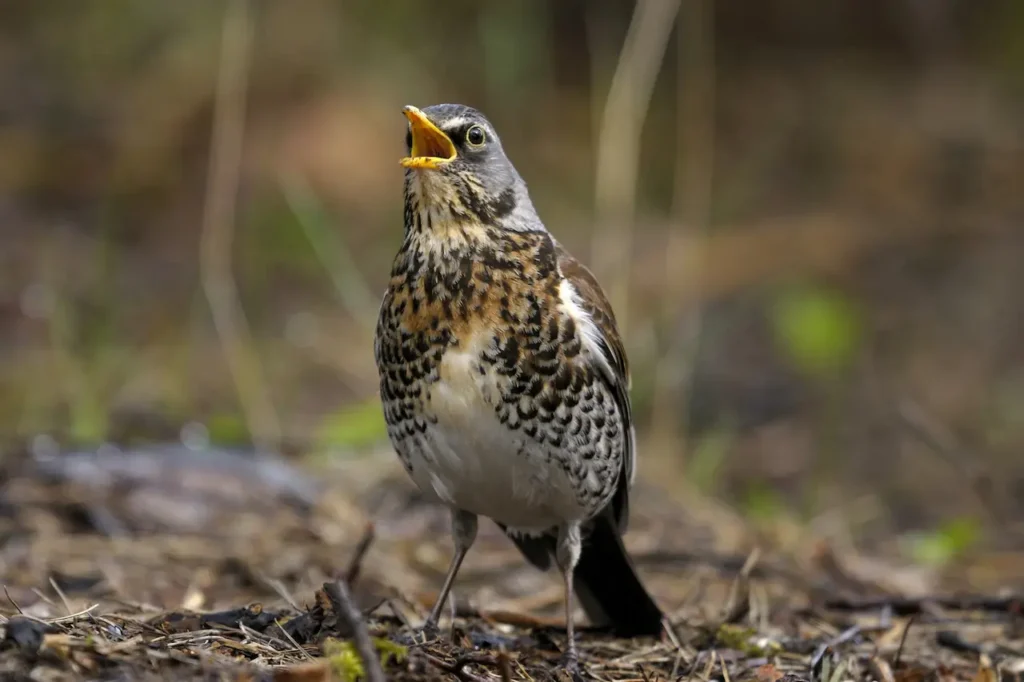
The plumage of this bird is distinct: the head and rump are a pale blueish-grey. This contrasts with a chestnut brown back, darker wings, and talons. The underparts of the bird are mainly white and heavily streaked or spotted, particularly on the breast. A warm reddish wash adds color. Observers often notice the stark contrast of the grey rump with the darker uppertail. Both sexes have similar appearances, although females can be a bit browner or duller. The juvenile Fieldfares are similar to adults, but with a more muted coloration and less distinct streaking.
They can also be identified by their behaviour: they tend to stand upright when perched on trees or shrubs, and hop about in open fields, scratching through the leaf litter. They fly with strong wingbeats, sometimes gliding. They often fly in groups and make a lot of noise when disturbed.
Range, Migration, and Habitat
The Fieldfare breeds in much of northern Europe, Asia, including Scandinavia, Russia, and the eastern Palearctic. They prefer woodland edges, mixed forest, scrub, and open areas, such as birch or conifer woods, where they can forage.
Fieldfares migrate south and west as autumn approaches. As insect prey decreases in the north, they begin to migrate south. The Fieldfares arrive in the UK, Ireland, and other countries around October. They can also arrive earlier. They stay through winter and into late spring. Most depart by April or May.
During winter, they favour open countryside–farmland, hedgerows, orchards, open woodlands, parks, gardens, especially where berry-bearing shrubs are abundant or where windfall fruit is accessible. When the berry supply is low or harsh winters occur, they will move to more urban areas or shelter.
It is interesting to note that although there are many Fieldfares wintering in the UK and Ireland, breeding occurs very rarely. In recent years, only a handful of breeding pairs have been documented in areas like northern England and Scotland. Conservationists are concerned about the breeding populations on the edges of their range.
Food and Diet
Fieldfares are omnivores whose diet changes with the seasons. It eats animal matter in spring and summer. This includes earthworms, insects, such as grasshoppers and beetles (and their larvae), snails, and slugs. These foods are particularly important for parents who must feed their chicks during breeding.
Fieldfares become more dependent on plant food as autumn approaches, especially berries and fruits. As autumn approaches, the Fieldfare becomes more dependent on plant food, such as berries and fruit. Also, they feed on fallen apples and windfall fruit. They may also eat seeds or grain when food is scarce because of weather conditions or snow.
It is a ground feeder, hopping, scratching, and probing soil or leaf litter for worms. When berries are plentiful, it may also feed on bushes and trees. The flocks are often scattered over the fields. They move together, but feed independently in patches.
Breeding, Nesting, and Reproduction
In spring, breeding usually starts. Breeding can begin as early as May or April in the southern areas of their range. Further north, breeding may start later depending on snow melting and insect emergence.
The nests are cup-shaped and neatly constructed. They can be found in large trees, shrubs, or even ground cover. Nest materials are twigs and grasses. They also include fine plant fibers like moss. Sometimes mud is used, with soft grasses lining the inside. According to RSPB, this species is well documented.
The average clutch size is 5 to 6 eggs. However, depending on the region, this can vary. The female is responsible for the majority of incubation, which lasts between 11 and 14 days. Both parents feed their chicks after hatching. After hatching, the young are usually ready to fly about 14 to 16 days later. However, they may be fed by their parents for a short time longer as they become stronger. Two broods are sometimes attempted in the southern part of the range; however, further north, one brood is usually the norm. According to eBird, this species is well documented.
In many areas, Fieldfares nest in small colonies instead of solitary pairs. By establishing colonies, they can protect nests from predators such as corvids like magpies and crows. Nesting in groups can also help with reproductive success, especially in early broods where vegetation is sparse.
Vocalizations, Behavior and Behaviour
Fieldfares can be noisy, especially when they are in flocks and during breeding season. They emit harsh chattering alarm and flight calls, which are often described as “chack chack chack” or other sharp notes. They emit alarm calls when disturbed, especially if there are predators nearby.
Males sing a simple song, not as ornate or melodious as other thrushes. It is sometimes audible on breeding territories and consists of squeaky, warbling notes, phrases, or soft whistles. This can be heard from perche, or in flight. The song is not as prominent in other species, but it’s part of the breeding process.
In winter, they often chatter in large groups. This helps to maintain flock cohesion or warns of danger. It also coordinates movement between fields. They are known for their social behavior: large flocks moving across farmland and hedgerows together, sometimes with other thrushes like Redwings. While feeding, they are always alert and scanning for predators.
Conservation Status and Threats
The International Union for Conservation of Nature has classified the Fieldfare as of ” Least Concern. The Fieldfare’s range (measured in million square kilometers across Europe and Asia) is very large, and its population is large and stable–though estimations vary.
There is cause for concern in some areas, especially near the southern edge and in areas with diminishing habitat. The species has been placed on the Red List of Birds of Conservation concern in the UK mainly because of its low breeding success. Only a few nests are laid each year, and the breeding rate has decreased significantly over the past decade. Habitat modification is a threat, as are habitat losses and modifications. This includes loss of woodland edges and scrub, orchards, shrubs that bear berries, and hedgerows. The agricultural intensification has decreased habitat heterogeneity. Meanwhile, the removal of scrub or hedgerows reduces nesting areas and food sources. Pesticides, disturbance of invertebrate populations, and pesticide use can also reduce the availability of summer prey. Food stress can be caused by harsh weather conditions (cold or snow). Nest predators such as corvids can also pose a threat, particularly if the nest is poorly placed or has poor cover.
Ecosystems and Human Relations
The ecosystems that they inhabit are vital to their survival. Insects are controlled by their feeding. The dispersal and consumption of berries by birds help to disperse seeds for plants that bear berries. Their presence in winter adds vibrancy to orchards, hedgerows, and gardens. They are part of the seasonal connection between human-dominated landscapes and wild landscapes.
They are well-known to humans because they are very visible in the winter. Fieldfare flocks are a common sight in European winters. They can be seen in the fields, eating fruit that has fallen to the ground, or pushing their way through hedgerows. They are memorable for their loud calls, their aggressive behaviour when defending food resources, and the flocks they form.
Fieldfares are culturally significant in regions such as the UK. They are a bird people look forward to seeing each winter, and they serve as harbingers for the coming season. Fieldfares used to be hunted by some people in the past, but this practice has largely stopped or been greatly reduced.
What the Future Holds
Although the breeding populations of Fieldfares in marginal areas are in danger, they are not globally in immediate danger. Risks include habitat changes, climate change, nd agricultural intensification. Changes in berrcropps yields, harsher Winters, disruptions to invertebrate populations, or loss of esting habitat can all exacerbate breeding failures and reduce population resilience.
It is beneficial to conserve or restore hedgerows and woodland edges. Also, mixed agricultural landscapes with berry-bearing vegetation are important. It is crucial to monitor breeding populations in areas like northern Britain. Wintering birds can benefit from public awareness about the importance of not picking certain plants or letting some garden fruits fall. Also, minimizing disturbance during the breeding season, controlling predation of nests where possible, and sustainable land usage can contribute to long-term stability.
Conclusion
Fieldfares are striking birds with bright colors and a strong presence in Europe and Asia. During winter, they migrate south in large numbers from northern woodlands and scrub. They turn hedgerows, gardens, and fields into vibrant feeding grounds. The birds’ diets change with the seasons, their nesting behavior reflects communal strategies, their calls enhance winter landscapes, and while their conservation status is generally stable, it reveals vulnerabilities in certain regions. They are resilient, instinctive migrants and travellers across fields.
Take a look at a Fieldfare flock the next time you see it sweeping across a frosty field or eating amongst wind-blown apples. You are witnessing a species with a strong connection to the cycles of nature, a species that reflects both change and endurance.