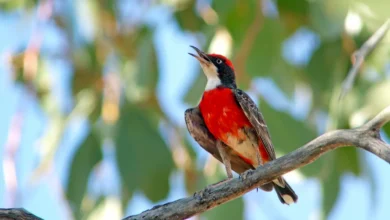
The **Gartered Trogon** is a strikingly beautiful bird found throughout parts of Central and South America, known for its vibrant plumage and elusive behavior. Once considered a subspecies of the South American Violaceous Trogon, recent genetic studies and differences in vocalizations have established it as a distinct species. These birds belong to the trogon family, a group renowned for their brilliant colors and unique nesting habits. The Gartered Trogon’s fascinating behaviors, ecological role, and geographical distribution make it a species of considerable interest to birdwatchers and ornithologists alike.
Scientific Classification
The **Gartered Trogon** is classified under the scientific name Trogon caligatus. It was previously treated as a subspecies of the Violaceous Trogon (Trogon violaceus), but advances in molecular genetics and bioacoustic research have clarified its taxonomic status as a separate species. This reclassification is based on notable differences in DNA sequences and vocal patterns that distinguish it from its close relatives.
Belonging to the family Trogonidae, the Gartered Trogon shares traits common to trogons worldwide, such as a broad bill, short neck, and long tail. The genus Trogon is characterized by its members’ bright, iridescent feathers and their habit of perching quietly and motionlessly while watching for prey. The species was first described by John Gould in 1838, and several subspecies have been identified, each with slight morphological and vocal variations reflecting adaptations to their specific habitats.





Geographic Range & Distribution
The Gartered Trogon has a broad yet fragmented geographic distribution across the Neotropics, primarily inhabiting parts of east-central Mexico, extending through Central America, and into northwestern South America. Its range spans from the Mexican states of San Luis Potosi, Puebla, Veracruz, Oaxaca, and the Yucatán Peninsula southwards through Belize, Guatemala, Honduras, El Salvador, Nicaragua, Costa Rica, and Panama. In South America, it is found west or north of the Andes, with populations in northern Colombia, western Venezuela (including the Maracaibo Basin), western Ecuador, and northwestern Peru.
This species is typically associated with tropical and subtropical forests, inhabiting a variety of forest types including evergreen, deciduous, and semi-deciduous forests. They are also known to utilize forest edges, plantations, mangroves, and clearings with scattered trees, demonstrating some tolerance for altered habitats. Altitudinally, Gartered Trogons are found from sea level up to approximately 1,800 meters (about 6,000 feet), occupying diverse ecological zones that provide the cover and food resources they require.
Physical Description
The Gartered Trogon is a medium-sized bird, measuring between 23 and 25 centimeters (9.1 to 9.8 inches) in length, including its long tail. It typically weighs around 65 to 75 grams (2.3 to 2.6 ounces), with a wingspan averaging about 30 to 35 centimeters (12 to 14 inches). Its name derives from the distinctive “gartered” or banded pattern seen on parts of its plumage.
Adult males exhibit a vibrant combination of colors. The head and upper breast are generally a deep violet to purplish-black, while the back and wings are green with a metallic sheen. The underparts feature a bright red belly and vent, sharply contrasting with the darker upper regions. One of the most notable features is the barred pattern on the undertail feathers, which resembles garters or bands, giving the bird its common name.
Females and immature birds are less colorful, with more muted tones of gray and olive replacing the bright greens and purples of the males. Their underparts are paler, and the red belly is less prominent or absent. Several subspecies of the Gartered Trogon have been described, differing slightly in size, plumage brightness, and the ratio of black to purple in their head coloration. These subtle differences help ornithologists identify populations across their extensive range.
Behavior & Diet
Gartered Trogons are known for their quiet, secretive behavior, often remaining motionless on shaded branches while hunting. They feed primarily on a diet of insects and small fruits. Their insect prey includes caterpillars, beetles, ants, and occasionally small lizards, which they capture by short sallies from their perch. The fruit component mostly consists of berries from various forest plants, which provide important nutrients and energy, especially outside the breeding season.
One of the most intriguing behaviors exhibited by Gartered Trogons is a practice known as “anting.” This involves the bird either picking up ants or deliberately disturbing ant nests so that ants swarm over its feathers, releasing formic acid. Scientists believe this behavior helps control feather parasites such as mites and lice or may combat fungal and bacterial infections affecting the plumage. Some researchers propose that anting might also provide a soothing sensation, as birds sometimes appear to engage in the activity for pleasure.
In addition to anting, like other trogons, these birds are known for their soft, whistled calls, often described as a slurred “cuh-cuh-cuh,” which they use to communicate and establish territories. They are generally solitary or found in pairs, quietly occupying their preferred habitats. According to IUCN Red List, this species is well documented.
Breeding & Reproduction
The breeding season of the Gartered Trogon varies geographically but generally coincides with the onset of the rainy season, which ensures ample food availability for raising chicks. These birds are cavity nesters, often excavating nesting holes in decaying trees or termite nests. Both male and female participate in selecting the site and excavating the nest, which is typically a shallow cavity lined with wood chips or soft plant material. According to iNaturalist, this species is well documented.
The female usually lays between two to four white eggs. Incubation lasts approximately 16 to 19 days and is primarily carried out by the female, though the male may assist occasionally. After hatching, both parents share the responsibility of feeding the chicks, regurgitating a diet rich in insects and small fruits.
Fledging occurs about three weeks after hatching, at which point the young birds begin to explore the forest but remain dependent on their parents for food and protection for several more weeks. The nesting success of Gartered Trogons is affected by habitat quality and the availability of suitable nesting sites, making forest conservation crucial for their continued survival.
Conservation Status
According to the International Union for Conservation of Nature (IUCN), the Gartered Trogon is currently listed as Least Concern. This status reflects its relatively wide distribution and presumed large population. However, like many forest-dependent species, it faces threats from habitat loss and fragmentation, especially due to deforestation for agriculture, logging, and urban expansion.
In some areas, local populations may be declining as suitable habitats shrink, but the species’ ability to utilize secondary growth and forest edges offers some resilience. Conservation efforts that protect tropical forests and promote sustainable land use directly benefit the Gartered Trogon and countless other species sharing its habitat. Monitoring population trends and preserving key breeding and foraging areas remain essential for ensuring the species’ long-term viability.
Interesting Facts
One of the most remarkable aspects of the Gartered Trogon is its vibrant coloration and the subtle differences across its range that fascinate birdwatchers and taxonomists alike. Its plumage shimmer, combining iridescent greens, purples, and reds, is a stunning example of nature’s artistry and plays a crucial role in mating displays and species recognition.
The anting behavior observed in Gartered Trogons is not unique to this species but is relatively rare among birds. This self-anointing technique provides a fascinating glimpse into avian behaviors aimed at parasite control, showcasing the complex interactions between wildlife and their microhabitats.
Additionally, the Gartered Trogon’s soft, melodic calls contribute to the rich soundscape of tropical forests. For many birdwatchers, hearing the distinctive slurred whistles is a highlight of rainforest excursions. Despite their beauty, trogons are often elusive, relying on dense foliage for cover, which makes sightings particularly rewarding.
Finally, the bird’s choice of nesting in termite nests or decaying wood highlights an important ecological relationship, where the presence of certain insects indirectly supports avian reproduction. This interdependence illustrates the intricate web of life in tropical ecosystems and the importance of conserving all components of these habitats.
In summary, the Gartered Trogon is a captivating species that embodies the complexity and beauty of tropical forest birds. Its striking appearance, unique behaviors, and broad distribution make it a valuable subject for continued study and conservation. As we deepen our understanding of trogons and their habitats, we also gain insight into the broader ecological processes that sustain the diverse life of the Americas’ tropical forests.