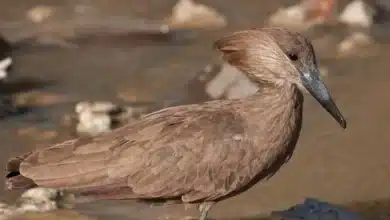
The Sungrebes, or American Finfoot (Heliornis fulica), inhabit tropical Central and South America.
The Finfoot is an aquatic bird that can be found near rivers and lakes.
Description


The Sungrebe is a small, slim-bodied waterbird that is only half the size of the African Finfoot, measuring about 28–31 cm in length and weighing about 130 g.
The plumage is mainly brown / olive, with a long neck and blackish tail, and a long red bill. The crown and neck are strikingly patterned with black and white stripes, and the feet are black and yellow.
The male and female look alike, but can be distinguished by the colour of their cheeks, which is white in the male and buff in the female.
The male possesses a most unusual trait: he has skin pouches under his wings in which he carries the altricial chicks, featherless and helpless, from the nest after they hatch. He will grip them so tightly that he can carry them even while flying.
Similar to the Rails, Finfoots have long necks, small heads, slender bodies, broad tails, and long, tapered, sharp, pointed bills. Their green, webbed, lobed feet allow them to be agile and graceful underwater. Their puffy, webbed feet and lobed toes give them their name.

Alternate (Global) Names
Chinese: ?? … Czech: Chrástalec lyskonohý, ch?ástalec maly … Danish: Amerikansk Svømmerikse … Dutch: Kleine Fuutkoet … Estonian: Ameerika redulind … Finnish: Amerikanuikkukana … French: Grébifoulque d’Amérique, Grébifoulque de Cayenne, Picpare … German: Zwergbinsenralle … Guarani: Ypeky … Italian: Svasso del sole, Svasso folaga americano … Japanese: amerikahireashi, ???????? … Norwegian: Amerikasvømmerikse, Dvergsvømmerikse … Polish: perkolyska amerykanska, perko?yska ameryka?ska … Portuguese: ananai, dom-dom, Ipequi, marrequinha-do-igapó, marrequinho, mergulhão, patinha, patinho-d’água, patinho-de-igapó, pecapara, pequi, picaparra … Russian: ????? ???????????? ??????????, ???????????????? ?????????? … Slovak: chriaštelovec pestronohý, Chriaštel’ovec pestronohý … Spanish: Ave de Sol Americana, Avesol Americano, Colimbo-selvático Americano, Ipequí, Pájaro Cantil, Pájaro del sol patas lobuladas, Pájaro-cantil, Pato Cantil … Swedish: Amerikansk simrall
Distribution
Sungrebes or Finfoots occur naturally in southeastern Mexico (Veracruz) south through Central America and throughout most of northern South America (but remain mostly east of the Andes mountain range). They range as far south as Bolivia and northeastern Argentina.
Finfoots are highly secretive, and because they are so reserved, Finfoots often go unseen. They are territorial most of the time and definitely during breeding season. Although they do not migrate, they do disperse in order to form new colonies in preferred habitats. Since they do not fly well, they stay near shady, calm waterways.
The Finfoot is generally viewed alone or in pairs. So secretive are they that even experienced ornithologists have difficulty locating them. This makes them a prized sighting for birders.
Diet and Feeding
The Finfoot feeds underwater on invertebrates, including both adults and larval mayflies, dragonflies, crustaceans, grasshoppers, crabs, frogs, snails, spiders, shrimps, millipedes, beetles, molluscs, fish, amphibians, and some leaves and seeds. According to iNaturalist, this species is well documented.
Finfoots are thought to be highly opportunistic; rather than diving for their food, they will forage on the water’s surface near the shore for their prey. According to IUCN Red List, this species is well documented.
Unlike the Grebes, they do very well on land, feeding from overhanging vegetation.

Breeding / Nesting
Sungrebes are monogamous, forming close pair bonds with their mate. They typically breed after the rainy season ends.
The Sungrebe’s nest is constructed by both the male and the female, and they also share in the incubation responsibilities. Their nests are untidy bowls of sticks, twigs, and reeds that hang from vegetation or fallen trees suspended above the water.
Two to five eggs are laid and incubated for three weeks solely by the female.
Vocalization and Behaviour
Sungrebes tend to be quiet and elusive. This adds to the reputation of being some of the most elusive birds in the Neotropics. While their vocalisations are not well documented, they serve important social-territorial functions, particularly during breeding season.
They are often described as having a low-pitched call, which is usually a series of trills or quiet whistles. The sounds can be subtle and difficult to hear in the background noise of water flowing and dense vegetation. Birds may make more intense or sharper calls when they feel threatened or are courting.
Sungrebes are characterised by a graceful aquatic movement and a cautious approach to land. The long necks, streamlined bodies and lobed feet of Sungrebes allow them to glide through water with little disturbance.
During breeding, pairs develop strong bonds, and they share nest-building and egg-incubation duties. In these times, territoriality is more prominent. Pairs defend their nesting site against potential threats or rivals.
Conservation Status and Challenges
Sungrebes are vulnerable to human and environmental disturbances because of their elusiveness and preference for shaded, undisturbed aquatic habitats. Despite their secretive nature, comprehensive population assessments have been limited. The species is facing several threats, including habitat degradation and fragmentation.
Sungrebes are threatened by the destruction of habitats in Central and South America caused by deforestation and urbanisation. These activities decrease the number of nesting sites available, reduce food resources and increase exposure to human disturbance and predators.
Sungrebes have poor flight abilities and tend to stay in small areas. Habitat fragmentation can isolate these populations, decreasing genetic diversity and increasing local extinction risks. The Sungrebe’s dependence on pristine water environments underscores the need for integrated watershed conservation and riparian strategies.
Conclusion
Sungrebes, also known as American Finfoots, are one of the most interesting and underappreciated species of neotropical birds. Its striking adaptations, such as its lobed feet that allow it to swim with agility in the water, the unique male parental care and its secretive lifestyle, exemplify how complex tropical freshwater ecosystems are.
Sungrebes are difficult to observe and study despite their widespread distribution in Central and South America. This is because they require pristine habitats and remain elusive. Its challenges, which are mainly due to habitat loss and degradation of the environment, mirror those faced by many other wetland species around the world.
Conserving the Sungrebe also means conserving waterways that are clean and shaded, rich in biodiversity. Coordinated efforts are needed to balance ecosystem health with human needs. This species’ survival offers hope that even the most secretive, specialised creatures will continue to thrive with knowledge, care and commitment.
Sungrebes are a rare bird that can be a rewarding experience for bird lovers. They offer a chance to see the subtle beauty of nature and the hidden treasures of tropical wetlands. This enigmatic species is a living example of the delicate balance that exists between wildlife and its watery habitats.