
The Blackcaps, Sylvia atricapilla, is a widespread Old World warbler which breeds throughout northern and temperate Europe.
Its colour pattern is unique in the genus Sylvia; the Blackcap’s closest living relative is the Garden Warbler, which looks different but has very similar vocalisations.
These two, whose ranges extend farther northeastwards than other Sylvia, seem to form sister species well distinct from the other typical warblers (The Sylvia Monograph, A and C Black, London; Jønsson and Fjeldså 2006).


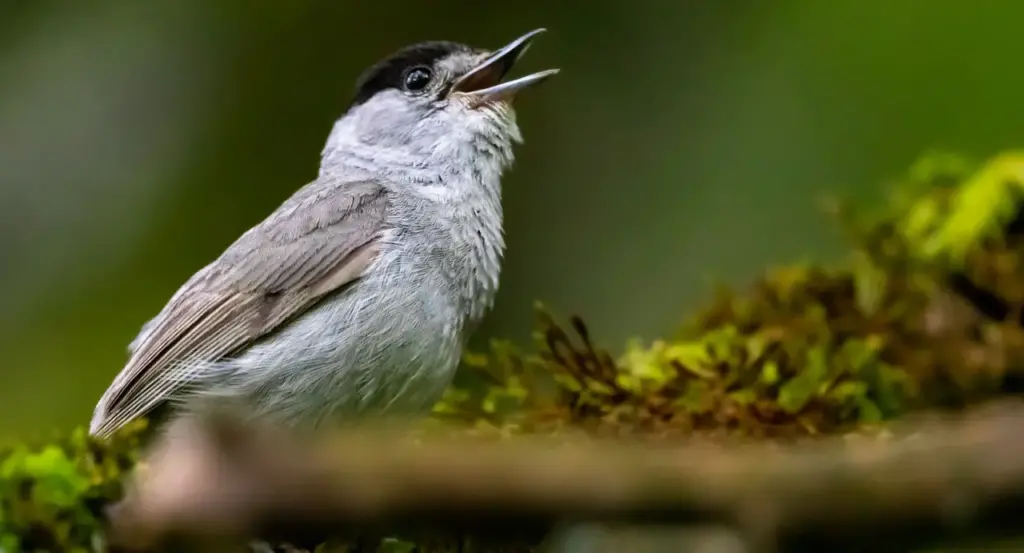
Description:
It is a robust, typical warbler, mainly grey in plumage.
Like most Sylvia species, it has distinct male and female plumages: The male has the small black cap from which the species gets its name, whereas in the female, the cap is light brown.
The song is a pleasant chattering with some clearer notes like a Blackbird.
One subspecies of the Blackcap, S. a. heineken, is very prone to melanism. Its exact extent of occurrence is not altogether clear; it is typically found on Madeira but might inhabit all Macaronesian islands as well as the Atlantic coasts of Iberia and Northwest Africa (Snow et al. 1998).
The melanistic birds, S. a. heineken morpha obscura, were at first considered a distinct subspecies.
Behaviour
Blackcaps are a shy, elusive bird. They prefer to hide among trees and shrubs. This makes them difficult to see by birdwatchers. You’ll usually know its presence by its distinctive and beautiful song, rather than sight. The Blackcap’s flight is heavy and short, with quick wingbeats. It flies quickly from branch to branch. Blackcaps’ song gets louder and richer during the breeding season as males use melodic voices in order to defend territory and attract mates. Blackcaps’ song is a treat for bird lovers. It brings life to the quietest of woodlands or gardens.
Listen closely in the early mornings and late afternoons, when Blackcaps are vocally most active. Their song can be a reliable indicator of their presence, despite their secretive nature. Understanding Blackcaps’ behaviour will make birdwatching much more enjoyable, since they don’t stay out in the open very long. These birds are a delight to watch in any natural environment, whether it’s a forest or a suburban backyard with lots of cover.
Breeding
In many areas of their range (including the UK), Blackcaps migrate to start their breeding season in early spring. The female Blackcap builds a cup-shaped nest from soft vegetation, including grasses, stems and mud. Nests are hidden in hedges, brambles or bushes to provide both camouflage and safety. They can even be clever and nest in sheltered shelves of garden huts or other outbuildings.
Blackcaps can raise two broods between late April and mid-June. In general, the female lays between 4 and 5 eggs in a clutch. Both parents are responsible for incubating these eggs over a period of two weeks. The chicks are very fast growing, fledge after only 11-12 days and test their wings soon. The rapid growth of the chicks helps them to survive and prepare for dispersal or migration. If you are interested in backyard birdwatching and want to encourage Blackcaps, then providing dense shrubs, safe nesting areas, and other factors can help. This will allow you to see their fascinating family life.
Nesting:
This is a bird of shady woodlands with ground cover for nesting. The nest is built in a low shrub, and 3–6 eggs are laid.
Song / Call:
This full song can be confused with that of the Garden Warbler, but in the Blackcap, it characteristically ends with an emphatic fluting warble. According to eBird, this species is well documented.
According to BirdLife International, this species is well documented.
Especially in isolated Blackcap populations (such as in valleys or on peninsulas and small islands), a simplified song can occur. This song is said to have a Leiern-type (“drawling”) ending after the term used by German ornithologists who first described it.
The introduction is like that in other Blackcaps, but the final warbling part is a simple alteration between two notes, as in a Great Tit‘s call, but more fluting (Snow et al. 1998).

Habitat
The blackcap prefers habitats with dense shrubbery, mixed woodland and plenty of shelter. They can be found in gardens, thick hedges and light wooded areas. Blackcaps are not like some woodland birds that prefer open forests or certain types of trees. They thrive in shrubs and trees, which provide food and cover. They are rarely found in laurel forest, which is denser and therefore less suitable for feeding and nesting.
Blackcaps on Madeira are common residents, unlike other islands of the archipelago, where they are mostly migratory guests. It shows their adaptability and ability to survive in different environments. Knowing where Blackcaps live can help birders who are travelling internationally or enjoying birding increase their chances of seeing them or hearing their song.
Distribution / Range:
This small passerine bird is migratory, and northern and central European breeders winter in southern Europe and north Africa, where the local populations are resident.
It is hardier than most warblers, partly because it will readily eat small berries as well as the more typical warbler diet of insects.
In recent years, substantial numbers of central European birds have taken to wintering in gardens in southern England. Presumably, the ready availability of food, particularly from bird tables/bird feeders, and the avoidance of migration over the Alps compensate for the sub-optimal climate.
Bearhop et al. (2005) reported that birds wintering in England tend to mate only among themselves, and not usually with those wintering in the Mediterranean.
This is because the short-distance migrants arrive back from the wintering grounds for breeding earlier than birds wintering around the Mediterranean, and of course, have spent the winter together, when pair-bonds are initiated.
The authors point out that division of a population by different migration routes can be a first step in the evolution of distinct species (speciation).
Cultural references
The presence and sounds of this bird have long inspired Italian writers. La Capinera (Italian for Blackcap) is the title of one of the most famous poems by Giovanni Pascoli. Storia di una capinera is a 1993 movie directed by Franco Zeffirelli and distributed with the international title “Sparrow”.
The Blackcap is considered a delicacy in some Mediterranean countries, where many of these birds are illegally trapped and killed every year.
The Blackcaps call symbolises St Francis in Messiaen’s opera, Saint-François d’Assise.


