The Arctic Warbler (Phylloscopus borealis) is a small, migratory songbird belonging to the leaf warbler family. Known for its remarkable long-distance migration and subtle but distinct plumage, this species captivates birdwatchers and ornithologists alike. It breeds in the vast boreal forests of northern Eurasia and parts of Alaska, then embarks on an impressive journey to wintering grounds in Southeast Asia. Despite its unassuming appearance, the Arctic Warbler plays an important role in the ecosystems it inhabits, feeding primarily on insects and contributing to insect population control. This article explores the taxonomy, distribution, physical traits, behavior, reproduction, and conservation of this fascinating warbler species.
Scientific Classification
The Arctic Warbler belongs to the family Phylloscopidae, a group of small insectivorous birds commonly known as leaf warblers. Its scientific name is Phylloscopus borealis. The genus Phylloscopus encompasses more than 50 species, many of which are difficult to distinguish due to their similar size and plumage. The Arctic Warbler was first described by the Swedish naturalist Carl Linnaeus in 1758, highlighting its long-standing recognition by the scientific community.
Within its genus, the Arctic Warbler is closely related to the Greenish Warbler (Phylloscopus trochiloides) and the Kamchatka Leaf Warbler (Phylloscopus examinandus), species with which it was once thought to be conspecific. Advances in molecular genetics have now clarified these relationships, confirming that the Arctic Warbler is a distinct species with a unique genetic lineage. This distinction is important for understanding its migration patterns, ecological niche, and conservation needs.


The Arctic Warbler is part of the order Passeriformes, which includes perching birds or songbirds, the largest avian order globally. Like many warblers, it exhibits the typical traits of small size, agile flight, and a diet focused on small insects and invertebrates.
Geographic Range & Distribution
The Arctic Warbler breeds across an extensive range spanning the boreal forests and tundra regions of northern Eurasia, from Scandinavia and Fennoscandia eastward across Siberia to the Russian Far East. Its breeding range also includes parts of northern Alaska, making it one of the few Old World warblers to establish a breeding presence in North America. The species favors open, moist woodlands dominated by birch (Betula) and mixed coniferous forests, often near streams, lakes, or wetlands where insect prey is abundant.
During the non-breeding season, the Arctic Warbler undertakes one of the longest known migrations among Old World insectivorous birds, traveling thousands of kilometers south to winter in tropical and subtropical regions of Southeast Asia. Its wintering grounds span from Thailand and Malaysia to the Indonesian archipelago and the Philippines. This extensive migratory journey is remarkable not only for its length but also for the diversity of habitats the species encounters along the way.
In autumn, Arctic Warblers are occasionally recorded as vagrants in western Europe, with annual sightings in Great Britain, particularly during migration periods. These vagrants are typically young or inexperienced individuals that have strayed off course. Such occurrences fuel interest among birdwatchers and contribute valuable data for monitoring migration patterns and population health.
Physical Description
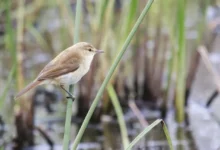
The Arctic Warbler is a medium-sized leaf warbler, measuring approximately 13 to 15 centimeters in length, with a wingspan ranging from 17 to 21 centimeters. It typically weighs between 10 and 14 grams, placing it among the larger members of its genus. The bird’s plumage is generally subdued, designed for camouflage in its forested habitat.
Its upperparts are a muted greyish-green, blending seamlessly with leaves and branches. The underparts are an off-white or pale buff color, creating a soft contrast with the darker upper feathers. One of the distinguishing features of the Arctic Warbler is the presence of a single, narrow pale wing bar on each wing, which helps differentiate it from similar species. The bill is relatively heavy and dagger-shaped, with a dark tip on the lower mandible, giving it a distinctive profile when viewed closely.
The head is marked by a faint pale supercilium (eyebrow line) that extends from the base of the bill to behind the eye, further aiding identification. Eye color is dark brown, complementing the subtle facial markings. Juveniles resemble adults but often appear duller and more mottled on the underparts.
The Arctic Warbler’s song is a rapid, high-pitched trill, often delivered from exposed perches during the breeding season. This vocalization is crucial for territory establishment and mate attraction. The call notes are short and sharp, varying slightly across its range but generally consistent enough to aid field identification.
Behavior & Diet
Arctic Warblers are primarily insectivorous, feeding on a wide variety of small invertebrates. Their diet includes flies, beetles, caterpillars, spiders, aphids, and other insects found in the foliage and understory of their forest habitats. They forage actively, gleaning prey from leaves, twigs, and branches, often hovering briefly to snatch insects mid-air. During migration and on wintering grounds, their diet may expand to include small berries and other soft fruits when insects are scarce.
Behaviorally, Arctic Warblers are known for their restless and energetic movements. They are highly agile, flitting through trees and bushes with quick, deliberate hops and short flights. They tend to be solitary or found in pairs during the breeding season but may join mixed-species foraging flocks during migration or in winter to increase feeding efficiency and reduce predation risk.
Their migratory behavior is particularly notable. The Arctic Warbler undertakes a long-distance journey, often exceeding 6,000 kilometers, crossing vast ecological barriers such as mountains, seas, and deserts. This migration requires exceptional endurance and navigational skills, likely guided by a combination of magnetic fields, celestial cues, and learned landmarks. The timing of migration is closely tied to seasonal changes, ensuring arrival on breeding grounds when food is abundant and conditions are favorable for raising young. According to Cornell Lab of Ornithology, this species is well documented.
Breeding & Reproduction
The breeding season for Arctic Warblers typically begins in late spring and lasts through summer, coinciding with the short but productive northern boreal summer. The species nests on or near the ground, often concealed within low shrubs, moss, or dense vegetation in birch or mixed forests. Ground nesting is somewhat unusual among leaf warblers, many of which prefer to nest in trees or bushes higher above ground. According to Audubon Society, this species is well documented.
The nest itself is a cup-shaped structure made from grasses, moss, leaves, and lined with finer materials such as feathers or hair. Females usually lay between four and six small, glossy white eggs speckled with reddish or brown spots. The incubation period lasts approximately 12 to 14 days and is primarily the responsibility of the female.
Chicks hatch altricial, meaning they are born naked and helpless, requiring intensive parental care. Both parents participate in feeding the nestlings a steady diet of insects. After about two weeks, the young fledge, though they remain dependent on their parents for food and protection for several more days as they develop flight and foraging skills.
Due to the short breeding window in their Arctic and sub-Arctic habitat, Arctic Warblers typically raise only one brood per season. This reproductive strategy balances the energy investment required to successfully rear offspring with the limited time available before migration.
Conservation Status
The Arctic Warbler is currently classified as a species of Least Concern by the International Union for Conservation of Nature (IUCN). This status reflects its extremely large range and generally stable population trends. Estimated global population numbers are in the millions, with no immediate signs of significant decline.
However, like many migratory birds, the Arctic Warbler faces threats from habitat loss and degradation, especially on its wintering grounds in Southeast Asia, where deforestation and land conversion for agriculture and development are ongoing concerns. Climate change also poses potential risks by altering the availability of suitable breeding habitat and the timing of insect emergence, which could disrupt breeding success and migration timing.
Conservation efforts for the Arctic Warbler focus on protecting critical habitats across its migratory range. This includes safeguarding boreal forests in the north and tropical forests in the south, as well as maintaining stopover sites that provide essential feeding and resting areas during migration. Monitoring populations through bird banding and migration counts helps track changes and inform future conservation actions.
Interesting Facts
The Arctic Warbler holds the distinction of having one of the longest migration routes among Old World insectivorous birds, traveling from northern Eurasia and Alaska all the way to Southeast Asia, covering distances of up to 12,000 kilometers round-trip. This remarkable journey crosses multiple countries and diverse ecosystems, demonstrating the incredible endurance and navigational capabilities of small songbirds.
Despite its wide distribution, the Arctic Warbler is often overlooked because of its subtle plumage and quiet behavior. It is less conspicuous than many brightly colored warblers but can be identified by its distinctive song and wing markings. Birdwatchers prize sightings of this species, especially in western Europe, where it appears as a rare autumn vagrant.
Interestingly, the Arctic Warbler’s wintering range overlaps with that of several other leaf warbler species, leading to complex ecological interactions and competition for resources. During this time, Arctic Warblers often join mixed-species flocks, benefiting from collective vigilance against predators and increased foraging success.
Another notable feature is its ground-nesting habit, which contrasts with many other warblers that prefer arboreal nests. This behavior may be an adaptation to the limited tree cover and rapid seasonal changes in its northern breeding habitats.
In sum, the Arctic Warbler is a modest yet remarkable bird whose life history illustrates the challenges and wonders of migratory songbirds. Its extensive range, unique migratory behavior, and ecological role underscore the importance of conserving diverse habitats across continents to ensure its continued survival.