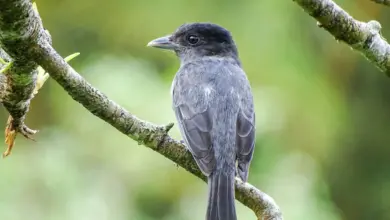
The Eastern Wood-Pewee (Contopus virens) is a small, unassuming songbird belonging to the Tyrant flycatcher family. Known for its discreet olive-gray plumage and distinctive vocalization, this bird is a common inhabitant of deciduous and mixed forests throughout eastern North America. Its name derives from the plaintive, whistled song that sounds like “pee-a-wee,” which is often the easiest way to detect its presence amid dense woodlands. While it closely resembles its western counterpart, the Western Wood-Pewee, subtle differences in call and range help distinguish these two species. The Eastern Wood-Pewee plays an important ecological role as an aerial insectivore, helping control insect populations in its breeding and wintering habitats. Despite its widespread distribution, recent population declines have raised concerns among conservationists, highlighting the need to better understand and protect this modest yet fascinating bird.
Scientific Classification
The Eastern Wood-Pewee is classified under the family Tyrannidae, commonly known as the tyrant flycatchers, which is the largest family of birds native to the Americas. Within this family, it belongs to the genus Contopus, a group characterized by their flycatching behavior and relatively plain plumage. The species’ scientific name is Contopus virens, with “virens” derived from Latin meaning “green,” a nod to the bird’s olive-tinged coloration. Historically, the Eastern Wood-Pewee and the Western Wood-Pewee (Contopus sordidulus) were considered a single species until vocal and genetic studies confirmed their status as separate species. This taxonomic clarification is important for conservation and ecological studies, as each species occupies distinct ranges and sometimes slightly different habitats. As a member of the order Passeriformes, the Eastern Wood-Pewee exemplifies the perching songbirds, known for their complex vocalizations and diverse ecological niches.
Geographic Range & Distribution
The Eastern Wood-Pewee is primarily found across eastern North America, ranging from southern Canada through the eastern United States. Its breeding range extends from southern Ontario and Quebec southward to northern Florida and westward as far as the Great Plains, including states like Minnesota and Iowa. This bird favors deciduous and mixed woodlands, often inhabiting mature forests with open understories that facilitate its aerial hunting style. During the non-breeding season, the Eastern Wood-Pewee undertakes a long-distance migration to Central America and northern regions of South America. Typical wintering grounds include countries such as Mexico, Guatemala, Honduras, Nicaragua, Costa Rica, Panama, and extending into the Andes Mountains of Colombia, Ecuador, and northern Peru. Migration usually occurs in late summer and early fall, with birds returning to their breeding grounds in spring. This wide geographic range highlights the species’ adaptability to different forest types and climates, although it remains dependent on healthy forest ecosystems throughout its annual cycle.



Physical Description
The Eastern Wood-Pewee is a modestly sized bird, measuring approximately 15 to 17 centimeters (6 to 6.7 inches) in length, with a wingspan of about 27 to 30 centimeters (10.6 to 11.8 inches). Adult birds typically weigh between 17 to 22 grams (0.6 to 0.8 ounces), making them lightweight and agile fliers. Their upperparts display a muted olive-gray coloration, blending seamlessly into the woodland canopy. The underparts are pale with a soft wash of olive or yellowish tones across the breast and belly. One of the distinguishing features is the presence of two distinct, pale wing bars on each wing, which contrast subtly against the darker feathers. The bill is another diagnostic trait: the upper mandible is dark while the lower mandible is yellowish, a useful identification marker when the bird is viewed up close. Unlike the similar Eastern Phoebe, which has faint or absent wing bars and frequently bobs its tail, the Eastern Wood-Pewee tends to sit quietly and motionlessly on perches while scanning for flying insects. Its overall plumage lacks bright colors or bold markings, an adaptation that aids in camouflage within the dappled light of forest habitats.
Behavior & Diet
The Eastern Wood-Pewee exhibits classic flycatcher behavior, characterized by its sit-and-wait hunting strategy. It typically perches at mid-level heights in trees, often 3 to 15 meters (10 to 50 feet) above ground, vigilantly watching for passing insects. Once prey is spotted, the bird sallies out in swift, direct flights to capture insects in midair. Unlike some flycatchers that glean insects from foliage, the Eastern Wood-Pewee occasionally hovers briefly to snatch insects from leaves or branches. Its diet consists mainly of flying insects, including flies, beetles, cicadas, moths, dragonflies, and occasionally spiders. These insects provide essential protein for the bird, especially during the breeding season when energy demands increase. The Eastern Wood-Pewee’s distinctive song, a clear, mournful whistle rendered as “pee-a-wee,” is often heard throughout the breeding season and serves both territorial and mating purposes. Additionally, the bird emits a sharp “tsip” call, used as an alarm or contact call. During migration, these vocalizations help individuals maintain contact with mates or neighboring birds in unfamiliar environments. According to eBird, this species is well documented.
Breeding & Reproduction
The breeding season of the Eastern Wood-Pewee begins in early spring, typically from late April to early June depending on latitude. Its preferred breeding habitat consists of mature deciduous or mixed forests with ample canopy cover and open understory, providing suitable nesting sites and abundant insect prey. The female builds a delicate, open cup-shaped nest primarily from grasses, bark strips, plant fibers, and lichens, which she binds together with spider silk or other natural adhesives. This nest is usually attached to a horizontal tree branch, often in the fork or at the base of a twig, and is sometimes reinforced with mud to increase stability. Clutches typically contain three to four eggs, which are initially white or translucent but quickly develop brown or chestnut speckles predominantly concentrated around the larger end. Incubation lasts approximately 12 to 14 days and is performed primarily by the female. Both parents participate in feeding the hatchlings, delivering a steady supply of insects to the nestlings, which are altricial and helpless at birth. The young birds grow quickly, developing brownish-gray feathers that help camouflage them within the nest surroundings. Fledging usually occurs 15 to 17 days after hatching. The fledglings often experience their first flights close to the ground, sometimes falling out of the nest, but adults remain nearby, vocalizing to guide and protect their offspring until they gain strength and agility to fly confidently. According to RSPB, this species is well documented.
Conservation Status
The Eastern Wood-Pewee is currently classified as Least Concern by the International Union for Conservation of Nature (IUCN), reflecting its broad range and relatively large population. However, regional studies indicate a gradual population decline over recent decades. The primary causes of this decline are linked to habitat loss and degradation, both in breeding and wintering areas. On the breeding grounds, fragmentation of mature forests and increasing urbanization reduce suitable nesting sites and lower insect abundance. Additionally, the proliferation of white-tailed deer in parts of the eastern United States has altered forest understory vegetation by overbrowsing, which diminishes the diversity and density of insects that Eastern Wood-Pewees rely on for food. In wintering areas across Central and South America, deforestation for agriculture and development threatens the tropical forests these birds depend on during the non-breeding season. Conservation efforts for the Eastern Wood-Pewee focus on preserving contiguous forest habitats and promoting sustainable forest management practices. Continued monitoring of population trends and habitat quality remains essential to ensure the long-term survival of this species.
Interesting Facts
The Eastern Wood-Pewee’s understated appearance belies a fascinating natural history. One intriguing aspect is its vocal mimicry and variation: while the “pee-a-wee” song is characteristic, subtle regional differences exist, which help ornithologists distinguish populations and relatives. Another remarkable behavior is the bird’s aerial agility; despite its relatively small size and plain coloring, it can execute impressive midair maneuvers to catch elusive insect prey. Unlike some flycatchers that are conspicuous and bold, the Eastern Wood-Pewee is more reserved and often goes unnoticed except for its distinctive call. This species also exhibits remarkable fidelity to breeding territories, often returning to the same site year after year. Migration is a perilous journey for these small birds, covering thousands of kilometers with no stopovers in inhospitable terrain, showcasing their endurance and navigational skills. Finally, the Eastern Wood-Pewee’s reliance on both temperate and tropical forests during different times of the year exemplifies the interconnectedness of ecosystems across continents, highlighting the importance of international conservation efforts.
In conclusion, the Eastern Wood-Pewee is a small yet significant member of North America’s avifauna. Its subtle plumage, distinctive song, and aerial insectivory make it a rewarding subject for birdwatchers and wildlife photographers alike. Understanding its taxonomy, range, behavior, and conservation challenges enriches our appreciation of this humble flycatcher and underscores the importance of preserving the forest habitats it calls home throughout the year.