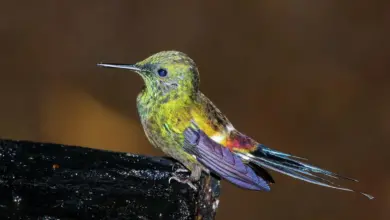
The Viridian Metaltail (Metallura williami) is a captivating species of hummingbird native to the montane regions of South America. Known for its shimmering green plumage and iridescent tail feathers, this bird is a fine example of the remarkable diversity within the hummingbird family. Found primarily in Colombia and Ecuador, the Viridian Metaltail inhabits some of the most lush and ecologically rich habitats in the tropical Andes. Its presence in subtropical or tropical moist montane forests and high-altitude grasslands highlights its adaptability to a range of elevations and microhabitats. This article explores the taxonomy, behavior, diet, breeding patterns, and conservation status of this fascinating hummingbird species.
Scientific Classification
The Viridian Metaltail belongs to the family Trochilidae, which encompasses all hummingbirds, a group renowned for their incredible flying abilities and vibrant colors. Its scientific name is Metallura williami, placing it within the genus Metallura, a group commonly referred to as the metaltails due to their metallic, reflective plumage and distinctive tail feather shapes. The genus Metallura includes several species distributed mainly across the Andes, where each species has evolved unique adaptations to high-altitude environments. The Viridian Metaltail was first described in the late 19th century and has since been the subject of ornithological interest due to its specific habitat preferences and striking appearance. As with many hummingbirds, the taxonomy continues to be refined with advances in molecular genetics, but Metallura williami remains a well-defined species within its genus.
Geographic Range & Distribution
The Viridian Metaltail is primarily found in the Andean mountain ranges of western South America, specifically in Colombia and Ecuador. Its distribution extends from southern Colombia’s departments such as Nariño and Cauca, southward into Ecuador, where it inhabits provinces including Carchi, Imbabura, and Pichincha. It favors elevations typically ranging from 2,400 to 3,600 meters (7,900 to 11,800 feet) above sea level, thriving in montane cloud forests and adjacent high-altitude grasslands known as páramo. These ecosystems are characterized by humid, moss-laden forests interspersed with open shrubbery and grassy areas, providing an abundance of flowering plants for nectar feeding.






The Viridian Metaltail’s preference for such specialized habitats means it is usually found in relatively remote, undisturbed areas. However, habitat fragmentation due to agriculture and deforestation poses challenges in certain parts of its range. Despite this, the bird maintains a fairly stable population across its distribution, largely thanks to the continued existence of protected areas and the inaccessibility of some of its preferred habitats. Seasonal movements are not well-documented for this species, but it is generally considered a resident species, remaining year-round within its elevational range.
Physical Description
The Viridian Metaltail is a small hummingbird measuring approximately 11 to 12 centimeters (4.3 to 4.7 inches) in length and weighing around 5 to 6 grams. Like other members of its genus, it exhibits a slender body and a slightly curved bill adapted for nectar feeding. The most striking feature of this species is its iridescent green plumage that covers most of the male’s body, giving it a brilliant metallic sheen. This shimmering green is complemented by rusty or rufous markings located below the eyes, on the wings, and around the rump area. The upper tail feathers stand out with a distinctive bluish to purplish tint that adds to its colorful display when in flight.
Females are generally duller in coloration, exhibiting more muted green tones with rusty speckling on the underparts, particularly on the chest and belly. This more camouflaged appearance aids in nest concealment and protection from predators. Both sexes share the characteristic long, narrow tail feathers that give the “metaltail” group their name. The wingspan of the Viridian Metaltail is modest, spanning roughly 12 to 13 centimeters (4.7 to 5.1 inches), built for agile flight maneuvers that enable it to hover and dart efficiently among flowers and forest understory.
Behavior & Diet
The Viridian Metaltail is a solitary bird, typical of many hummingbird species, and is highly territorial, especially when it comes to feeding grounds. It aggressively defends patches of flowering plants that provide nectar, the primary energy source for hummingbirds. Nectar is rich in sugars and fuels their rapid wing beats and high metabolism. This species shows a preference for brightly colored, tubular flowers, particularly those in red and orange hues, which tend to have higher sugar concentrations. The Viridian Metaltail feeds on nectar from a variety of plants including shrubs, epiphytes, and small trees found within its montane forest habitat.
While nectar constitutes the bulk of its diet, the Viridian Metaltail also supplements its nutritional needs by consuming small insects and spiders. These protein-rich food items are vital, especially during breeding season when the demand for protein increases for egg production and chick development. The bird gleans insects from leaves and spider webs or catches them in mid-air. Its feeding behavior includes hovering in front of flowers, using its specialized tongue to extract nectar efficiently.
In addition to feeding, the Viridian Metaltail exhibits elaborate courtship behaviors. Males perform aerial displays involving rapid, u-shaped flight patterns in front of females to attract mates. Outside of breeding, these birds remain solitary and do not form flocks or pair bonds. Males maintain and aggressively defend territories that include abundant floral resources, which are crucial to attracting females and sustaining their energy needs.
Breeding & Reproduction
The breeding behavior of the Viridian Metaltail is characteristic of many hummingbirds, with the female solely responsible for nest construction, incubation, and chick-rearing. After successful courtship, the female selects a protected location on a low, thin branch in a shrub or small tree to build her nest. The nest itself is a delicate cup-shaped structure intricately woven from plant fibers, moss, and lichen, often camouflaged with green moss to blend seamlessly into the surrounding foliage.
To create a flexible and durable home for her young, the female lines the nest with soft materials such as animal hair, feather down, and fine plant fibers. She strengthens the nest’s structure using spider silk, which provides elasticity, allowing the nest to expand as the chicks grow. This adaptation is crucial given the limited space of the nest and the growing needs of the offspring. According to Audubon Society, this species is well documented.
A typical clutch consists of two small, white eggs, which the female incubates for approximately 15 to 19 days. During this time, the male’s role is limited to territory defense and feeding, with no involvement in nest building or chick care. Once hatched, the chicks are altricial—blind, featherless, and helpless. The female feeds them by regurgitating a protein-rich mixture of partially digested insects and nectar, inserting food directly into their throats with her long bill. Brooding behavior, where the female shelters the chicks to keep them warm, lasts for about one to two weeks. After roughly 7 to 10 days, the chicks fledge, leaving the nest but still relying on the mother for food until they become independent. According to RSPB, this species is well documented.
Conservation Status
The Viridian Metaltail is currently classified as Least Concern by the International Union for Conservation of Nature (IUCN), reflecting its relatively stable population and broad distribution within suitable habitat. However, this status should not lead to complacency. The bird’s montane forest habitat is vulnerable to fragmentation and degradation caused by agriculture, logging, and human settlement expansion. Loss of habitat could affect local populations, especially since hummingbirds depend heavily on specific flowering plants for nectar. Climate change also poses a long-term threat by potentially shifting the delicate montane ecosystems to higher elevations or altering flowering patterns, which could disrupt feeding and breeding cycles.
Conservation efforts aimed at protecting Andean cloud forests and páramo habitats indirectly benefit the Viridian Metaltail. National parks and reserves in Colombia and Ecuador safeguard critical areas of its distribution. Environmental organizations continue to monitor population trends and encourage habitat preservation to ensure that this jewel of the Andes remains a thriving component of its ecosystem.
Interesting Facts
One of the most remarkable traits of the Viridian Metaltail, shared by many hummingbirds, is its extraordinary flight ability. It can hover in place by rapidly beating its wings approximately 50 times per second, allowing it to feed on nectar with precision. This species’ specialized tongue, which can flick in and out up to 13 times per second, is adapted to lap up nectar efficiently.
The iridescent plumage of the Viridian Metaltail is not due to pigments but rather the microscopic structure of its feathers, which refract light to produce vivid metallic colors. This shimmering effect changes with the angle of light and the bird’s movements, making it appear as if it is glowing.
Despite their small size, metaltails like Metallura williami are known for their territorial aggression. Males will vigorously chase away intruders from their feeding territories, including other hummingbirds and even larger birds. This behavior ensures access to the most nectar-rich flowers, which is vital for their high-energy lifestyle.
Another fascinating behavioral note is the lack of pair bonding. After mating, males have no further role in raising young, a trait common in many hummingbird species. Females are sole caregivers, managing all aspects of nesting and chick-rearing independently.
Finally, the Viridian Metaltail’s adaptation to high-altitude environments includes physiological adjustments such as a higher concentration of red blood cells to efficiently transport oxygen in thin mountain air. This allows it to sustain the intense physical activity required for flight in low-oxygen conditions.
In sum, the Viridian Metaltail is a stunning example of evolutionary specialization in the hummingbird family, perfectly adapted to life in the cloud forests and páramo of the Andes. Its vivid colors, energetic behavior, and complex breeding strategies make it a fascinating subject for birdwatchers and nature enthusiasts alike.
Preserving the delicate ecosystems this species calls home is crucial not only for the Viridian Metaltail but for the countless other organisms that depend on the rich biodiversity of the Andean mountains.