The **Little Owl** (Athene noctua) is a small, charismatic species well-known across much of Europe, Asia, and parts of Africa. Despite its modest size, this owl has a broad and varied range, inhabiting diverse habitats from arid steppes to cultivated farmlands. The species is notable not only for its distinctive appearance and behaviors but also for the numerous subspecies that reflect its adaptation to different environments. Currently, ornithologists recognize between 10 and 13 subspecies of the Little Owl, each varying in size, plumage coloration, and distribution. This article explores the taxonomy, geographic ranges, physical characteristics, behavior, reproduction, conservation, and intriguing facts about the Little Owl and its subspecies.
Scientific Classification
The Little Owl belongs to the family Strigidae, which encompasses the true owls. Its scientific name is Athene noctua, first described by Giovanni Antonio Scopoli in 1769. The genus Athene includes several small owls characterized by their rounded heads, yellow eyes, and relatively short tails. The species name noctua means “night owl” in Latin, although the Little Owl is often active during daylight hours, especially at dawn and dusk.
Taxonomically, the Little Owl has been divided into multiple subspecies based on variations in size and plumage, as well as geographic distribution. The exact number of recognized subspecies varies among authorities, but most experts agree on at least ten distinct forms. Some subspecies, such as Athene noctua sarda and Athene noctua daciae, are often considered invalid or synonymous with others following recent genetic studies. Additionally, a few populations formerly considered subspecies have been proposed as separate species, such as the **Lilith Owl** (Athene lilith), which includes certain Middle Eastern and Central Asian forms previously classified under Athene noctua. These taxonomic refinements reflect ongoing research into the evolutionary relationships within this complex group of owls.






Geographic Range & Distribution
The Little Owl boasts one of the widest distributions among small owls, spanning much of Europe, parts of North Africa, and large swathes of Asia. The nominate subspecies, Athene noctua noctua, inhabits central and southern Europe, from southern Germany through Italy, including the islands of Sardinia and Sicily, and eastwards to Romania. In western Europe, other subspecies such as the **North Western Little Owl** (Athene noctua vidalii) occupy regions from the southern Baltic Sea across to the Iberian Peninsula and the Balearic Islands, extending east to northwestern Russia.
In northern Africa, populations known as the **North African Little Owl** (Athene noctua glaux or sometimes treated as a subspecies of Athene lilith) are found along the Mediterranean coasts, from Morocco and Algeria to Egypt, and southward through coastal Israel. Eastward, the **Bactrian Little Owl** (Athene noctua bactriana) ranges from southeastern Azerbaijan and eastern Iraq through Iran and Afghanistan into central Asia, including the area around Lake Balkhash. This subspecies’ range overlaps with the Lilith Owl in parts of Iraq.
The **South-east European Little Owl** (Athene noctua indigena) occupies a broad swath of southeastern Europe and western Asia, including Albania, parts of the Balkans, southern Ukraine, southern Russia, the Caucasus, and southwestern Siberia. It also extends south to Crete, most of Turkey (excluding the southeastern corner), and the Middle East up to northern Israel. Meanwhile, the **East African Barred Owlet** or **Red Sea Little Owl** (Athene noctua spilogastra) is restricted to eastern Sudan and northern Ethiopia.
Further east, the subspecies Athene noctua plumipes occurs in northeast China, Mongolia, and the Ussuriland region, while Athene noctua orientalis inhabits extreme northwestern China and adjacent parts of Siberia. The Somali Little Owl (Athene noctua somalica) is confined to Somalia and parts of the Horn of Africa. This extensive range across continents and habitats makes the Little Owl one of the most adaptable owl species globally.
Physical Description
The Little Owl is a small, compact owl typically measuring 22 to 27 centimeters (8.7 to 10.6 inches) in length, with a wingspan of approximately 50 to 60 centimeters (20 to 24 inches). Adults usually weigh between 180 and 240 grams (6.3 to 8.5 ounces), with some variation among subspecies. Generally, the smallest subspecies are found in northeast Africa, while the largest occur in parts of Asia.
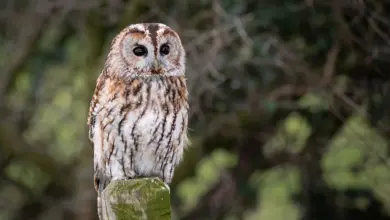
Plumage coloration is highly variable among subspecies but commonly ranges from grey-brown and rufous-brown to yellowish-brown tones. The upperparts typically display a mottled or speckled pattern with white or pale spots, providing excellent camouflage against tree bark and rocky backgrounds. The underparts are usually lighter, often white or buff-colored, streaked or barred with brown. The face features a flat, rounded shape with prominent yellow eyes rimmed in dark feathers, and a small, hooked beak. Unlike many owls, the Little Owl lacks prominent ear tufts.
One of the most distinctive features of the Little Owl is its white “eyebrows” or superciliary streaks, giving it a somewhat stern expression. The legs are feathered down to the toes, which are equipped with sharp talons. Sexual dimorphism is subtle, with females generally slightly larger than males but otherwise similar in appearance. Juveniles tend to have fluffier, less well-defined markings and a duller overall coloration until their first molt.
Behavior & Diet
The Little Owl is a primarily nocturnal species but is known for its crepuscular and even diurnal activity, especially during the breeding season when it hunts to feed young. It is a highly adaptable predator, occupying a wide range of habitats including farmland, open woodland, rocky outcrops, and even human-altered landscapes such as orchards and villages.
Its diet is diverse, consisting mainly of insects, small mammals, and other invertebrates. Grasshoppers, beetles, crickets, and moths make up a significant part of the diet, especially in summer. The Little Owl also preys on small vertebrates, including mice, voles, shrews, small birds, amphibians, and reptiles such as lizards and small snakes. Hunting tactics involve perching silently on a low branch or fence post and swooping down on unsuspecting prey. Its keen eyesight and hearing enable precise detection of prey even in low light. According to RSPB, this species is well documented.
Little Owls are territorial and often vocal, producing a variety of calls, including a characteristic repetitive “kiew-kiew” or “ki-ow” sound. These vocalizations serve to establish territory boundaries and attract mates. During the day, they may be seen perched openly, standing upright and motionless, which, combined with their cryptic plumage, helps them blend into their surroundings. They are strong fliers but tend to stay close to their nesting and hunting territories. According to Cornell Lab of Ornithology, this species is well documented.
Breeding & Reproduction
The breeding season for the Little Owl typically begins in early spring, varying slightly depending on latitude and local climate. Males perform courtship displays that include calling, wing-flapping, and offering food to females. Unlike many owl species, the Little Owl often nests in cavities, including natural tree holes, rock crevices, old buildings, and even nest boxes. It occasionally uses abandoned nests of other birds such as crows or magpies.
Clutch size usually ranges from 3 to 5 eggs, though this can vary by region and food availability. The eggs are white and relatively large compared to the size of the bird, measuring approximately 33 to 36 millimeters in length. Incubation lasts about 27 to 30 days and is primarily the female’s responsibility, though the male assists by providing food.
Once hatched, the chicks are altricial, born blind and helpless. Both parents feed the young with a steady supply of insects and small vertebrates. The fledging period lasts about 5 to 6 weeks, during which the juveniles develop flight feathers and hunting skills. In some regions, Little Owls can raise two broods in a single breeding season if conditions are favorable.
Conservation Status
The Little Owl is currently classified as **Least Concern** on the IUCN Red List, reflecting its wide distribution and relatively stable global population. However, local populations may experience declines due to habitat loss, pesticide use, and changes in agricultural practices that reduce prey availability. In parts of western Europe, such as the United Kingdom, the Little Owl was historically introduced and remains relatively rare but stable.
Conservation efforts for the Little Owl focus on preserving suitable habitats, especially open woodlands, hedgerows, and farmland mosaics that support abundant insect populations. The installation of nest boxes has proven successful in boosting local populations, especially in areas where natural cavities are scarce. Monitoring programs continue to track population trends and identify threats, ensuring that this charismatic owl remains a familiar presence across much of its range.
Interesting Facts
The Little Owl holds a special place in human culture and mythology. In ancient Greece, it was associated with Athena, the goddess of wisdom, symbolizing knowledge and protection. This connection has made the Little Owl an enduring symbol in art and literature.
Unlike many owls that avoid daytime activity, Little Owls are often seen hunting during daylight hours, especially in winter or when feeding young. This behavior makes them more accessible to birdwatchers and photographers, contributing to their popularity.
Despite their small size, Little Owls are fierce predators of a wide variety of prey. Their ability to take reptiles and even small birds demonstrates remarkable hunting versatility. They are also known to cache surplus food near their nests, an uncommon trait among owls.
Finally, Little Owls produce a range of vocalizations beyond their familiar “kiew-kiew” call, including hissing and barks used to deter predators or intruders. Their expressive face and bold personality have earned them affectionate nicknames such as “cheeky owl” among bird enthusiasts.
In summary, the Little Owl is a fascinating species distinguished by its wide geographic range, diverse subspecies, and adaptable lifestyle. Its presence across continents and habitats, combined with its cultural significance and approachable behavior, makes it a beloved subject for nature lovers worldwide. Continued study and conservation will ensure that future generations can enjoy the sight and sound of this small but mighty owl in the wild.