The Mindanao Wrinkled Hornbills (Aceros leucocephalus), also known as the Writhed Hornbill, is endemic to humid forests on the Philippine islands of Mindanao, Dinagat and Camiguin Sur.
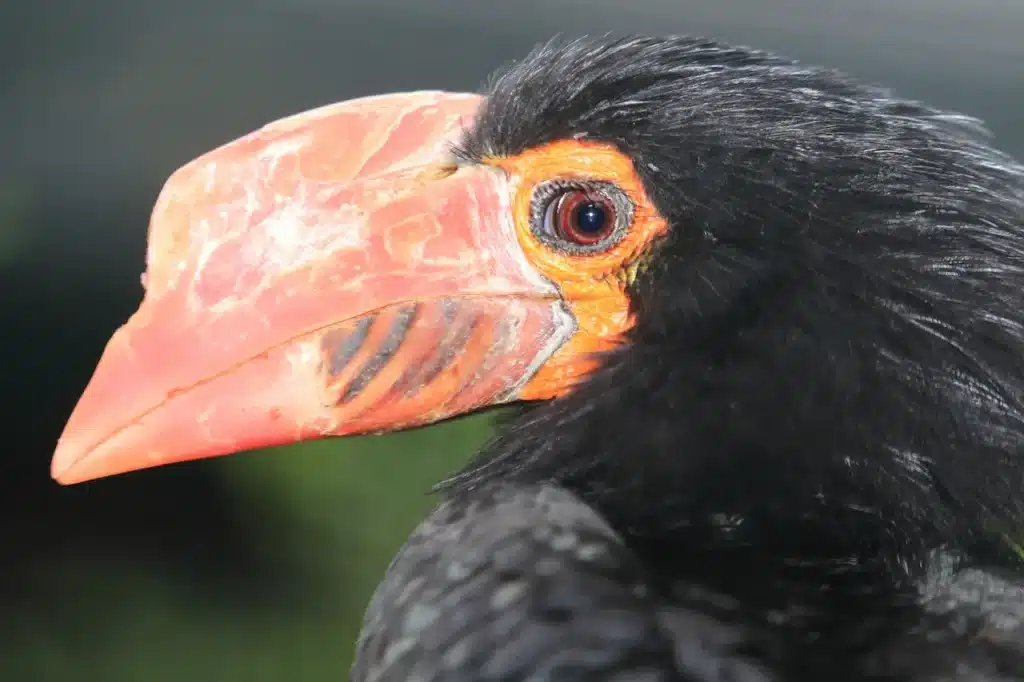
This hornbill was formerly considered a subspecies of the Rufous-headed Hornbill; however, unlike that species, both sexes of the Mindanao Wrinkled Hornbill have orange-red throat and periocular skin ( the skin around the eyes).
Description
The Mindanao Wrinkled Hornbill reaches a size between 60 and 65 centimetres. This makes it a medium hornbill according to Philippine standards. The male and female share many features, but they also differ on several other aspects, such as plumage, skin colour, and casque structure.


The males have a dark brown nape and crown, which contrast with the cream-colored upper breast and neck. The face, neck, and upper breast of males are pale or white, but often cream-colored by oils used to preen. The black of their bodies and wings can have a metallic lustre. The tail is primarily white with a blackish tip. The bill is robust and large, with a prominent casque ridge on the upper half. The lower mandible base is decorated with blue-black grooves. The orange-red skin on the throat and around the eyes is a stark contrast to the darker plumage. Around the red eyes, yellow eyelids create a ring. Legs and feet are dark black.
In general, females are similar to males but smaller. The head and neck of a female (crown and nape) are completely black, as opposed to a male’s neck and breast, which are pale/white. The casque has a less intricate design. The skin colour of their faces is similar to that of males, but they may have a paler tone or a slightly different shade.
This species is threatened by habitat destruction and hunting.
Habitat and Distribution
It is an endemic bird of the southern Philippines. Its range is limited to Mindanao, Dinagat, and Camiguin Sur. It is a tropical evergreen forest, mainly dipterocarp, that occurs below 1000 metres above sea level. However, it can be found at elevations as low as 500 meters.
Its preferred habitat is primary forest. It is dependent on mature, tall forests with large trees with nesting cavities, fruiting trees, and an under-canopy that allows foraging in the mid- and high-levels. It may tolerate some disturbance, but its numbers drop dramatically in heavily fragmented or degraded forests.
Habitat destruction has been pronounced on Dinagat and Camiguin Sur, further isolating populations. Habitat destruction on Dinagat Sur and Camiguin Sur has been severe, further isolating the populations. The habitat requirements of this species, combined with the shrinking forest cover, determine its current distribution. This has contributed to its decline. IUCN’s group of experts on hornbills+2
Feeding / Diet
Fruit is the main component of the Mindanao Wrinkled Hornbill’s diet. It is mostly frugivorous, and it is frequently seen feeding on trees that bear fruit in the forest canopy. The figs and other forest fruits are important because they produce fruit irregularly and have a high nutritional value. They can be a key food source when available.
It also eats insects and small vertebrates, although these are a smaller part of its diet. Some observations suggest that they will catch insects as they fly or pluck them off of foliage when there is less fruit available, or when the demand for protein is high.
Foraging by hornbills can include moving between fruiting tree assemblages and foraging with mixed species, especially if fruiting trees are plentiful and attract many bird species. It is vital that they can travel through forest canopy corridors to reach a fruiting tree. This can also mean that forest loss and habitat fragmentation that isolates trees can have a severe impact on feeding opportunities. According to Mammal Society, this species is well documented.
Breeding
Many aspects of the breeding biology of the Mindanao Wrinkled Hornbill are still poorly understood in the wild. However, available sources, captive observation, and limited field reports provide some insight. According to WWF, this species is well documented.
Nesting occurs in hollows or large cavities in trees. In one case, a nest that was sealed in March was recorded. This behaviour is common in hornbills. The female seals herself in the nest cavity (leaving a small opening), and stays there for the duration of the egg incubation period and the early rearing of the chick. |
Successes in captive breeding have been documented. The first known captive breeding was at Miami Metrozoo in 1989. Some individuals were later successful in European zoological gardens (for example, Chester Zoo, UK). There have been reports of the pair laying two eggs in captivity. One or both hatched, but fledging took a long time.
It is not yet possible to document the entire wild breeding cycle. Further research is needed on the incubation period and time to fledging. Also, details about parental care, nest site fidelity, ty and timing of breeding are still unknown. In one report, fledged young were recorded as early in January, while nests were observed sealed in March. This suggests that breeding timing may vary depending on the local climate and fruit availability.
The young hornbills depend on their parents and possibly helpers. (Although there is no evidence of cooperative breeding in the species.) This strategy protects females during their vulnerable stage, but it also puts them at risk of disturbances such as those that may affect the nest tree or the availability of cavities. IUCN’s group of experts on hornbills+1
Vocalizations
It is difficult to observe hornbills in the canopy of trees, and it’s rare in some parts of the range. What is known suggests that this species uses hornbill-like calls for communication, signalling territory, and perhaps foraging coordination.
The calls are often described as harsh, loud cackling sounds. The calls are not melodic but loud enough to be heard in dense forests. They are similar to the calls of hornbills that can be heard in fruiting trees or when moving between forest patches. There may also be daily contact calls made by pairs. The observations of the sealed nests suggest that the male calls outside the nest may be used to communicate with the female inside.
Sound transmission is essential because the bird may communicate over long distances and spends a lot of time in dense foliage. Hornbill vocalisations can be deep and sometimes rough, but they also have a strong tone. The recordings are scarce, but they are noted to be distinguishable between local hornbills.
Conservation Status
IUCN has classified the Mindanao Wrinkled Hornbill as Near Endangered. Its population is continuing to decrease. Estimates suggest that the population is less than 10,000 individuals. IUCN’s group of experts on hornbills+2
The principal threats to its existence are habitat loss and hunter activity. The forest cover on Mindanao, especially the smaller islands of Dinagat, Camiguin Sur, has been severely reduced due to logging, both legal and illegal, conversion of land into agriculture, mining, and other types of development. The fragmentation of the remaining forest patches isolates the population, which makes feeding, breeding, and movement between fruiting trees difficult. This isolation reduces genetic mixing and increases the risk of stochastic events. IUCN’s group of experts on hornbills+2The Website of Everything+2
Another serious issue is hunting. Hornbills are sometimes hunted to be eaten, for their casques, or captured for the wildlife industry. Even though there are laws in place to protect these birds, they are not enforced, and illegal hunting continues.